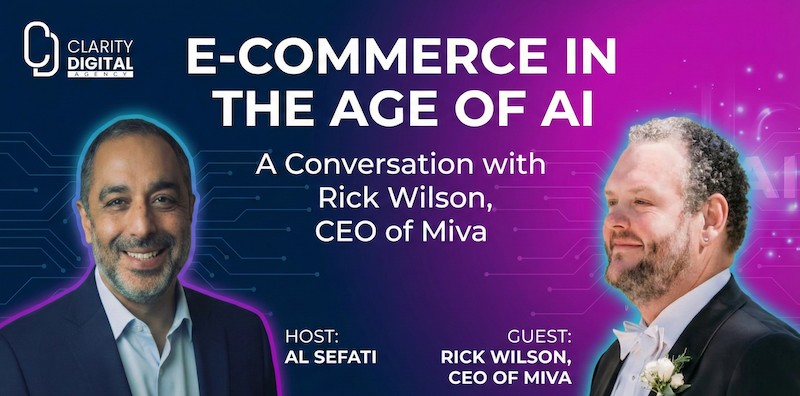

In this episode of Clarity Digital Pod, I sat down with Rick Wilson, CEO of Miva, to explore the rapidly evolving landscape of e-commerce in 2026. Rick brings nearly 30 years of experience in the e-commerce software industry and offers one of the clearest perspectives on what’s happening right now in digital commerce—and what’s coming next.
We discussed the current state of e-commerce, including the explosive rise of TikTok Shop, the role of Amazon, and how consumer behavior is shifting. But the real focus was on artificial intelligence. Rick broke down how Large Language Models (LLMs) like ChatGPT and Perplexity are transforming product discovery and what the emergence of agentic checkout means for merchants.
He explained why structured data and schema markup are non-negotiable in 2026, how AI is already helping with customer service, on-site search, and analytics, and what merchants need to do to stay visible and profitable in a world driven by machine learning.
We also covered how Miva is positioning itself as a modern e-commerce platform for brands that want more control, scalability, and AI-powered features without relying on dozens of plugins. Whether you’re an enterprise brand or a small online retailer, this episode delivers actionable insights on how to stay competitive in today’s AI-first environment.
If you’re in e-commerce, this is one episode you don’t want to miss.
Watch the Episode
Full Podcast Transcription
Al Sefati:
Hi Rick. How are you doing today?
Rick Wilson:
I’m doing great, Al. How about yourself?
Al:
Very good. Welcome. I really appreciate that you had time to join us. I’ve been wanting to speak to you since last year. I know you’ve been busy, so thank you again.
Rick:
Oh, my pleasure. Happy to be here.
Al:
If you don’t mind, could you introduce yourself to our audience—who you are, what you do, and where you work?
Rick:
Absolutely. I’m Rick Wilson, CEO of Miva. Miva is an e-commerce software platform. We’re a mid-market competitor to Shopify, focusing on businesses with large catalogs—both D2C and B2B—on a single site.
But more interestingly, I’ve been working in e-commerce platforms for 29 years. I’ve seen every evolution: from downloadable software, to SaaS, to mobile, and now AI. It’s been a fascinating journey.
Al:
I remember those downloadable platforms. I built my first e-commerce site using X-Cart way back in the early 2000s in PHP. That’s also when I learned SEO—because I built the site, launched it, and realized no one was coming. I needed traffic.
Rick:
Classic story. Build it and realize… no one shows up.
Al:
Exactly. So, let’s jump in. What’s the current state of e-commerce as of January 16th, 2026?
Rick:
E-commerce is thriving. After years of steady growth—about 5-7% annually—we’re seeing acceleration again.
Amazon has stabilized at 39% of US online sales. Other marketplaces account for about 11-15%. The rest? It’s direct—from independent websites. What’s notable is TikTok Shop. It went from non-existent two years ago to now having more GMV than eBay. That kind of growth is astronomical.
But TikTok Shop isn’t for everything. It works well for influencer-led, impulse-type products, not so much for complex or B2B sales. Still, it shows how rapidly the space can shift.
Al:
Yeah, Amazon still dominates, but it’s not the whole game anymore.
Rick:
Exactly. Amazon wins on convenience—fast shipping, easy returns—but it doesn’t offer real brand engagement. When people buy direct, they get better access to deals, more product education, even community. That’s what makes D2C so powerful.
Al:
That’s a good segue into product discovery. It’s been Google and Amazon for so long. What are you seeing now?
Rick:
That’s changing fast. For the last 15 years, product discovery was either Google or Amazon. But those experiences have degraded because of ad overload.
Consumers are now shifting to LLMs—like ChatGPT or Perplexity—for product discovery. These tools provide cleaner, ad-free experiences, which people love. You used to Google “best walking shoes,” and now it’s ads, ads, ads. But ask an LLM the same thing, and you get an actual answer.
Al:
Exactly! I recently used Perplexity to look for wide walking shoes. It gave me a short list of good options—with actual links to buy. Google’s SERPs are just chaos now.
Rick:
Right. And what’s interesting is that LLMs are about to enter checkout too. OpenAI and Stripe have launched one version. Microsoft and Google are doing their own. Everyone’s racing to offer agentic checkout—where you can buy within the chat interface.
But it’s not easy. You have to manage tax, inventory, shipping, and know who owns the transaction. That’s where platforms like Miva and Shopify come in. We orchestrate those layers behind the scenes.
Al:
So agentic checkout is coming, but merchants need to prepare.
Rick:
Exactly. And here’s how: First, get your product data structured. If you’re cramming “black XL” into one field instead of separate size and color attributes, LLMs can’t make sense of it.
Next, use proper schema markup—label your data so machines know what’s what. Then, start feeding your product data into LLMs that accept it.
The final step, eventually, is enabling payment integration inside those interfaces. But don’t rush that. Focus first on visibility and discovery.
Al:
Right. And all of that ties into data ownership too. If you rely solely on Amazon or LLMs, you don’t own the customer. That’s risky.
Rick:
Big time. Amazon assumes every buyer is their customer. LLMs could go that route too. So, while LLMs are a huge opportunity, you still need your own website. That’s your “owned media.” You control the brand, data, and customer relationship.
Al:
Couldn’t agree more. I’ve seen brands hand everything over to Amazon—and then get undercut, copied, and lose their market.
Rick:
Yep. Use LLMs for growth, but don’t give up control.
Al:
What’s your take on reviews and user-generated content (UGC)? I feel like they’re making a comeback—not just for conversions, but for AI visibility.
Rick:
Absolutely. Reviews are now critical for AI discovery. They provide trust signals and context. But they have to be authentic. If all your reviews sound like AI wrote them and they’re all five stars, the LLMs may discount them.
Focus on real customer reviews. It’s user-generated content, and it helps both SEO and AI.
Al:
Makes sense. And LLMs, as advanced as they seem, are still machines. They look for signals, patterns, and structured data.
Rick:
Exactly. They’re not human. They’re running thousands of statistical predictions. Feed them clean data and real content, and they’ll elevate your products.
Al:
Let’s talk about what Miva is doing with AI. What innovations are you building?
Rick:
Four key areas:
- AI-Powered Site Search – We’ve built a new AI search with vector-based modeling. It understands product intent, not just keywords. It performs better than traditional MySQL or ElasticSearch engines.
- Customer Service AI – Merchants spend 40% of their time in customer service. AI can handle FAQs, shipping status, and even create tickets—freeing up your team.
- Conversational Data Insights – Ask business questions in plain English. “What was my best-selling item in Q4?” and get an answer without writing SQL.
- AI Merchandising with Profit Awareness – Our system promotes not just related products, but high-margin ones. For example, instead of recommending a low-margin jersey, it might promote a sticker pack with higher margins and lower shipping costs.
All of this works without needing code. It’s built for agility.
Al:
That’s impressive. I know a lot of legacy platforms don’t offer any of that out of the box.
Rick:
Yeah, and too many merchants are running 10–20 plugins just to get basic functionality. That leads to bugs, slow sites, and broken checkout flows. Our platform is “batteries included.”
Al:
Agility is everything. Big brands move slow. I had to walk away from one client because they wouldn’t implement changes. Meanwhile, smaller brands are out there moving fast and grabbing market share.
Rick:
Totally agree. Smaller brands have a window right now to get ahead—before the big brands catch up.
Al:
That’s exactly what happened to me. I sold my e-commerce store to a larger competitor years ago—because they wanted the rankings. They never maintained the site, and now it’s dead.
Rick:
Classic story. They just wanted the SEO, then dropped the ball.
Al:
Any final words on what store owners should focus on right now?
Rick:
Yes—get your data in order. That’s the foundation. Clean data, good schema, and authentic reviews. Then push that data to LLMs.
And for checkout, be patient. Let the standards evolve. But visibility is available now—if you take the right steps.
Al:
Where can people connect with you and learn more about Miva?
Rick:
Visit miva.com. You can email me directly at [email protected]. We’re also hosting Camp Miva in San Diego this March. It’s focused on e-commerce, AI, and strategy. You’ll be there speaking too.
Al:
Absolutely, I’m excited for that. Thanks again for your time, Rick. Great insights all around.
Rick:
Always a pleasure, Al. Looking forward to seeing you in March.
Al:
Same here. Take care.