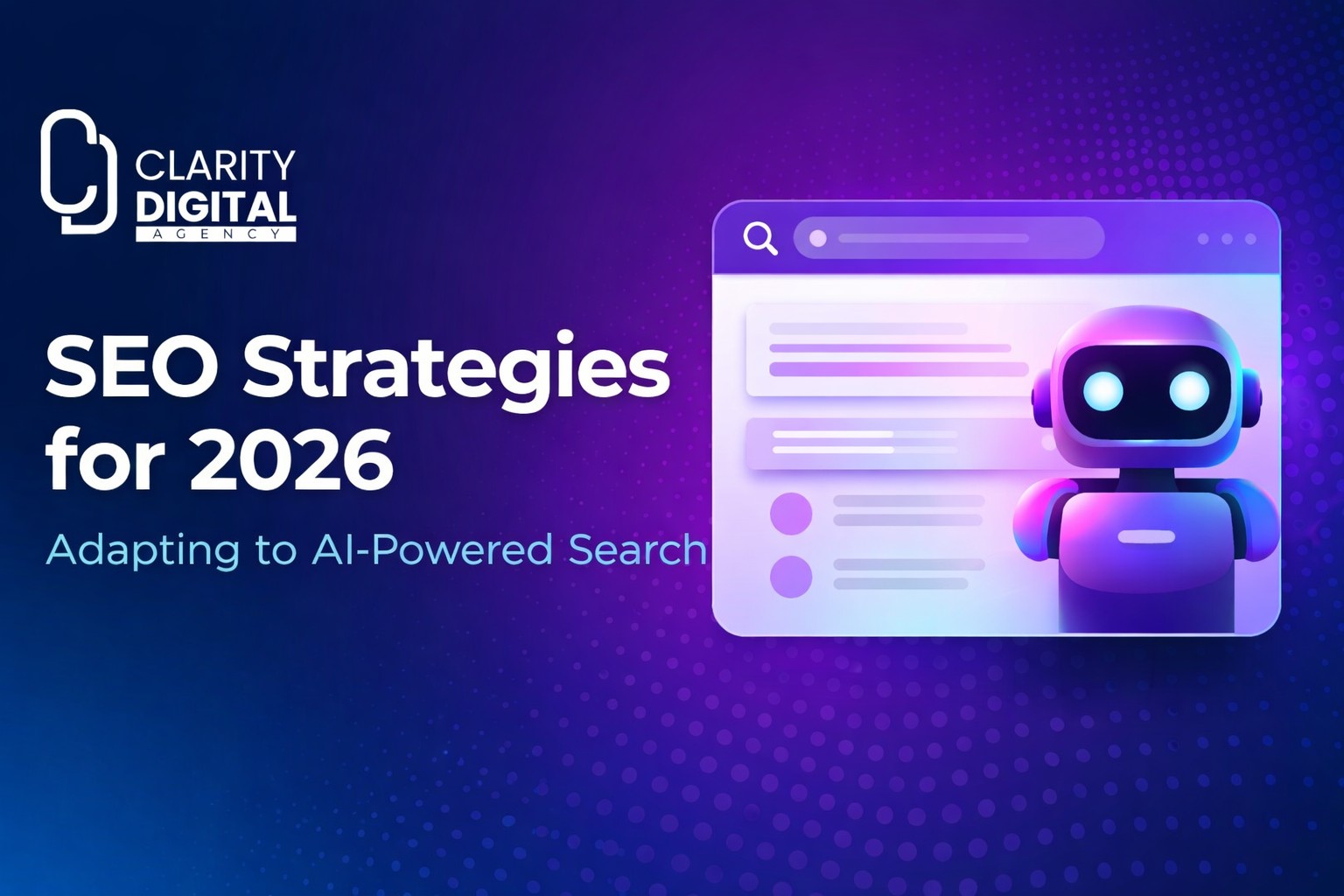

SEO Strategies for 2026: Adapting to AI-Powered Search
The Search Paradigm Has Shifted
By now, you’ve seen it: ChatGPT and LLMs returning direct answers, Google’s AI Overviews pushing organic listings further down, and search behavior migrating into these AI platforms like Perplexity, and Bing Chat.
One Gartner study predicts that starting this year, 2026, over 30% of all search queries won’t result in a traditional click. The AI era of search is here and with it, average consumer is catching on to the AI trends, and there’s naturally anxiety among marketers who have not invested fully in AI SEO, or AEO\GEO.
So let’s address it head-on: SEO is no longer just about ranking in the top 10 blue links. The game has changed, and we’re entering a new phase: Answer Engine Optimization (AEO).
This isn’t just semantics. It’s a fundamental shift in how information is discovered, trusted, and surfaced by AI-powered systems. Traditional SEO fundamentals—technical health, quality content, keyword targeting still matter. But they’re table stakes. The new differentiators? Structured data, entity clarity, content formatting for AI parsing, and demonstrable expertise.
If you’re responsible for digital visibility, pipeline growth, or brand authority, this article lays out what you need to know and what to do next.
The AI-Powered Search Landscape
We’re seeing an ecosystem evolve in real-time. Google’s AI Overviews blend generative answers with cited sources, often leaving traditional organic results below the fold. ChatGPT offers web search through its browser, while platforms like Perplexity are building AI-native search engines that don’t rely on traditional link structures.
But don’t confuse evolution with extinction. While AI tools are shifting how people interact with search, traditional search still commands billions of queries monthly. The key difference is how those queries are processed, and what content gets surfaced.
In this new reality, AI-powered search engines summarize and synthesize answers from multiple sources. Brand visibility depends less on keyword frequency and more on structure and clarity. Credibility signals have become central to determining what information gets surfaced by AI. Search is no longer a ten-result list—it’s an AI-curated experience that favors structured, authoritative, and relevant content.
This convergence of SEO and AEO marks a significant opportunity for strategic marketers. Instead of optimizing only for algorithms, we’re now optimizing for AI systems that act as intermediaries between content and users.
The implication is clear: Your content must speak fluently to both humans and machines.
AI & Answer Engine Optimization Priorities
Structured Data as Your AI Communication Layer
Structured data, specifically schema markup, functions as the translation layer between your content and AI systems. Without it, even the most well-crafted page may be invisible to AI summarization engines.
Schema allows you to specify exactly what each piece of content represents. For instance, tagging an FAQ section with the appropriate markup tells an AI system that this content is designed to answer specific user questions. Similarly, marking up a HowTo guide, a product listing, or an organization page ensures AI can extract and contextualize that information correctly.
The impact is measurable. Businesses that implement structured data consistently see improved inclusion in featured snippets, rich results, and now, AI Overviews. Schema isn’t just helpful, it’s essential.
To prioritize your efforts, focus on applying schema to content types that align with user intent and high-conversion pages. This includes frequently asked questions, instructional content, product details, articles, and corporate information pages. Each of these contributes differently to visibility and credibility across AI platforms.
E-E-A-T Signals for AI Trust
AI engines evaluate content using E-E-A-T: Experience, Expertise, Authoritativeness, and Trustworthiness. These aren’t new concepts, but in the AI context, their importance has grown significantly.
What AI wants to surface is not just correct information, but credible information. If your content lacks author attribution, references no trusted sources, or appears disjointed from your brand’s core identity, it’s far less likely to be included in an AI summary.
To establish trust, ensure that content includes named authors with verifiable expertise. Link to authoritative external sources and cite your own original research or case studies where appropriate. Demonstrate first-hand experience wherever possible, especially in sensitive industries like finance, healthcare, or B2B software, where trust can directly impact decision-making.
Consistent branding across your website and third-party properties also reinforces credibility. AI systems look for coherence: does your content align with your public identity? Do off-site references support your expertise? These factors now influence not only rankings but inclusion in AI-generated responses.
Entity Optimization & Knowledge Graph Building
You may ask, What are entities? Entities are the conceptual building blocks that AI uses to understand the world. In the context of your business, this means your brand, your products, your services, and your people.
Optimizing for entities involves more than just repeating keywords. It requires a deliberate effort to define and interlink the core concepts that matter to your brand. This includes building dedicated pages for each major entity, linking them through contextual relationships, and using consistent naming conventions.
Imagine a knowledge graph that connects your CEO, your flagship product, your core services, and your industry topics—all reinforced through content, links, and external references. That’s what AI systems are building. The more you help them, the more likely you are to be surfaced.
This also ties directly to internal linking strategy. Pages shouldn’t exist in isolation—they should support and amplify one another. Linking your case studies to service pages, your team bios to thought leadership, and your product pages to related solutions not only improves usability, but also strengthens the semantic clarity of your site.
Content Formatting for AI Extraction
Generative AI doesn’t just read content; it extracts, condenses, and reuses it. The way you structure content directly affects whether AI systems can understand and utilize it.
This starts with clarity. Lead with concise summaries that answer key questions up front. Use well-organized subheadings and break down complex topics into digestible sections. Lists, definitions, comparisons, and callouts all help AI systems quickly interpret meaning.
Think about how your content would look if stripped of design and reduced to plain text. Would the message still come through clearly? If not, rework it. Better yet, create content hubs that bring together the best answers on a topic into a single, AI-friendly format. This reduces fragmentation and increases your authority on that subject.
Also, diversify your formats. AI doesn’t limit itself to text. Video, imagery, and downloadable content like PDFs all contribute to your perceived authority and coverage. The more formats you use, the more angles you give AI to engage with your brand.
Optimizing for Featured Snippets & AI Overviews
Featured snippets haven’t gone away. If anything, they’ve become more valuable as AI systems reference them for summaries. These snippets often form the source material for AI Overviews and they’re one of the few places where brand attribution is preserved.
To earn these placements, focus on creating tightly structured, question-driven content. Definitions, how-to guides, and comparisons often perform well when formatted with clear subheadings and brief, direct answers.
While you may not see direct clicks from these placements, the brand visibility they offer is significant. In an environment where users may never leave the search interface, being the quoted authority still builds familiarity and trust.
And importantly, measure these placements separately from traditional rankings. Use tools that track AI Overview citations and featured snippet ownership. These are your new visibility metrics.
Essential Technical Foundations
Even the best-optimized content will struggle without strong technical SEO. AI systems, like search engines before them, depend on accessible, performant sites to retrieve and interpret information.
Site performance, particularly Interaction to Next Paint (INP), has emerged as a core metric under Google’s Core Web Vitals. A slow-loading or unresponsive site won’t just hurt UX—it will reduce your visibility across AI-powered search experiences.
Mobile-first indexing remains critical. With mobile traffic dominating and AI systems prioritizing mobile snapshots, a poor mobile experience effectively removes you from the conversation.
Lastly, make sure your site is crawlable and indexable. This means auditing robots.txt files, reviewing canonical tags, maintaining clean URL structures, and avoiding duplicate content. These foundational elements still underpin your discoverability in both traditional and AI-driven environments.
Strategic Recommendations
Audit and Benchmark
Begin with an honest assessment of your current state. Do you use structured data across core templates? Are your content creators demonstrating E-E-A-T effectively? How well are your key topics and entities defined—and how are they interlinked?
Examine your presence in featured snippets and AI Overviews. You may already be cited without knowing it. Tools that track these inclusions can provide early insights into how AI systems perceive your authority.
Phase Your Implementation
Don’t try to transform everything overnight. Start with high-impact pages—those that generate conversions or establish authority. Add structured data, reformat for clarity, and improve internal linking gradually. Then expand to supporting content and secondary topics.
This phased approach allows for iterative improvement without overwhelming your team or budget.
Align Team Structure
Answer Engine Optimization isn’t just a content task or an SEO task—it’s cross-functional. Content strategists, SEOs, developers, and analytics teams all play a role. Define ownership for schema, for entity documentation, for E-E-A-T improvements.
Train your teams on AEO principles, and ensure your agency partners understand the shift.
Evaluate Agency Expertise
Not all SEO partners are equipped for the AI era. Ask whether they’ve worked with schema at scale, whether they track AI Overview inclusion, and whether they understand entity optimization as a strategic discipline—not just keyword stuffing.
The best partners will help connect these tactical improvements to broader business KPIs like lead quality, pipeline contribution, and brand lift.
Invest Strategically
Allocate resources based on both urgency and opportunity. Fix what’s broken—site speed, crawl issues, schema gaps—then build toward thought leadership and long-term authority.
Structured content and trust signals provide quicker returns. Entity building and AI-friendly content hubs pay dividends over time.
Measure What Matters
Traditional rankings and traffic still matter—but they’re not the whole picture. Track visibility in AI interfaces, featured snippet inclusion, schema deployment progress, and improvements in Core Web Vitals.
Tie these to business outcomes wherever possible. Organic shouldn’t be a traffic-only conversation—it should be about contribution to goals.
SEO Isn’t Dead. It’s Just Smarter Now.
Yes, the search landscape looks different in 2026. But SEO hasn’t disappeared—it’s matured. The fundamentals still matter, but new priorities—like structure, clarity, and trust—now determine who gets seen.
Don’t get caught flat-footed. Audit your current approach against these strategies, prioritize where you can make immediate gains, and build toward long-term visibility in the AI era.
Adaptation beats prediction. And the time to adapt is now.
Need a second set of eyes? We’re always open to conversations about how to evolve your SEO strategy for the AI-powered future. Reach out anytime.