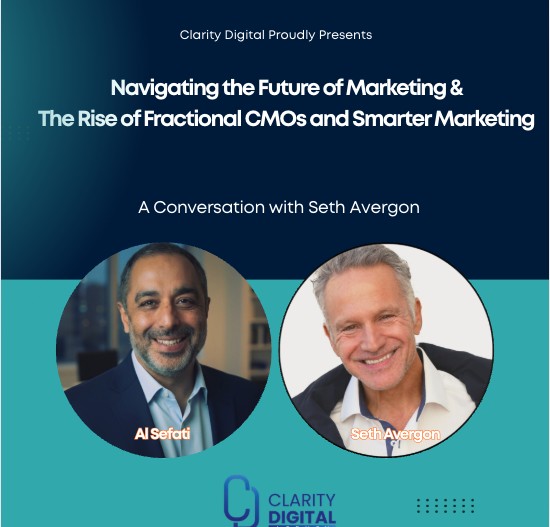

In this episode of Clarity Digital Pod, I sit down with Seth Avergon, founder of Avergon Marketing Group and a long-time marketing executive with over 25 years of experience. Seth has led marketing strategy for major global brands including Citizen Watch, DENSO Automotive, and RSI Home Products. We dive deep into what the modern CMO role looks like, how fractional marketing leadership is evolving, and what companies often get wrong when it comes to AI and execution.
This conversation pulls back the curtain on what actually drives business results. Whether you are a CMO, a founder, or someone trying to step into leadership from the marketing side, you will find a lot of value in this episode.
Watch the Full Episode of Clarity Digital Pod with Seth Avergon
Get an inside look into how high-performing marketers think about go-to-market strategy, sales alignment, leadership, and technology. If you want to build marketing that drives revenue, not just clicks, this is the episode for you.
Watch now and subscribe to the Clarity Digital Pod for more straight-talk marketing conversations.
Summary: Marketing Leadership in a Changing Landscape
Seth Avergon is not new to marketing transformation. In this conversation, he explains how the role of the CMO has shifted over the last decade and why so many companies are struggling to find effective marketing leadership. He also shares why AI is being misunderstood across organizations and how to think critically about execution, planning, and positioning.
What It Really Means to Be a Fractional CMO
Seth was doing fractional work before the term became popular. Back in 2009, he launched his firm because he saw the gap between strategic consultants and tactical agencies. Most businesses had one or the other, but rarely both under the same roof.
Today, many are calling themselves fractional CMOs, but few have actually held senior marketing roles or managed full departments. According to Seth, a real fractional CMO is hands-on, owns the strategic plan, and usually works with no more than three or four clients at a time.
If someone is managing ten accounts, they are not a CMO. They are running an agency.
The Sales and Marketing Disconnect
One of the most discussed topics in B2B marketing is the alignment between sales and marketing. Seth explains that the two functions must be viewed as one unified funnel. Marketing drives awareness and demand at the top, while sales closes deals at the bottom. Without communication and joint planning, both functions suffer.
In high-performing companies, marketing and sales plan together. They share goals, messaging, and even feedback loops. That alignment is no longer optional if you want to grow efficiently.
Understanding MQLs, SQLs, and the Right Timing
We also break down the difference between marketing qualified leads (MQLs) and sales qualified leads (SQLs). Seth warns against passing off early-stage leads just because they downloaded a white paper or attended a webinar. These leads are not ready to talk to sales.
Instead, marketers must nurture these prospects until there is intent and interest. Then, and only then, should they be handed off to sales for deeper conversations. Anything earlier only creates frustration and wasted time.
AI is Not a Strategy
AI is everywhere right now. It is being positioned as a solution for everything from writing content to building campaigns. But Seth and I both agree that AI is not a marketing strategy. It is a tool, and like any tool, it needs direction.
AI will accelerate whatever systems or logic you feed into it. If your strategy is flawed, AI will only make it worse, faster. The key is understanding the context, not just the prompts. Seth refers to this as context engineering, where you give AI a framework that leads to useful outcomes, not generic noise.
Strategy Comes First, Always
Seth emphasizes that no campaign, no matter how well executed, will succeed without a clear marketing foundation. Before any SEO, paid ads, or demand generation efforts begin, companies must have a strategic plan in place.
This includes defining the ICP (ideal customer profile), brand messaging, value propositions, and clear KPIs. Without these building blocks, your marketing execution will fail to generate meaningful results.
Advice for Aspiring CMOs
I asked Seth how someone like me, or other experienced marketers, can move into a true CMO role. His answer was direct.
Learn how to manage budgets, present in the boardroom, and align marketing with business goals. Get involved in strategy early and start acting like a CMO before you are given the title. Most importantly, be the person who can tie marketing activity to business outcomes.
There is also no shame in being a strong second-in-command. Trusted advisors and CMO whisperers play a critical role in building strategy and keeping execution focused. Know your lane, but be ready to lead.
Final Takeaways
This episode is a must-watch for anyone who is:
- Frustrated with misaligned marketing and sales teams
- Confused about how to apply AI effectively
- Hiring a fractional CMO or considering becoming one
- Looking to scale marketing but lacks a strategic plan
- Curious about what separates good marketers from great ones
Seth Avergon brings deep experience, clarity, and real-world insight. His perspective is a valuable reminder that tools, tactics, and trends only work when they are grounded in strategy. If you are trying to build something sustainable, this conversation is one to pay attention to.
Connect With Us
Subscribe to Clarity Digital Pod for weekly conversations on marketing leadership, digital strategy, and modern growth frameworks.
Learn more about Seth Avergon and Avergon Marketing Group at: https://www.avergronmarketing.com
Connect with Al Sefati on LinkedIn: https://www.linkedin.com/in/alsefati/
Episode Transcription
In this episode of the Clarity Digital Pod, I sat down with Seth Avergon, a seasoned marketing strategist and founder of Avergon Marketing Group. With more than 25 years of experience, Seth has worked with major brands across multiple industries, including Citizen Watch, DENSO Automotive, RSI Home Products, and more.
Seth is known for bridging the gap between high-level strategy and hands-on execution, a combination many organizations struggle to find. We discussed account-based marketing, the evolving role of CMOs, AI’s real impact on marketing, and how sales and marketing can work together more effectively.
Introductions
Al:
Hi Seth. How are you doing today?
Seth:
Doing great. How are you?
Al:
Very good. Welcome to the podcast. I appreciate you taking the time. I know we’ve both been busy, especially with the holidays, so thank you for being here.
If you don’t mind, can you introduce yourself to our audience, how long you’ve been in marketing, and what you do?
Seth’s Background in Marketing
Seth:
I’ve been in marketing for about 25 years. My career started working with large brands. I worked with the Citizen Watch division, RSI Home Products handling the Lowe’s channel across 850 stores nationwide, DENSO Automotive, which was about an $18 billion company at the time, and Rain Bird, the sprinkler company.
I gained extensive big-brand experience. Then in 2009, I decided to go out on my own and form Avergon Marketing Group.
The reason was simple. I wanted to create something I wished existed.
On one side, I had agencies that were strong tactically but weak strategically. On the other side, I had strategy consultants who were great at planning but didn’t want to get their hands dirty with execution.
I thought, why doesn’t someone do both?
So I started doing exactly that in 2009.
Fractional CMO Before It Was a Term
Al:
That’s impressive. 2009 was early.
Seth:
Yeah. Back then it wasn’t even called “fractional CMO.” That term came several years later. I was already doing the work long before the label existed.
Account-Based Marketing Explained Simply
Al:
There are so many marketing terms now. ABM, ABX, account-based everything. Can you explain account-based marketing clearly?
Seth:
Traditional marketing was broad based. You pushed a message out and hoped something stuck.
Then we moved into more personalized, audience-based marketing.
Account-based marketing (ABM) is the next level. It’s when a company says, “There are five companies we want so badly that we’re going to align marketing and sales around winning those exact accounts.”
You build customized plans for each account. You might change messaging, materials, even presentations.
I like to say ABM is the sniper rifle of marketing, not the shotgun.
Marketing Authority, Budgets, and Pushback
Al:
I’ve worked in organizations where my title didn’t match my authority. Sometimes I had no budget control or hiring input. How does that affect the CMO role?
Seth:
Regardless of title, my approach is zero-based budgeting.
Instead of being handed a number, I want leadership to say:
“We’re at $5M and want to get to $7M next year. What does marketing need to make that happen?”
My job is to define:
- What needs to be done
- How much it costs
- What success looks like
- What KPIs and milestones matter
If I’m given a budget without context, I push back. That’s part of the CMO’s responsibility.
Marketing is unique because we advocate for the customer. Organizations often get internally focused, but marketing must ask: What does the customer actually need to buy?
Aligning Sales and Marketing
Al:
There’s always tension between sales and marketing, especially in B2B. How do you align them?
Seth:
Early in my career, I was fortunate to work in organizations where sales and marketing planned together.
We didn’t have a marketing plan. We had a sales and marketing plan.
As a marketer, I need to be in the field. I don’t believe in ivory-tower marketing. I talk to customers alongside sales.
Likewise, sales has to understand strategy and constraints. Alignment happens through time, communication, and shared planning.
Marketing owns the top of the funnel. Sales owns the bottom. It’s one system.
MQLs, SQLs, and When to Hand Off to Sales
Seth:
A visitor becomes a Marketing Qualified Lead (MQL) when they identify themselves. We nurture them.
They become a Sales Qualified Lead (SQL) only when they show buying intent.
Marketing’s job is to nurture until the prospect raises their hand and says, “I want to talk.”
Sales hates being handed cold leads who just downloaded content. That’s a marketing failure.
The State of CMOs Today
Al:
We’re seeing many CMOs between roles and more fractional CMOs than ever. What’s going on?
Seth:
Three major factors:
1. AI, Used Poorly
AI accelerates what already exists. If your strategy is bad, AI just accelerates failure.
AI supports marketing. It does not do marketing. It lacks emotional intelligence, differentiation, and true strategy.
2. Dilution of the Fractional CMO Market
Ten years ago, fractional CMOs had actually run marketing departments. Today, many people adopt the title without the experience.
That drives down quality and pricing.
3. Economic Uncertainty
Tariffs, policy shifts, and inventory costs make companies cautious. Marketing budgets pause first.
Inventory, Tariffs, and Marketing Pauses
Al:
We lost a client because they reallocated marketing budget to inventory ahead of tariffs.
Seth:
That’s common. Manufacturers and retailers can’t risk margin collapse. Inventory planning becomes priority over growth initiatives.
AI Reality Check
Seth:
AI is powerful, but it’s not a magic bullet.
Most AI failures come from poor strategy and unclear objectives. I do AI assessments for clients to determine:
- What AI should do
- What it shouldn’t do
- What KPIs matter
It should be treated like any other marketing tool.
Context Engineering vs Prompt Engineering
Al:
One thing I learned is that AI agrees with you too much.
Seth:
Exactly. AI is designed to be agreeable.
That’s why context engineering matters more than prompt engineering. Give AI background, constraints, and objectives before asking it to perform.
Otherwise, you get confident answers that aren’t useful.
Becoming a CMO
Al:
For someone with deep marketing experience who wants to become a CMO, what’s the path?
Seth:
It’s about developing additional skill sets:
- Budgeting and financial literacy
- Strategy development
- Executive communication
- Planning processes
- Emotional intelligence
You can learn academically, but real growth comes from involvement. Ask to join planning conversations. Learn how business, marketing, and strategy plans connect.
About Avergon Marketing Group
Seth:
At Avergon Marketing Group, we focus on:
- Brand and marketing strategy
- Go-to-market planning
- Tactical execution
I assemble the right team for each client and manage execution.
I also mentor executives one-on-one. The C-suite can be lonely, and trusted advisors matter.
Personal Questions
Outside of Work
Seth:
I live by the beach in Southern California. I explore the city with my dog, work out, and practice mindfulness and meditation.
Favorite Travel Destination
Thailand stands out. Sailing, scuba diving, unplugging completely. Shoes off, phone down.
Superhero Choice
Spider-Man. Thoughtful, human, flawed, resilient.
Closing
Al:
This was a great conversation. Thanks for joining the podcast.
Seth:
My pleasure. This was fun. Thank you.