
Public relations has always been about reputation and credibility, but in the AI era, PR has taken on a completely new role.
It’s no longer just about getting featured in the news or sending out press releases. Today, PR is directly connected to SEO, AI visibility, and brand authority across the internet.
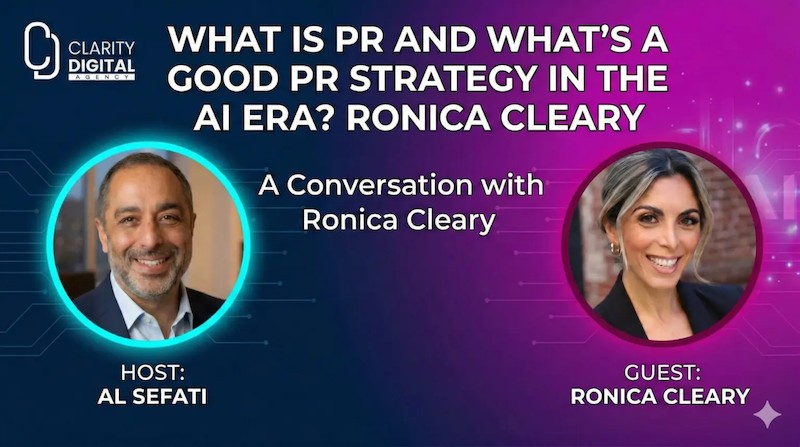
In this episode of Clarity Digital Pod, I sat down with Ronica Cleary, Founder and CEO of Cleary Strategies, to talk about what modern PR really means and why it matters more than ever in the age of AI-driven search.
Ronica has a unique background. Before launching her PR agency in 2018, she worked as a television journalist and White House correspondent in Washington, DC. That experience gives her a rare perspective on how media actually works and how brands should approach public relations strategically.
Below is the full conversation.
What Public Relations Really Is
One of the first things we discussed was a simple question that many business owners still struggle to answer:
What exactly is PR?
Many people assume PR just means sending press releases or getting featured in the media. But according to Ronica, public relations is really about something deeper.
PR is about managing the relationship between a brand and the public.
That relationship is shaped through:
- Media coverage
- Expert commentary
- Thought leadership
- Interviews
- Podcasts
- Digital publications
- News commentary
A PR professional helps businesses navigate how their brand is perceived publicly, particularly through trusted third-party platforms like media outlets.
And that third-party validation is what gives PR its power.
PR vs Marketing: Why the Difference Matters
One of the most interesting parts of our conversation was the distinction between PR and marketing.
Marketing and advertising allow you to control the message completely. You write the copy, design the ad, choose where it appears, and pay for the placement.
PR works differently.
With PR, the message passes through a third-party decision maker — the media.
You don’t control whether the story runs or how it’s framed. But that lack of control actually creates something extremely valuable:
Credibility.
When people see a company featured in news coverage or quoted as an expert in an article, they interpret it differently than an advertisement.
They know the company didn’t pay for that placement.
That’s why earned media often builds trust much faster than traditional marketing.
Which Companies Should Invest in PR?
Another common misconception is that PR is only for large corporations.
In reality, companies of all sizes can benefit from PR, depending on their goals.
For example:
Startups
PR can help startups build credibility with investors, customers, and potential partners.
Growing Companies
Media visibility can position founders and executives as industry experts.
Established Brands
PR strategies often focus on reputation management, crisis communications, and brand authority.
Sometimes the goal is visibility. Other times the goal is actually the opposite: staying out of negative headlines.
The key is having a strategy that aligns with business objectives.
The Importance of the Discovery Phase
One insight Ronica shared that really resonated with me was how her agency structures client onboarding.
Early on, her team would onboard clients quickly and begin pitching immediately.
But over time they realized something important.
If alignment isn’t established first, campaigns can become chaotic.
Now Cleary Strategies starts with a structured discovery phase before pitching any media.
During this phase they define:
- Messaging pillars
- Content themes
- Media targets
- Strategic angles
- PR goals
By the time outreach begins, both the agency and the client are aligned on the strategy.
This reduces friction and improves results significantly.
Inbound vs Outbound PR Strategy
Another topic we explored was the difference between inbound PR and outbound PR.
Many PR agencies rely heavily on inbound opportunities.
These come from journalist request platforms where reporters ask for expert sources.
If a reporter is looking for commentary on a topic and your client fits, you can respond and potentially get featured.
But there’s a downside.
Inbound opportunities depend heavily on the news cycle.
That means results can be inconsistent.
Outbound PR, on the other hand, is proactive.
It involves:
- Monitoring upcoming news trends
- Predicting media interest
- Creating strategic pitches
- Reaching out to journalists before they request sources
This approach creates more consistent media coverage and keeps clients visible even when inbound opportunities slow down.
Why PR Is Becoming Critical for AI Search
One of the most exciting parts of our discussion was the role PR now plays in AI-driven search engines.
Large language models and AI search systems evaluate credibility differently than traditional search engines.
Instead of relying primarily on backlinks, AI systems look heavily at:
- Brand mentions
- Media citations
- Online sentiment
- Authoritative sources referencing a brand
In many ways, this resembles what PR has always produced.
When a company is mentioned in trusted media outlets, that information becomes part of the internet’s credibility layer.
AI systems then use that information when generating answers.
This means PR is becoming a major driver of AI visibility.
Why Smaller Media Mentions Now Matter More
Another interesting shift Ronica mentioned is that smaller publications are gaining new importance.
In the past, many companies focused only on top-tier outlets.
But AI systems value a broader ecosystem of mentions, including:
- Local journalism
- Industry publications
- Digital magazines
- Podcasts
- niche media outlets
These sources contribute to the overall digital footprint of a brand.
And that footprint influences how AI systems interpret credibility and expertise.
The Intersection of PR, SEO, and GEO
Historically, SEO and PR were treated as separate disciplines.
Today they are increasingly interconnected.
PR campaigns often generate:
- Backlinks
- Brand mentions
- authoritative citations
- expert commentary
All of these signals influence search visibility.
Now with the rise of Generative Engine Optimization (GEO), PR has become even more important.
When AI systems generate answers about companies or industries, they often pull from media coverage and trusted publications.
This means PR is no longer just about awareness.
It’s about being included in the knowledge graph of the internet.
Crisis Communications and Media Training
Ronica’s journalism background also gives her team a major advantage when it comes to crisis communications.
When a company faces a public controversy, the biggest risk often comes from how leaders handle media interviews.
Journalists are trained to extract headlines.
Executives often underestimate that dynamic.
PR professionals help prepare leaders to:
- understand reporter incentives
- avoid misinterpretation
- deliver clear messaging
- stay focused under pressure
The goal isn’t to spin the story.
The goal is to navigate the media landscape intelligently.
Technology Powering Modern PR Agencies
PR today also relies heavily on specialized technology.
Ronica shared several tools agencies use to manage campaigns and media outreach, including platforms that:
- track journalist requests
- build media contact databases
- monitor brand mentions
- measure audience reach
- report campaign performance
Technology helps agencies scale their efforts while still maintaining personalized outreach.
PR’s New Role in the AI Era
If there’s one takeaway from this conversation, it’s this:
PR is no longer just about publicity.
It’s about building digital credibility.
As AI becomes the primary interface for discovering businesses and information, brands that earn consistent media coverage and brand mentions will have a significant advantage.
PR, SEO, and AI visibility are converging.
And companies that understand that shift early will be far better positioned in the years ahead.
Connect with Ronica Cleary
Website
https://clearystrategies.com
LinkedIn
https://www.linkedin.com/in/veronicacleary
About Clarity Digital Pod
Clarity Digital Pod explores the future of SEO, AI search, marketing strategy, and digital growth.
Hosted by Al Sefati, each episode features conversations with founders, marketers, and industry experts about how technology is reshaping digital marketing.