
The AI-Fluent CMO: Why Surface-Level Adoption Is Already Failing
AI StrategyThe 60-second answer. Most marketing organizations are using AI the way they used social media in 2009: a channel-level experiment owned by whoever volunteered. That is no longer enough. AI is a substrate, not a tactic. CMOs who treat it as a content shortcut will lose ground to peers who treat it as an operating model decision. The shift required is from tactical pilots to a four-layer AI stack (strategy, operating model, channel, measurement) with named owners and a continuous learning program.
The quiet repricing of marketing leadership
There is a shift happening in CMO hiring conversations that most marketing leaders have not fully priced in. Boards and CEOs are no longer impressed by AI pilots in the content team. They are asking whether the CMO can articulate an AI-native go-to-market model.
The bar moved. AI fluency at the leadership level is becoming a hiring filter, not a bonus. A CMO who delegates AI strategy to a director of marketing ops is signaling that they do not understand the magnitude of the shift. The CEOs we work with read that signal clearly.
This is not a generational story or a tools story. It is a leadership story. AI is reshaping the unit economics of marketing the same way mobile reshaped distribution between 2008 and 2012. The marketing leaders who built around mobile early defined the next decade. The same window is open now, and it closes faster.
Why siloed AI adoption is already failing
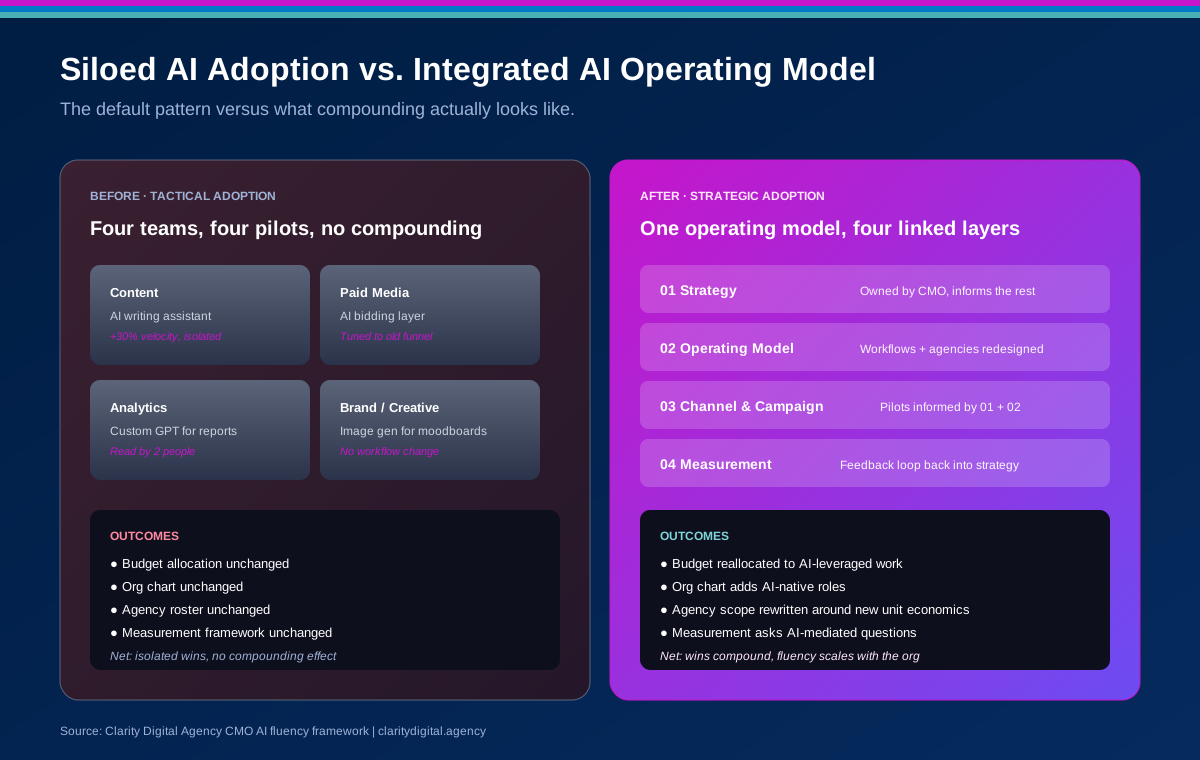
The default pattern looks like this. The content team adopts a writing assistant. The paid media team tests an AI bidding layer. The analytics team experiments with a custom GPT. The brand team uses image generation for moodboards. None of it talks to each other. None of it changes the budget, the org chart, the agency roster, or the measurement framework.
The failure mode is not that these pilots underperform. Several of them work. The failure mode is that isolated wins never compound. A 30% lift in content velocity does not matter if the demand gen funnel, the brand strategy, and the analytics stack are still built for a pre-AI world.
Free Visibility Audit
See how your site ranks across Google and AI search.
Technical SEO, AEO/GEO readiness, and competitive snapshot. No obligation.
Top to bottom: the four-layer AI marketing stack
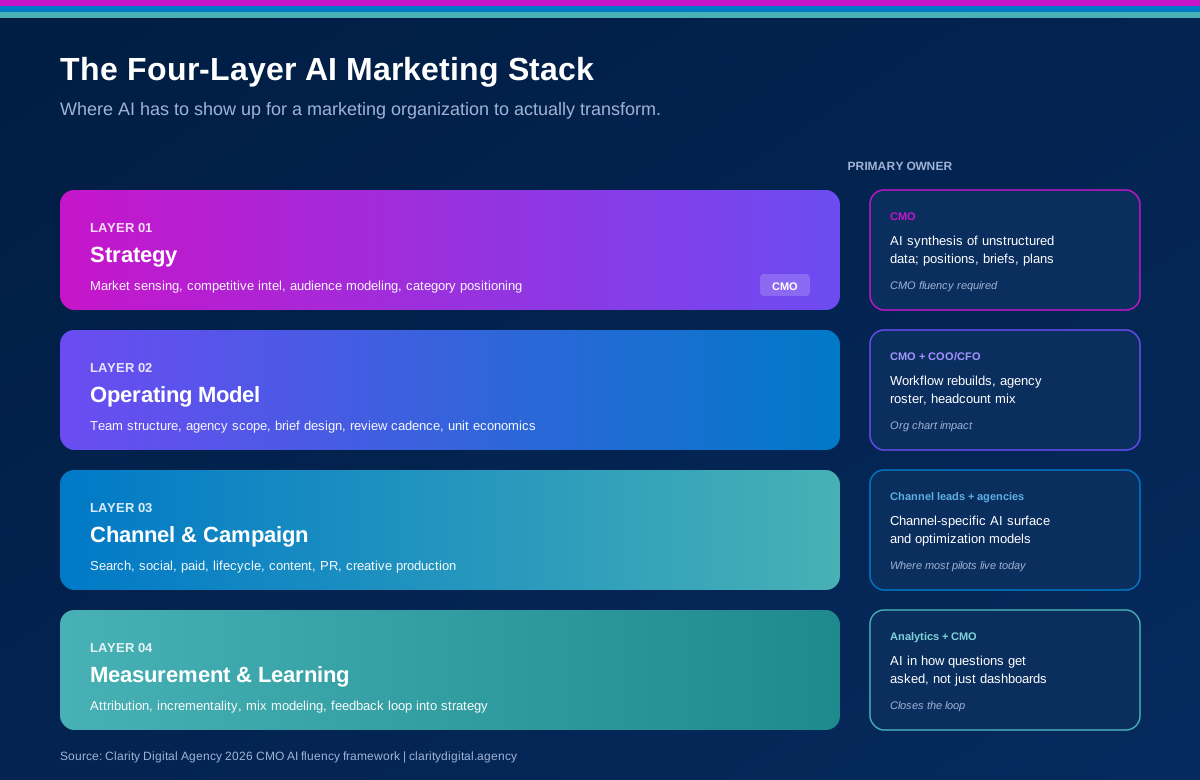
For AI to actually change how a marketing organization performs, it has to show up at four layers. Most orgs are operating on layer three only. That leaves the top three layers on the table.
Strategy layer
Market sensing, competitive intelligence, audience modeling, and category positioning informed by AI synthesis of unstructured data. This is the layer where the CMO personally needs fluency. Delegating it is the most common, most expensive mistake of 2026.
Operating model layer
How teams are structured, how agencies are scoped, how briefs are written, how reviews happen. AI changes the unit economics of every workflow in the department. A brief that took a week now takes a day. A creative round that took eight people now takes three. If the operating model does not change, the savings get reabsorbed and nothing compounds.
Channel and campaign layer
Search, social, paid, lifecycle, content, PR, and creative production. Each channel has its own AI surface area and its own optimization model. This is where most pilots live today, and where most boards are being shown the wrong scorecard.
Measurement and learning layer
Attribution, incrementality, mix modeling, and the feedback loop between campaigns and strategy. AI is now embedded in how questions get asked of the data, not just how dashboards get built. Without this layer, the other three never tune themselves.
| Layer | Primary owner | AI surface | Failure mode if ignored |
|---|---|---|---|
| 01 Strategy | CMO | Synthesis of unstructured data | Pilots solve the wrong problem |
| 02 Operating model | CMO + COO/CFO | Workflow and agency redesign | Velocity gains get reabsorbed |
| 03 Channel & campaign | Channel leads + agencies | Per-channel optimization | Where most pilots already live |
| 04 Measurement | Analytics + CMO | How questions get asked | No feedback loop into strategy |
The new CMO skill stack
What CMOs actually need to be fluent in is not prompt engineering. It is not picking tools. The real skills are about reasoning, decision rights, and culture.
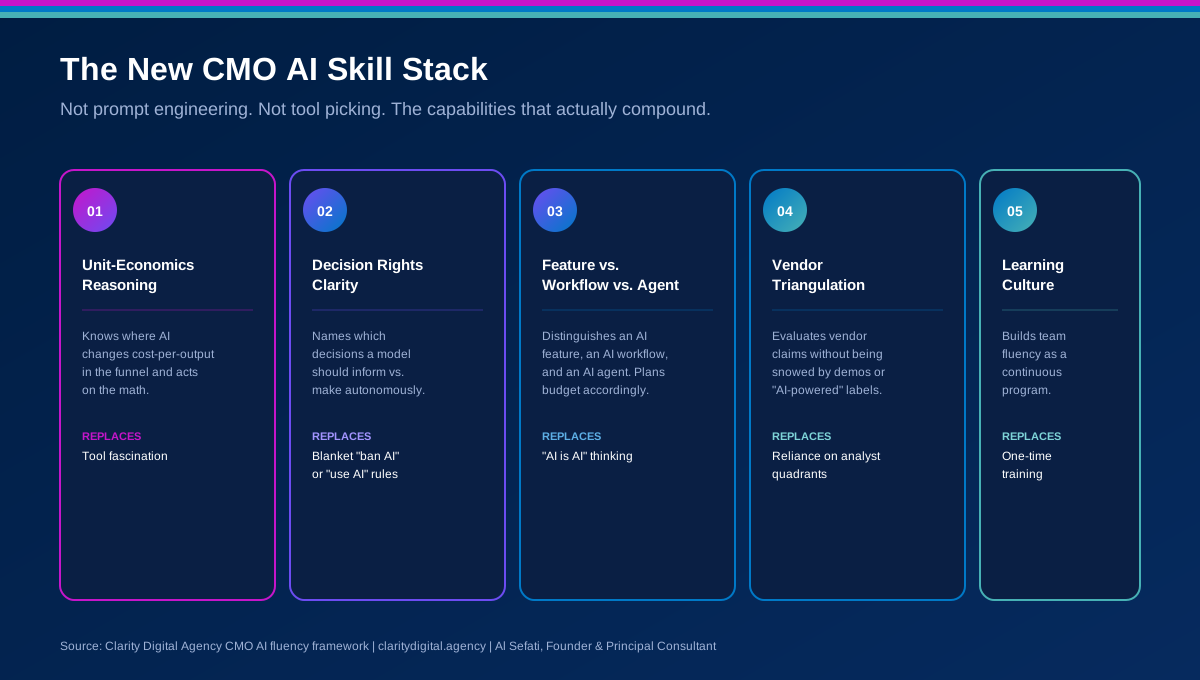
The five capabilities are reasoning about where AI changes unit economics in the funnel, knowing which decisions a model should inform versus make, understanding the difference between an AI feature and an AI workflow and an AI agent, evaluating vendor claims without being snowed, and building a learning culture so the team's fluency compounds.
None of these require code. All of them require time the CMO has not currently set aside.
How to move from tactical to strategic AI adoption
Start with a marketing AI audit that maps current usage by team, by workflow, and by decision type. Most CMOs are surprised by how much shadow AI is already in their org.
Then identify the three highest-leverage strategic decisions where AI synthesis would change the answer, not just speed up the work. Pricing strategy, category positioning, and audience prioritization are common candidates.
Rebuild one core workflow end to end with AI as a first-class participant, not a bolt-on. Use that workflow as the proof point to redesign the operating model, the agency roster, and the measurement plan. Treat team enablement as a continuous program, not a one-time training.
Build the fluency, then build the strategy
AI fluency is not a credential. It is a habit. The CMOs pulling ahead are the ones who have made structured learning a personal and team-level commitment.
This is part of why we built our sister company, ClarityDigital.AI, as a free AI Academy for marketing leaders, practitioners, and cross-functional teams. The library covers strategic frameworks for executives, hands-on tracks for marketers, content teams, analysts, and operators, and reference material on agentic AI, custom GPTs, and MCP integrations. If you are a CMO trying to bring your team up the curve without burning a full training budget on the wrong vendor, it is a reasonable place to start.
The closing frame
The CMOs who win the next three years will not be the ones with the best AI tool stack. They will be the ones who rebuilt how their marketing organization thinks, plans, and learns. That work starts at the top, not in a pilot.
If you want a partner to run the audit, redesign the operating model, or step in as a fractional Head of AI or fractional CMO, that is exactly what Clarity Digital does. For self-serve learning, ClarityDigital.AI is free and open.
Frequently asked questions
Why do CMOs need to understand AI beyond tools?
Because AI changes the unit economics of marketing work itself. A CMO who only evaluates AI as tool selection cannot make the calls that actually matter: which workflows to rebuild, which agency lines to retire, which decisions to delegate to a model, and how to restructure the team. Tool decisions are downstream of operating model decisions, and the operating model is the CMO's job.
How should AI be integrated into a marketing strategy?
Across four layers, not one. Strategy (market sensing, positioning, audience modeling), operating model (team and agency design), channel and campaign (per-channel optimization), and measurement (attribution and feedback). If AI only shows up at the channel layer, three quarters of the value is left on the table.
What is the difference between tactical and strategic AI adoption?
Tactical adoption is a pilot inside an existing team that does not change the budget, the org chart, the agency roster, or the measurement framework. Strategic adoption rewires all four. Tactical wins do not compound. Strategic wins do.
How do CMOs build AI fluency across their marketing team?
Treat enablement as a continuous program, not a one-time training. Establish a structured curriculum, a named owner for AI learning inside the team, a quarterly fluency assessment, and time on the calendar for practitioners to build with the tools rather than just attend webinars.
Where can marketing leaders learn AI for free?
ClarityDigital.AI offers a free AI Academy for marketing leaders, practitioners, and cross-functional teams, with strategic frameworks for executives and hands-on tracks for marketers, analysts, and operators. It is a structured starting point that does not require a vendor commitment.
Your Next Step
Two ways to turn this into results.
Pick the path that fits where you are right now. We will meet you there.
Free CMO Resource
Download the AI-Fluent CMO Operating Model Brief
Branded PDF with the four-layer stack, the siloed vs. integrated comparison table, the CMO skill stack, and a 90-day plan to move from tactical pilots to an AI operating model.