The 2026 D2C Ecommerce Marketing Playbook: Eight Strategies Reshaping How Brands Acquire and Retain Customers
EcommerceThe 2026 D2C Ecommerce Marketing Playbook: Eight Strategies Reshaping How Brands Acquire and Retain Customers
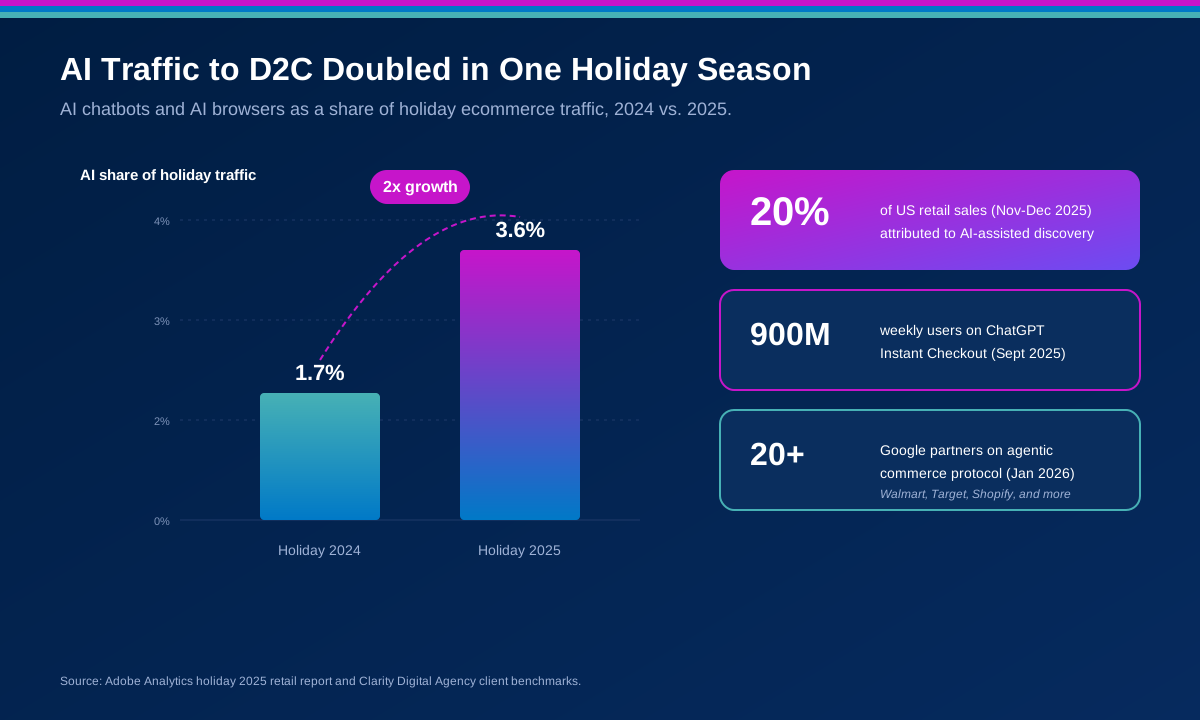
The 60-second answer. D2C ecommerce is operating under different rules in 2026. AI chatbots and AI browsers doubled their share of holiday ecommerce traffic between 2024 and 2025, AI was credited with driving 20% of US retail sales that season, ChatGPT's Instant Checkout reaches roughly 900 million weekly users, and Google launched an agentic commerce protocol in January 2026 with Walmart, Target, Shopify, and more than 20 partners. Discovery is moving off your website. Eight strategies, sequenced as a build order, define who wins the next 18 months. Full playbook below.
Why the old D2C playbook is breaking
D2C ecommerce in 2026 is operating under a different set of rules than it did even twelve months ago. AI chatbots and AI browsers doubled their share of holiday ecommerce traffic between 2024 and 2025, and AI was credited with driving 20% of all retail sales during that season. ChatGPT's Instant Checkout has been live since September 2025, serving roughly 900 million weekly users. Google launched its own agentic commerce protocol in January 2026 with Walmart, Target, Shopify, and more than 20 other partners.
The implication is simple. Discovery is moving off your website. Your product catalog has to be legible to machines, not just attractive to people. And the marketing budget that once flowed almost entirely into Google Ads, Meta, and Shopify apps now needs to fund a parallel infrastructure for AI search, agentic commerce, first-party data, and retention.
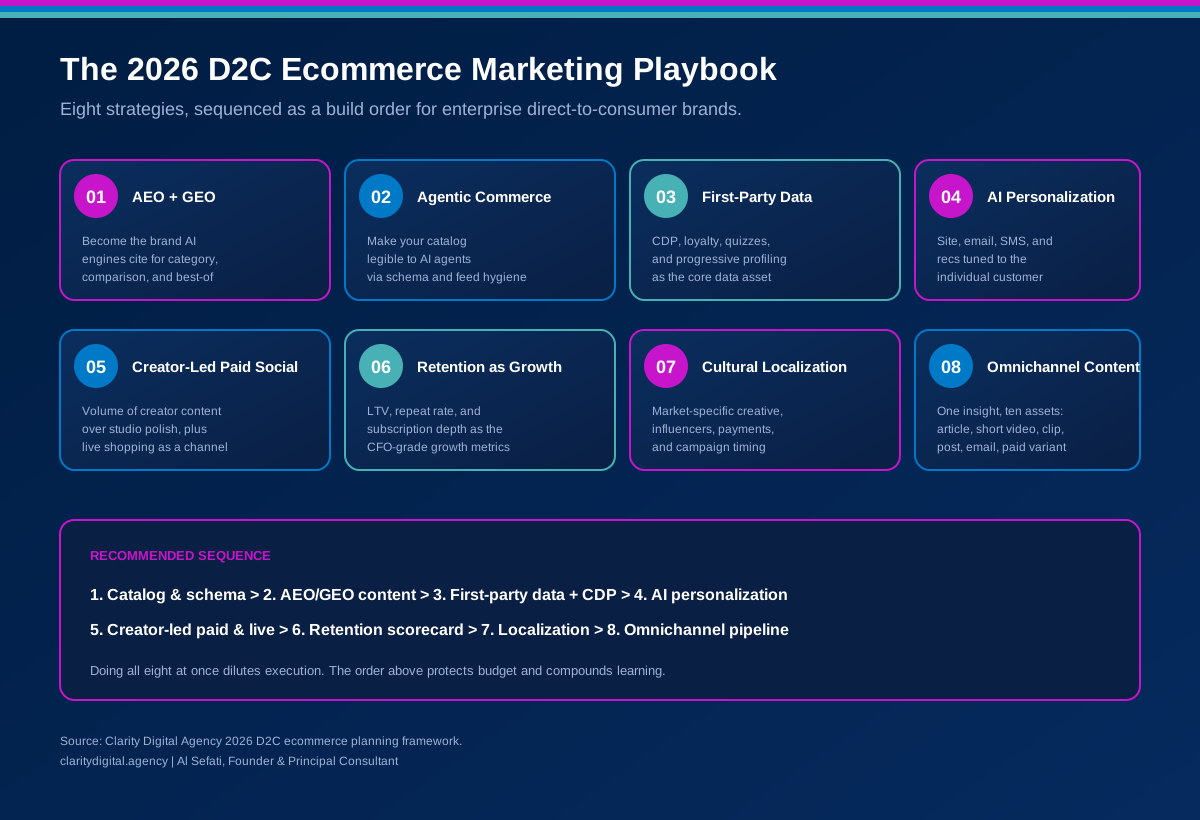
This playbook covers the eight strategies enterprise D2C brands should be executing in 2026, why each one matters, and how to sequence them.
The eight strategies reshaping D2C marketing in 2026
1. Answer Engine and Generative Engine Optimization (AEO and GEO)
Traditional SEO still drives meaningful traffic for D2C brands, but it is no longer the whole story. A growing share of product research happens inside ChatGPT, Perplexity, Claude, Gemini, and Google's AI Overviews. The user types a question, gets a synthesized answer, and never visits a site at all. This is zero-click discovery, and it is the single biggest threat to traditional ecommerce funnels.
Answer Engine Optimization (AEO) and Generative Engine Optimization (GEO) are the disciplines that make your brand the answer AI systems cite. The work breaks into four areas.
- Extractable content. Short paragraphs, clear claims, defined terms, and citable statistics give LLMs the structure they need to lift your content into an answer.
- External authority signals. AI engines weight mentions in Reddit, industry publications, expert roundups, and review sites heavily.
- Comparison and definitional content. X vs Y, what is Z, best X for Y. These formats earn disproportionate citation share because they match how users prompt AI tools.
- Measurement. AI referral traffic now needs its own segment in GA4 alongside organic search.
Brands that built their SEO program around keyword volume and rankings will struggle. Brands that build around question-led content, structured data, and external authority will compound advantages.
2. Agentic Commerce Readiness
This is the infrastructure layer most marketing teams have not started on yet, which is precisely why it is the highest-leverage opportunity in 2026.
Agentic commerce means an AI agent, acting on behalf of a customer, completes a purchase without the customer ever opening your storefront. The customer sets intent and guardrails. The agent handles discovery, comparison, and checkout. McKinsey projects this channel will drive $3 to $5 trillion globally by 2030. It is not theoretical.
The marketing work here is unfamiliar to most ecommerce teams because it is not creative or audience work. It is data and infrastructure. Your product feed has to be complete, accurate, and updated in real time. JSON-LD product schema needs to cover every attribute an AI agent might query: waterproof, vegan, hypoallergenic, ankle support, ships in 2 days. Shipping costs, delivery windows, and return policies must be machine-readable and unambiguous. If an AI agent cannot quickly determine whether your product qualifies, it will skip you without the customer ever seeing the option.
Inside enterprise stacks, this often requires an adapter layer that exposes existing commerce infrastructure to emerging agentic protocols rather than a full replatform. The brands that ship this work in 2026 will collect the first wave of customer data, conversion learnings, and platform relationships. Brands that wait until 2027 will be optimizing against incumbents.
3. First-Party Data as the Core Asset
Third-party cookies are gone. Customer acquisition costs are rising across every paid channel. Privacy regulation continues to tighten. The brands with the most defensible growth model in 2026 are the ones that own their customer data outright.
First-party data strategy spans four mechanics. Loyalty programs that reward profile completion. Quizzes that surface zero-party data (style, fit, preferences, goals) and feed personalization. Progressive profiling that captures one or two new attributes per visit instead of asking for everything upfront. Preference centers that let customers tell you directly what they want to see.
The technical foundation is a customer data platform (CDP) that unifies behavioral, transactional, and zero-party data across email, SMS, on-site, paid, and customer service. For Shopify-based brands, this often means Klaviyo plus a CDP like Segment or RudderStack. For enterprise stacks, it is typically a more integrated platform like mParticle, Tealium, or Twilio Segment paired with a composable identity layer.
Without first-party data, AI personalization is guesswork. With it, personalization compounds.
4. AI-Driven Personalization at Every Touchpoint
Segmentation in 2026 is no longer cohort-based. It is individual. AI models trained on behavioral, transactional, and contextual signals deliver homepage layouts, product recommendations, email send times, subject lines, and even copy variations tuned to the single customer.
Brands implementing AI personalization at scale see 40% higher engagement rates and 25% increases in average order value, on average. The lift is real, but the requirements are non-trivial. Personalization quality is downstream of data quality, which is downstream of first-party data collection.
The tactical stack typically includes a recommendation engine (Rebuy, Bluecore, Nosto, Dynamic Yield), an AI-driven email and SMS platform (Klaviyo, Attentive, Bluecore), and an on-site personalization layer that varies hero content, category sort order, and product detail page elements by visitor.
The strategic point is that personalization is no longer a feature. It is the baseline expectation, and customers can tell the difference between brands that have it and brands that do not.
5. Creator-Led Paid Social Over Studio Creative
Paid social continues to drive discovery and remarketing volume, but the creative model has inverted. Studio-produced ads now underperform creator content repurposed as paid media across nearly every D2C category we work in. The reason is trust. Customers scrolling Reels and TikTok read studio ads as advertising and creator content as recommendation.
The 2026 paid social playbook looks different from 2022. Volume of creator content matters more than polish. Brands need a pipeline that produces dozens of creator variants per month, tests them at small spend, kills losers fast, and scales winners aggressively. Influencer marketing tools like Whalar, Aspire, and Insense are the standard infrastructure for this.
Live shopping is also driving real conversion now, not just impressions. TikTok Shop, Instagram Live, and Amazon Live formats convert at meaningfully higher rates than static social commerce when paired with the right host and product. For brands with strong demonstration value (beauty, apparel, home, food), live should be a budgeted channel in 2026, not an experiment.
6. Retention as the Primary Growth Lever
When CAC keeps rising and AI is shrinking the top of the funnel, lifetime value becomes the math that matters. The CFO conversation in 2026 is not about traffic or impressions. It is about LTV, repeat purchase rate, and subscription penetration.
Retention strategy in 2026 spans several layers. Subscription and replenishment programs convert one-time buyers into recurring revenue and are particularly powerful in consumables, beauty, and pet categories. Post-purchase email and SMS flows (shipping updates, education, cross-sell, review requests) carry the customer relationship beyond the transaction. VIP tiers and loyalty programs reward repeat behavior with status, access, and economic benefits. Win-back campaigns reactivate lapsed customers before they fully churn.
Customers arriving through AI channels have already done extensive research. They know your price, your competitors' prices, and your return policy before they hit your site. The window to differentiate on the consideration phase is narrowing. The window to differentiate on post-purchase experience is wide open.
If LTV exceeds CAC, repeat purchase rate is growing, and conversion is improving, your D2C strategy is scalable. If not, no amount of paid spend will fix the model.
7. Cultural Localization for Global and Regional Brands
For D2C brands expanding internationally or marketing to distinct regional segments inside a single country, localization in 2026 means more than language translation.
Localization now covers visual style, humor and tone, influencer selection, payment methods, campaign timing, and even product positioning. A campaign that works in California will often miss in Texas, let alone in Tokyo or Mumbai. Generative AI has made producing localized variants economical for the first time, which means the brands investing in cultural fluency are pulling away from competitors still running one-size-fits-all global campaigns.
The practical implication is a creative workflow that produces a base concept, then forks it into market-specific variants with native creator input, regionally appropriate visuals, and payment and delivery options that match local norms. Brands that get this right see meaningfully higher engagement and conversion in each market they enter.
8. Omnichannel Content Format Diversity
A single blog post or product page is no longer the unit of content. In 2026, every meaningful insight or product story gets produced as a long-form article (for AEO and traditional search), a short-form video (for TikTok, Reels, and Shorts), a podcast clip, a LinkedIn post, an email, and a paid social variant.
The reason is twofold. First, attention is fragmented across platforms, and the customer journey often touches three or four formats before purchase. Second, AI search engines weight multi-format brand presence as a credibility signal. Brands that show up consistently across formats earn more citation share in AI answers.
The operational shift is treating content production as a pipeline rather than a series of one-off projects. One insight feeds five to ten assets. A content team in 2026 includes a writer, a video editor, a designer, and an AI workflow operator who repurposes long-form into short-form at scale.
Free Visibility Audit
See how your site ranks across Google and AI search.
Technical SEO, AEO/GEO readiness, and competitive snapshot. No obligation.
How to rebalance your 2026 D2C marketing budget
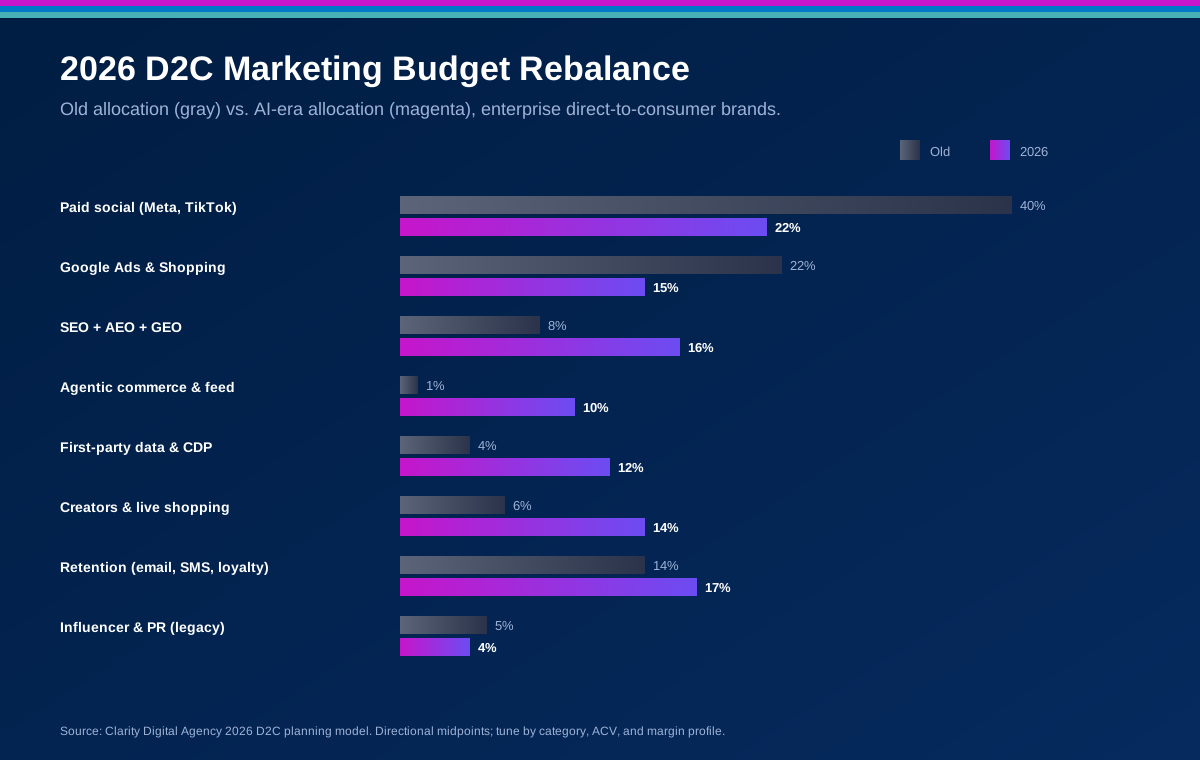
If you are operating off a 2022-era allocation that pours 40% into paid social and treats SEO as a side line, the math no longer works. Here is the directional rebalance we recommend for enterprise D2C clients.
| Channel | Old allocation | 2026 allocation | Why |
|---|---|---|---|
| Paid social (Meta, TikTok) | 35-45% | 20-25% | Saturated; creator-led only |
| Google Ads & Shopping | 20-25% | 12-18% | Repointed at high-intent only |
| SEO + AEO + GEO | 5-10% | 12-18% | AI search is the new top of funnel |
| Agentic commerce & feed | 0-2% | 8-12% | New line item, infra layer |
| First-party data & CDP | 2-5% | 10-15% | Foundation for personalization |
| Creators & live shopping | 3-8% | 12-18% | Replaces studio paid |
| Retention (email, SMS, loyalty) | 10-15% | 15-20% | Becomes top-of-funnel asset |
| Influencer & PR (legacy) | 5-8% | 3-5% | Rolled into creator line |
This is a directional model, not a prescription. Actual mix depends on category, margin profile, AOV, and where your customers actually research.
The strategic sequence for 2026
If you are starting from a traditional SEO and paid social foundation, the order of operations matters. Doing all eight strategies at once dilutes execution and burns budget.
The sequence we recommend to enterprise clients runs roughly as follows:
- Fix product data, schema, and feed hygiene so AI agents can actually parse your catalog.
- Build AEO and GEO content that earns citations in AI answers for category and comparison queries.
- Stand up first-party data capture and a CDP if you do not already have one.
- Layer AI personalization on email, SMS, and on-site experiences.
- Rebuild the paid social creative pipeline around creators and live shopping.
- Shift the executive scorecard so retention metrics (repeat rate, LTV, subscription percentage) carry equal weight with acquisition metrics.
- Layer in cultural localization as the foundation matures.
- Run an omnichannel content pipeline that turns every insight into five to ten assets.
The brands that will struggle in 2026 are the ones still running an acquisition stack built for 2020 while their catalog is invisible to AI agents and their first-party data is thin. The brands that will compound are the ones treating AI search, agentic commerce, and first-party data as core infrastructure rather than experiments.
Frequently asked questions
What is agentic commerce and why does it matter for D2C brands in 2026?
Agentic commerce is when an AI agent completes a purchase on behalf of a customer without the customer ever opening your storefront. ChatGPT Instant Checkout and Google's agentic commerce protocol with Walmart, Target, Shopify, and 20+ partners are the first scaled examples. McKinsey projects $3-$5 trillion in agentic commerce by 2030. For D2C brands, the practical implication is that product feeds, schema, shipping, and returns data must be complete and machine-readable, or AI agents will skip your products entirely.
How should D2C brands measure AI search performance in 2026?
Track three layers. First, citation share in ChatGPT, Perplexity, Claude, and Google AI Mode for your top 30 category and product queries. Second, AI referral traffic as its own segment in GA4 alongside organic search. Third, the downstream conversion behavior of AI-sourced visitors, which tends to convert at higher rates because they arrive with more context but expect a faster, more transactional experience.
Is paid social still worth investing in for D2C brands in 2026?
Yes, but the creative model has inverted. Studio-produced ads underperform creator content repurposed as paid media across nearly every D2C category. The 2026 paid social playbook is creator volume, fast iteration, and aggressive scaling on winners, complemented by live shopping on TikTok Shop and Instagram Live for products with strong demonstration value.
What does a first-party data strategy actually look like for D2C in 2026?
Four mechanics: loyalty programs that reward profile completion, quizzes that surface zero-party data, progressive profiling that captures one or two attributes per visit, and preference centers. The technical foundation is a CDP that unifies behavioral, transactional, and zero-party data across every channel. Klaviyo plus Segment or RudderStack works for Shopify-based brands; enterprise stacks typically need mParticle, Tealium, or Twilio Segment with a composable identity layer.
Where Clarity Digital fits
Clarity Digital Agency builds and operates this playbook end to end for enterprise D2C brands, funded startups, and established direct-to-consumer businesses. Our work spans SEO and AEO/GEO content programs, agentic commerce readiness audits, first-party data and CDP strategy, AI personalization implementation, creator-led paid media, and retention systems.
If you are evaluating where your 2026 marketing program stands against this playbook, we offer a structured assessment that benchmarks your current execution across all eight strategies and prioritizes the highest-leverage gaps. Contact us to start the conversation.
Al Sefati is the Founder and Principal Consultant at Clarity Digital Agency, with 25+ years of experience in SEO, AEO/GEO, paid media, analytics, and AI strategy and enablement. He also operates ClarityDigital.AI, focused on agentic AI solutions, custom GPTs, and MCP integrations.
Your Next Step
Two ways to turn this into results.
Pick the path that fits where you are right now. We will meet you there.
Free D2C CMO Resource
Download the 2026 D2C Ecommerce Marketing Playbook
Branded PDF with the eight-strategy playbook, the budget rebalance table, and a 90-day D2C CMO action plan. Built to share with your leadership team.