SEO for YMYL and E-E-A-T in 2026: Why Reviews, Ratings, and Brand Sentiment Now Decide Who Ranks
SEOSEO for YMYL and E-E-A-T in 2026: Why Reviews, Ratings, and Brand Sentiment Now Decide Who Ranks
The 60-second answer. If your business operates in a Your Money or Your Life category (finance, health, legal, major purchases, public safety), classic on-page SEO is no longer enough to rank or to be cited by AI Overviews, ChatGPT, Perplexity, Gemini, and Copilot. Google's quality framework, E-E-A-T (Experience, Expertise, Authoritativeness, Trustworthiness), is now evaluated against external reputation signals: review volume and recency, average ratings, brand sentiment across the open web, editorial citations, and verifiable author credentials. The winning operating model treats reviews and reputation as a search input, not a marketing afterthought.
What YMYL means and why it raises the SEO bar
YMYL stands for Your Money or Your Life. Google introduced the term in its Search Quality Rater Guidelines to describe topics that can materially affect a person's health, financial stability, safety, or wellbeing. The list is broad: medical conditions and treatments, mortgages and investing, legal advice, insurance, child safety, mental health, immigration, civic information, and large purchase decisions like cars, real estate, and enterprise software.
The reason this matters for SEO is simple. Google instructs its human raters, and increasingly its ranking systems, to hold YMYL content to a higher standard than informational or entertainment content. A wrong recipe is annoying. Wrong medical guidance can kill someone. Wrong financial guidance can wipe out a retirement. The systems are tuned to err on the side of caution, which means they downweight or suppress content that does not show clear E-E-A-T signals.
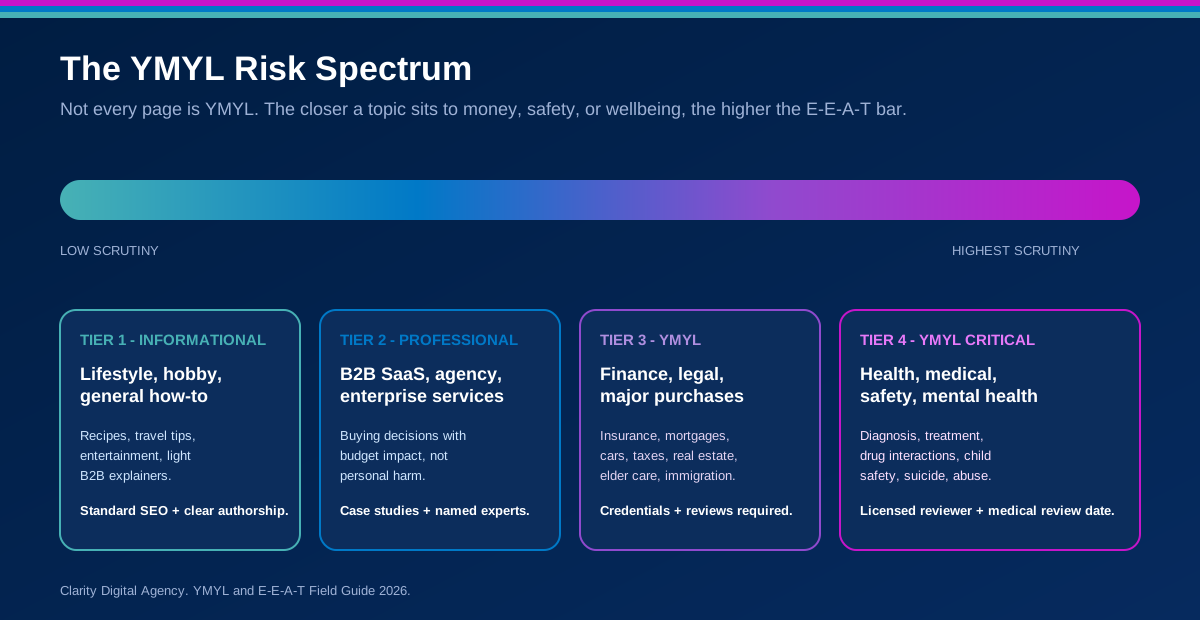
Not every page on a site is YMYL. A SaaS company writing about productivity habits is in Tier 1. The same company writing about HIPAA-compliant workflows for hospitals is in Tier 3. The audit question is not "are we a YMYL business?" It is "which pages are YMYL?" Treat them differently.
E-E-A-T is not a content checklist. It is a reputation system.
One of the most expensive misunderstandings of 2026 is treating E-E-A-T as a list of things to add to a page. Author bio, check. Credentials, check. Sources, check. That work matters, but it is the floor, not the ceiling. Google and AI search systems verify E-E-A-T by looking at the wider web and asking a different question: does the open web confirm that this brand and this author are who they say they are, and are they trusted by the people who would know?
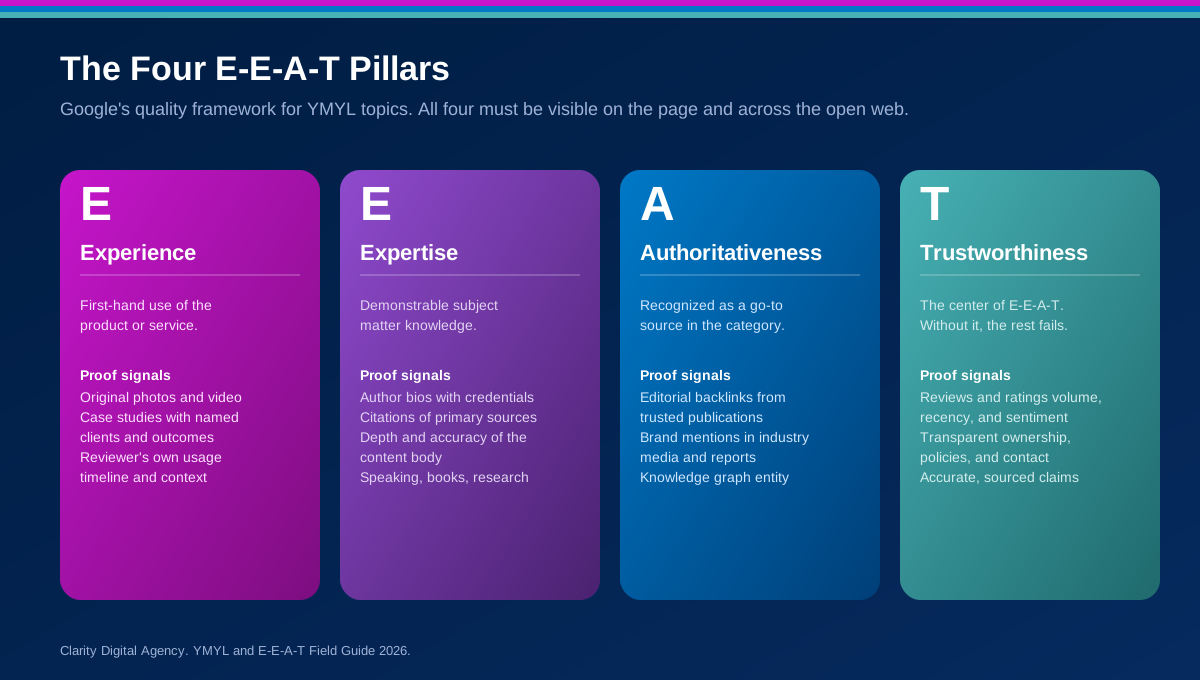
Experience
Has the author or the brand actually done the thing they are writing about? Original photos, named clients, real case studies, first-person details, and product usage timelines are signals of experience. Generic AI-written summaries are anti-signals.
Expertise
Does the author have demonstrable knowledge of the subject? Credentials matter, but so do the depth and accuracy of the writing, the citations used, the precision of the terminology, and the author's track record. A surgeon writing about a procedure clears this bar. An anonymous content team does not.
Authoritativeness
Is the brand recognized as a go-to source in the category? This is judged by the references the rest of the web makes to the brand: editorial backlinks, industry citations, podcast appearances, conference invitations, knowledge graph presence, and mentions in publications that themselves carry weight. Authoritativeness cannot be self-declared. It is conferred.
Trustworthiness
This is the center of the framework. Google explicitly states that the other three pillars are tools to assess trust. Trust is built through transparent ownership and policies, accurate and sourced claims, secure infrastructure, clean review profiles, positive brand sentiment, and the absence of red flags like undisclosed sponsorships or misleading medical claims. A site that fails trust fails the framework, regardless of how strong the other pillars look.
Free Visibility Audit
See how your site ranks across Google and AI search.
Technical SEO, AEO/GEO readiness, and competitive snapshot. No obligation.
Why reviews and ratings now sit at the top of the trust signal stack
For YMYL topics, the single fastest way to raise or lose ranking eligibility in 2026 is what your review and ratings profile looks like across the platforms users and AI systems consult. This is true for Google's organic results, for the Local Pack, for AI Overviews, and for citations in ChatGPT, Perplexity, Claude, Gemini, and Microsoft Copilot.
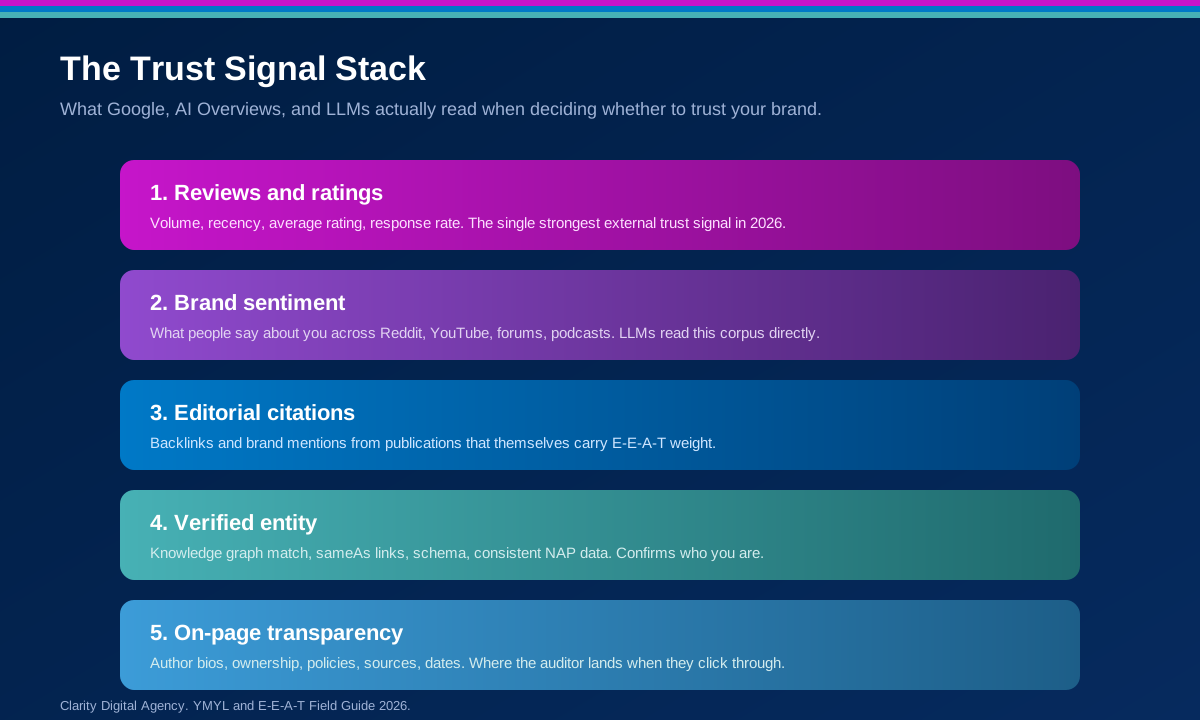
Three things matter in a review profile, in this order.
- Volume. A profile with 14 reviews loses to a profile with 400, even at the same star rating. Volume signals that real customers actually exist and that the brand has stood up to scrutiny over time.
- Recency. The newest reviews are weighted heaviest. A profile with strong reviews from 2022 and silence since reads as a brand that has stopped operating, or stopped serving customers well. Aim for a steady cadence of fresh reviews every month, not seasonal spikes.
- Response rate and tone. Brands that respond to reviews, especially negative ones, with specifics and accountability outperform brands that ignore them. The response is read by both humans and AI systems.
The platforms that move the needle depend on the category. For local and professional services, Google Business Profile, Yelp, BBB, and category-specific platforms (Healthgrades, Avvo, Zillow). For SaaS and B2B, G2, Capterra, TrustRadius, and Gartner Peer Insights. For ecommerce, Trustpilot, Sitejabber, and product-level reviews on the site itself with valid review schema markup. For employer reputation, which feeds back into brand trust, Glassdoor and Indeed matter more than people admit.
Brand sentiment: the corpus that LLMs actually read
Reviews are the structured signal. Brand sentiment is the unstructured signal, and in the AI search era it might be even more consequential. When ChatGPT, Perplexity, Claude, Gemini, or Copilot answer a question that mentions or implies your brand, they are not just reading your website. They are reading the open-web conversation about you: Reddit threads, YouTube reviews, podcasts, forums, news coverage, expert blog posts, and social discussion.
If that corpus is positive, specific, and consistent, the model will represent your brand favorably and is more likely to cite you. If it is thin, negative, or contradictory, the model will hedge, omit you, or surface a competitor. This is happening today, at scale, and it shows up in pipeline before it shows up in search analytics.
Practical implications:
- Reddit is now a tier-one SEO and AEO surface. Google partnered with Reddit for AI training data. LLMs index Reddit heavily. Brands that show up in helpful, non-promotional Reddit conversations build durable AI visibility. Brands that try to astroturf get caught and downranked.
- YouTube transcripts feed AI summaries. A founder or named expert appearing in long-form interviews creates a transcripted record that LLMs read as expertise evidence.
- Podcasts function like backlinks for the LLM era. Show notes are crawled. Episode descriptions get cited. Guest appearances on credible shows build authority that pure content marketing cannot match.
- Press and analyst coverage retain weight. A mention in a respected industry publication is read by humans, by Google's quality systems, and by AI training data. Earned media is no longer optional for YMYL brands.
The on-page work still matters, but it changes shape
Reputation is the foundation. The on-page work makes sure that when a Google quality rater, a journalist, or an AI crawler lands on your page, the evidence matches the off-page signal. The checklist for YMYL pages in 2026:
- Named author with a real bio. Bio includes credentials, licenses, links to LinkedIn and Google Scholar where relevant, photo, and a list of related publications or talks. Anonymous content does not pass.
- Reviewer or medical reviewer where applicable. Health, legal, and finance pages should list a licensed reviewer and a review date. Schema markup should reflect both.
- Sources and citations linked inline. Primary sources beat secondary sources. Government, academic, and industry-body sources beat consumer media.
- Clear ownership and policies. About page that names humans, contact information that works, editorial standards, fact-checking process, corrections policy, advertising disclosures, and a transparent revenue model.
- Schema markup that earns its keep. Organization, Person, Article, Review, AggregateRating, MedicalEntity, FinancialProduct, FAQPage, and HowTo where appropriate. Schema does not create trust, but it makes existing trust legible to machines.
- Updated dates that reflect real updates. Changing a date without updating the content is now actively penalized. Update the substance, then update the date.
- Original assets. Original photography, original data, original diagrams. AI-generated stock imagery is becoming an anti-signal for YMYL.
AEO and GEO change which sentences win
For YMYL queries, AI Overviews and LLM answers are usually the first surface a user sees. Optimizing for these surfaces is what we call AEO (Answer Engine Optimization) and GEO (Generative Engine Optimization). The mechanics map directly to E-E-A-T:
- Lead with a clear, sourced definitional sentence. The first 1 to 2 sentences under each H2 are what extractors pull. Make them precise, cite the source, and avoid hedging.
- Use question-led H2s and H3s. Match the way users actually ask the question. AI systems prefer passages that match the query shape.
- Include named entities. The brand, the author, the product, the regulator, the standard. Entities are how AI systems disambiguate and decide who to cite.
- Mention your brand in context with category leaders. Comparative passages where your brand is named alongside known authorities increase the chance of co-citation in AI answers.
- Publish data others quote. Original research, surveys, and benchmarks earn citations from publications, which feeds back into authoritativeness and into LLM training corpora.
The operating model that wins YMYL SEO in 2026
Most YMYL brands lose ground because the work that drives trust signals lives in five different teams: marketing owns content, product owns reviews, customer success owns response, PR owns earned media, and nobody owns Reddit and podcasts. The winning operating model collapses this into a single trust-and-authority program with one accountable owner reporting to the CMO.
The minimum viable structure includes a content lead who owns on-page E-E-A-T and AEO, a reputation lead who owns reviews, ratings, and response across platforms, a digital PR lead who owns earned citations and analyst relations, and a community lead who owns Reddit, YouTube, podcast guesting, and brand mentions. Together they meet weekly, share one dashboard, and treat sentiment, citations, and review velocity as core KPIs alongside organic traffic.
How Clarity Digital helps YMYL businesses win
Clarity Digital Agency runs an integrated SEO, AEO, GEO, and digital PR program built specifically for YMYL categories. For finance, healthcare, legal, real estate, automotive, insurance, and enterprise B2B brands, the engagement typically includes:
- YMYL and E-E-A-T audit. Page-level scoring against the full Google Search Quality Rater framework, plus a reputation audit across review platforms, Reddit, YouTube, podcasts, and earned media.
- Trust signal remediation. Author program, schema rebuild, policy and transparency pages, medical or legal reviewer workflow, and review platform strategy with a steady cadence of fresh, authentic reviews.
- AEO and GEO content engineering. Rewrites that earn AI Overview placements and LLM citations, with measurable lifts in branded answer share.
- Digital PR and authority engineering. Original research, expert positioning, and earned coverage that builds the off-page authoritativeness and sentiment that on-page work alone cannot create.
- Executive reporting that boards understand. Trust signal velocity, review and sentiment dashboards, AI citation share, and pipeline impact, not vanity rankings.
We work with founders, CMOs, and Heads of SEO who already know that the old playbook is breaking. If that sounds like the conversation you need to have, our team can walk you through where the gaps are and what a 90-day plan looks like.
Clarity Digital will benchmark your on-page E-E-A-T, your review and sentiment profile, and your AI citation share against the top three competitors in your category. You get a prioritized 90-day plan.
Request your auditFrequently asked questions
What is YMYL in SEO?
YMYL stands for Your Money or Your Life. It is Google's label for topics that can materially affect a person's health, finances, safety, civic participation, or wellbeing. Google applies a stricter quality bar to YMYL content and tunes its ranking systems to favor sources with strong E-E-A-T signals over generic content.
What does E-E-A-T stand for?
E-E-A-T stands for Experience, Expertise, Authoritativeness, and Trustworthiness. It is the framework Google uses to evaluate content quality, with trust at the center. Experience and expertise speak to the author. Authoritativeness and trust speak to the brand and the open-web reputation that surrounds it.
Is E-E-A-T a ranking factor?
E-E-A-T itself is not a single ranking signal that Google computes and applies. It is a framework that informs how Google's quality systems are designed and trained. The downstream signals that approximate E-E-A-T, like reviews, citations, entity verification, author transparency, and content accuracy, absolutely affect rankings, especially for YMYL queries.
How do reviews affect SEO for YMYL businesses?
Reviews are now the single strongest external trust signal for YMYL businesses. Volume, recency, average rating, and response rate all influence how Google and AI search systems judge trustworthiness. For local and professional services, review profile health often correlates more tightly with ranking movement than backlinks do.
Why does brand sentiment matter for AI search?
LLMs like ChatGPT, Perplexity, Claude, Gemini, and Copilot are trained on and increasingly retrieve from the open web, including Reddit, YouTube, podcasts, forums, and news. The collective sentiment of that corpus shapes how a model represents your brand and whether it cites you in answers. Positive, specific, consistent sentiment improves AI citation share. Thin or negative sentiment suppresses it.
Can you fix E-E-A-T just by adding author bios and schema?
No. Bios, schema, policies, and transparency pages are the floor. They make existing trust legible to machines. Without the off-page signals (reviews, citations, sentiment, entity verification) the on-page work does not move the needle for competitive YMYL queries.
How long does it take to rebuild E-E-A-T for a YMYL brand?
The on-page foundation can be rebuilt in 60 to 90 days. The off-page reputation work (reviews, citations, sentiment, earned media) is a continuous program that typically shows measurable lifts in 4 to 6 months and compounding gains across 12 months. There is no shortcut, but the work compounds.
What is the difference between SEO, AEO, and GEO for YMYL topics?
SEO optimizes for ranked links on Google. AEO (Answer Engine Optimization) optimizes for being the extracted answer in AI Overviews, featured snippets, and voice assistants. GEO (Generative Engine Optimization) optimizes for being the cited brand inside LLM answers from ChatGPT, Perplexity, Claude, Gemini, and Copilot. For YMYL queries, all three matter, and the trust signals that drive them overlap heavily.
Your Next Step
Two ways to turn this into results.
Pick the path that fits where you are right now. We will meet you there.