
The AEO Challenge Nobody Measures: How AI Visibility Becomes Direct and Branded Traffic
AnalyticsThe AEO Challenge Nobody Measures: How AI Visibility Becomes Direct and Branded Traffic
The direct answer: the AEO challenge is a measurement problem, not a visibility problem. Answer engine optimization (AEO) earns a brand a place inside AI answers, but that visibility shows up later as direct traffic and branded search instead of a trackable referral. The AEO work created the demand. The reporting stack cannot name it, so budget and credit drift toward the channels that close the deal rather than the ones that open it.
This article expands on a LinkedIn exchange between Ashley Segura, Head of Marketing at SearchLab, best-selling author, speaker, and one of the top-ranked content marketers in the industry, and Al Sefati, founder of Clarity Digital. Segura's observation was blunt: someone asks ChatGPT who to hire, sees a name, Googles it, and fills out a form. In the reports, that conversion shows up as an SEO lead or as direct traffic. The work is still working. The measurement is not. That gap has a name: the AEO challenge.
What is the AEO challenge nobody measures?
The AEO challenge is the gap between earning visibility inside AI answers and being able to prove what that visibility is worth. Answer engine optimization (AEO) is the practice of structuring content, entities, and evidence so AI assistants can retrieve and cite a brand when a buyer asks a question. Generative engine optimization (GEO) extends the same discipline to generated results more broadly. Both aim for one outcome: the brand is named in the answer.
Measurement is where the challenge bites. An AI answer passes no referrer, sets no campaign parameter, and writes no log in the brand's analytics. The buyer who was recommended a brand in ChatGPT arrives later as a direct visit or a branded search, and the lead is credited to those channels. AEO can therefore be working exactly as intended while every dashboard it influences reports something else. Visibility is the half teams fund. Measurement is the half nobody owns.
Free Visibility Audit
See how your site ranks across Google and AI search.
Technical SEO, AEO/GEO readiness, and competitive snapshot. No obligation.
What Ashley Segura's LinkedIn post gets right about the AEO challenge
Segura framed the problem in a single sentence: SEO is not dead, attribution is. Her example is the journey most B2B marketing teams now see in their CRM every week. A buyer asks an AI assistant for a recommendation, receives a shortlist of names, validates one of those names with a branded Google search, and then converts on the company's website. Every step after the AI answer is trackable. The step that created the demand is not.
That framing matters because it redirects the industry conversation. Much of the current debate treats AI search as an existential threat to SEO. Segura's point, and the position Clarity Digital has argued for some time, is that the demand-generation mechanism still works. Content, authority, and brand presence still produce buyers. What has changed is that the first touch increasingly happens inside an interface that passes no referrer, sets no campaign parameter, and leaves no impression log in the marketer's analytics platform.
Segura has written and spoken about content strategy for years, including in a previous Clarity Digital conversation on winning content strategies in the post-AI era. Her attribution observation extends the same theme: the fundamentals of content and search still drive growth, but the operating assumptions around measurement need to catch up with how buyers actually behave.
How AI visibility becomes direct and branded traffic in your reports
Walk the journey through the lens of a standard analytics setup. The buyer asks ChatGPT for a recommendation. That interaction produces no referrer and no session in the brand's analytics. The buyer then searches the brand name on Google. If the buyer clicks an organic result, analytics records an organic search session with a branded query that most reporting tools do not even expose at the keyword level. If the buyer types the URL directly or uses a bookmark, analytics records direct traffic. When the buyer converts, the lead source reads direct or organic, and the AI-assisted discovery that started the journey appears nowhere. AI visibility has quietly become direct and branded traffic.
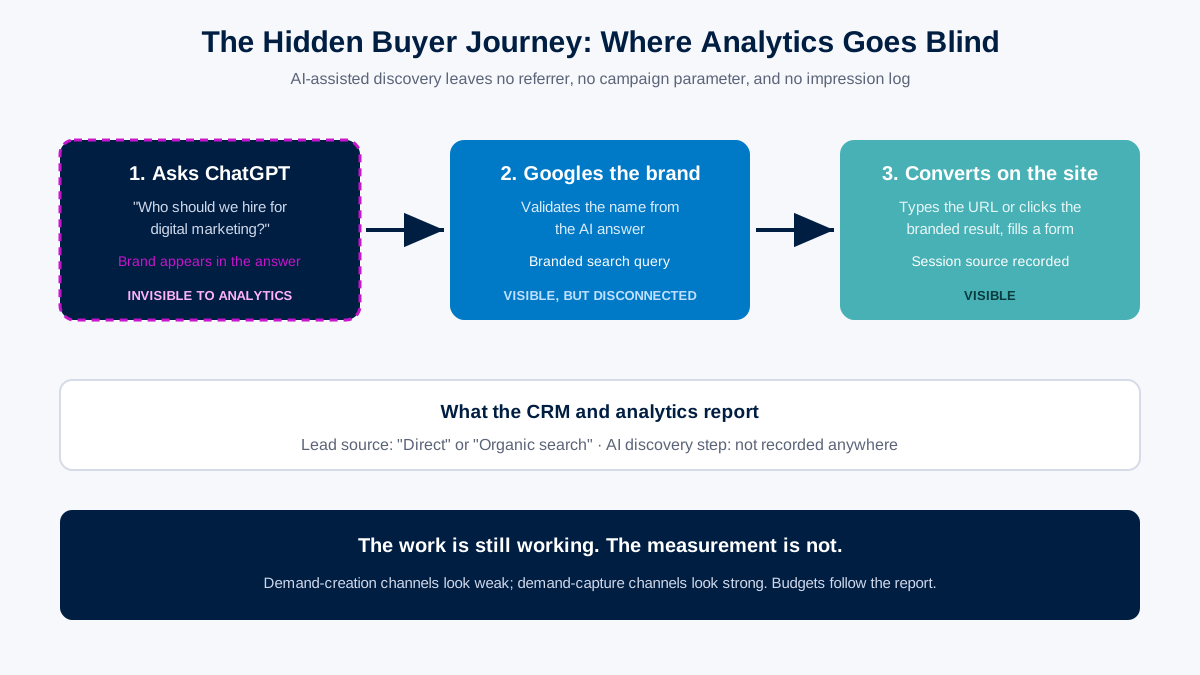
The result is a systematic bias, not random noise. Channels that close demand, such as branded search and direct, appear to overperform. Channels that create demand, such as content, digital PR, community presence, and AEO and GEO work, appear to underperform. A team that trusts the dashboard literally will gradually defund the activities that fill the pipeline.
Why does branded search growth hide in plain sight?
Branded search volume is one of the few observable proxies for demand created elsewhere. When AI answers, podcast appearances, or digital PR placements increase, branded queries tend to rise afterward. Most attribution models treat that branded traffic as a bottom-of-funnel channel with its own independent value, rather than as the measurable shadow of upstream work. The query data exists. The interpretation is what fails.
Why solving AEO visibility without solving attribution leads to bad budget decisions
In the LinkedIn thread, Sefati's response to Segura was that many teams are trying to solve the AI visibility problem when they should really be solving the AEO challenge, the measurement half of the same shift. The two problems are connected, but they are not the same problem, and the order of operations matters.
A company can invest in answer engine optimization, earn citations in AI responses, and see real pipeline growth from that work. If the reporting stack attributes the resulting leads to direct traffic, the initiative still looks unproven in the quarterly review. The next budget cycle reallocates spend toward whatever the dashboard credits, which is usually the channel closest to the conversion. The visibility work gets cut precisely because it worked in a way the measurement could not see.
The inverse mistake is just as common. Teams buy AI visibility reporting tools, watch mention counts rise, and declare victory without connecting any of it to pipeline. Citations are a leading indicator, not a business outcome. Without an attribution framework that ties AI discovery to branded demand, referral behavior, and closed revenue, neither the optimists nor the skeptics can prove their case.
Clarity Digital's SEO, AEO, and GEO work and its attribution modelling practice exist as separate services for this reason. Visibility without measurement is unaccountable. Measurement without visibility has nothing to count.
Which attribution signals still work when last-click breaks down
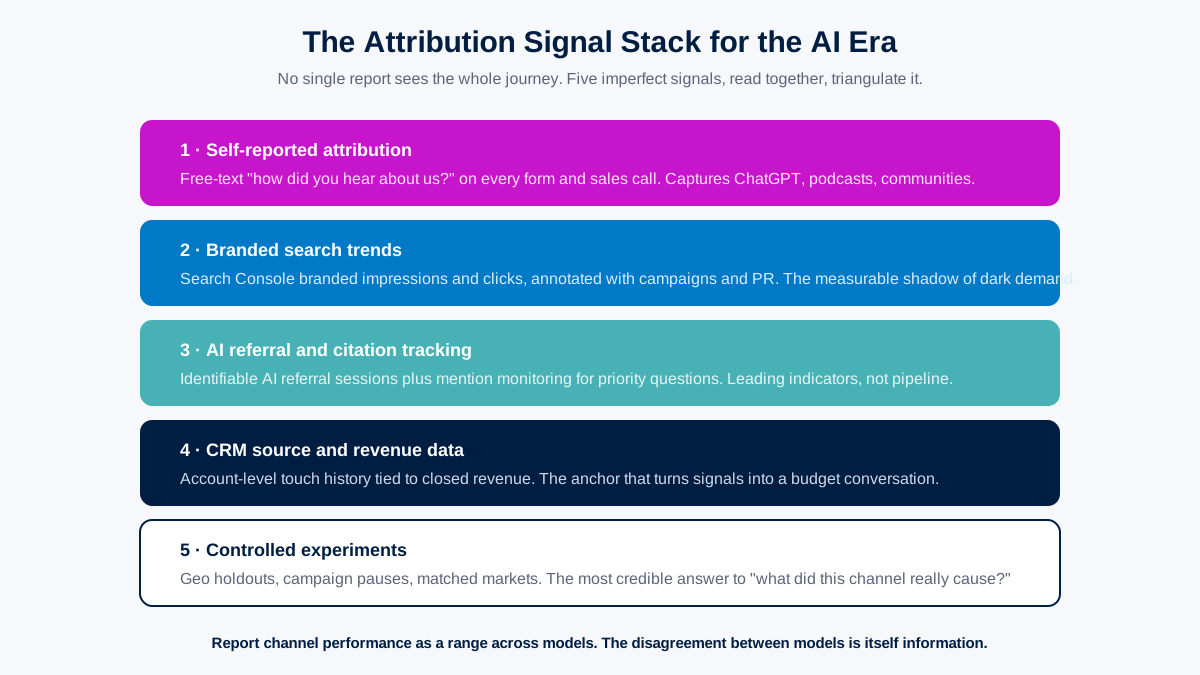
No single tool replaces the lost visibility. The workable approach is a layered set of signals, each imperfect, that triangulate the same question from different directions.
How does self-reported attribution recover the invisible first touch?
A free-text field on the conversion form, asking how the buyer first heard about the company, routinely surfaces answers that analytics cannot: ChatGPT, a podcast, a colleague, a newsletter. Self-reported data has recall bias, but it captures exactly the dark channels that tracking misses. The key is making the field free text rather than a dropdown, so buyers can name sources the marketing team did not anticipate.
What can branded search trends reveal about AI-driven demand?
Branded query volume in Google Search Console, trended over time and annotated with campaign and PR activity, acts as a demand barometer. A sustained rise in branded impressions and clicks following AI visibility work is evidence that discovery is happening upstream, even when the platform that delivered the discovery reports nothing.
Are AI referral traffic and citation tracking worth measuring?
Yes, with realistic expectations. AI platforms send some identifiable referral traffic, and mention monitoring can show whether a brand appears for its target questions. These signals measure presence, not pipeline. They belong in the model as leading indicators alongside, not instead of, revenue data.
Why is CRM source data the anchor of the whole model?
The CRM holds what analytics loses: the full history of touches on accounts that actually became revenue. Connecting first-touch, self-reported, and campaign data at the account level lets a team ask the only question that matters in a budget meeting: which activities appear in the histories of deals that closed. Clarity Digital's custom dashboard work typically starts by unifying exactly these sources.
Where do controlled experiments fit?
Geo holdouts, campaign pauses, and matched-market tests remain the most credible way to estimate what a channel truly contributes. They require planning and tolerance for short-term inefficiency, but they answer causation questions that no correlation-based model can.
A practical framework for rebuilding attribution around AEO and AI search
The following sequence is an operating process, not a promise of perfect measurement. The goal is a model that is directionally honest and useful for decisions, not one that pretends to see everything.
Step 1: Map the real buyer journey before touching the tooling
Interview recent customers and review CRM notes to document how buyers actually discovered and evaluated the company. The map almost always includes dark touches: AI assistants, communities, podcasts, and word of mouth. Build the measurement plan around the real journey, not around whatever the current tool happens to track.
Step 2: Add self-reported attribution to every conversion point
Introduce the free-text how-did-you-hear-about-us field on forms, and train sales teams to ask and record the same question on calls. Categorize responses monthly. Treat a rising share of AI-assistant answers as a demand signal worth investigating, not an anecdote to dismiss.
Step 3: Instrument the observable proxies
Trend branded search impressions and clicks, direct traffic to high-intent pages, AI referral sessions, and citation presence for a fixed set of priority questions. Annotate every marketing initiative on the same timeline so correlations are visible and debatable.
Step 4: Rebuild reporting around account-level revenue
Connect marketing touches to CRM accounts and closed revenue. Report channel performance as a range informed by multiple models: last-click for hygiene, position-based for context, self-reported for dark channels, and experiments for causation. Present the disagreement between models honestly. The gap between them is itself information about what the business cannot see.
Step 5: Review the model quarterly and defend the dark channels
Attribution in the AI era decays faster than it used to, because buyer behavior is shifting quickly. Revisit assumptions each quarter, and explicitly protect demand-creation budgets from being raided by whatever the dashboard over-credits that quarter.
Questions marketing leaders ask about the AEO challenge and attribution
What is the AEO challenge?
The AEO challenge is the difficulty of measuring the value of being cited inside AI answers. Answer engine optimization gets a brand named by ChatGPT and other assistants, but that mention passes no referrer, so the buyer later appears as direct traffic or a branded search. The visibility works and the reporting cannot see it, which is why AEO is so often judged on mention counts instead of pipeline.
Is SEO actually dead because of AI search?
No. Buyers still discover brands through content, authority, and search behavior, but the first touch increasingly happens inside AI interfaces that pass no referrer. SEO and content continue to create demand. The failure is in measurement: analytics records the final steps of the journey as direct traffic or branded search, which hides the contribution of the work that started it.
Why do AI-influenced leads show up as direct traffic?
AI assistants such as ChatGPT typically pass no referrer when a buyer later visits a site through a branded search or by typing the URL. Analytics platforms classify those sessions as direct or organic branded search. The AI interaction that created the demand leaves no trace in standard web analytics, so the lead source is mislabeled by default.
Can any tool fully track ChatGPT referrals?
No. Some AI platforms send identifiable referral traffic for a portion of visits, and monitoring tools can track brand mentions and citations. Neither captures the full journey, because much of AI-influenced discovery converts later through branded search or direct visits. Reliable measurement requires combining referral data, self-reported attribution, branded search trends, and CRM revenue data.
What is self-reported attribution and why does it matter now?
Self-reported attribution is a free-text question on conversion forms and sales calls asking how the buyer first heard about the company. It matters because it captures dark channels that tracking cannot see, including AI assistants, podcasts, communities, and word of mouth. A free-text field outperforms a dropdown because buyers can name sources the marketing team did not anticipate.
Should companies invest in AI visibility before fixing attribution?
Both should advance together. Investing in AI visibility without fixing attribution produces results the reporting stack cannot defend, which puts the budget at risk. Fixing attribution without investing in visibility optimizes the measurement of a shrinking presence. The practical sequence is to add self-reported attribution and proxy metrics immediately, then scale visibility work against the combined signal.
How should marketing leaders report AI-influenced pipeline to executives?
Present channel performance as a range informed by several models rather than a single number. Show last-click for hygiene, self-reported data for dark channels, branded demand trends for upstream impact, and experiment results for causation. State plainly where the models disagree. Executives trust a candid range more than a precise number that everyone in the room knows is wrong.
Conclusion: the AEO challenge is a measurement problem before it is a visibility problem
The LinkedIn exchange between Ashley Segura and Al Sefati compresses a year of industry anxiety into two sentences: SEO is not dead, attribution is. Read as an AEO argument, the exchange says something sharper. A team can win the visibility half of the challenge, earn the citation, and still lose the budget argument, because the win reaches the dashboard as direct and branded traffic with no name attached to it.
The companies that handle this well will not be the ones with the most sophisticated AI visibility dashboards. They will be the ones that rebuild attribution around how buyers actually behave: self-reported sources on every conversion, branded demand treated as evidence rather than as a channel, AI citations tracked as leading indicators, and every model anchored to closed revenue in the CRM. Perfect measurement is not coming back. Directionally honest measurement is entirely achievable.
Clarity Digital helps marketing teams connect AI-era search visibility with attribution modelling and revenue reporting that executives can trust. Contact Clarity Digital to discuss an attribution audit if the dashboard and the pipeline are telling different stories.
Put the framework into practice: download the AI search attribution checklist below. The article is freely available; the worksheet download requires contact details and consent to receive occasional Clarity Digital marketing communications.
Your Next Step
Two ways to turn this into results.
Pick the path that fits where you are right now. We will meet you there.
Free measurement worksheet
Download the AI Search Attribution Checklist
Rebuild measurement around how buyers actually discover brands: self-reported attribution, branded demand, AI citations, CRM revenue, and controlled experiments.