AI in Marketing vs. AI in Enterprise Marketing: What Changes at Scale
AI & MarketingAI in Marketing vs. AI in Enterprise Marketing: What Changes at Scale
The short answer: AI in marketing applies artificial intelligence to improve marketing tasks, decisions, and customer experiences. AI in enterprise marketing applies those same capabilities across a large organization, where data integration, governance, security, brand control, adoption, and measurable business value matter as much as the campaign itself.
Put more simply: AI in marketing is about better campaigns. AI in enterprise marketing is about building a scalable, governed marketing intelligence layer for the business.
- AI marketing can succeed inside one team, channel, or tool. Enterprise AI marketing must work across brands, regions, systems, and decision rights.
- The enterprise difference is not model size. It is the operating model around the model: trusted data, formal governance, workflow integration, role-based access, training, and business-wide measurement.
- Generative, predictive, decisioning, conversational, and orchestration AI are the core functional capabilities. Enterprises combine them rather than buying each as an isolated experiment.
- The safest path is to select one high-value, repeatable workflow, establish guardrails and baselines, integrate approved data, and prove quality plus incremental value before scaling.
- The strategic question is no longer “Which AI tool should the team use?” It is “Which decisions, workflows, data assets, and customer experiences should AI improve, and what controls make that repeatable?”
The simple distinction between AI marketing and enterprise AI marketing
The difference is organizational complexity and accountability. A marketer can use a generative AI assistant to draft an email without changing the marketing operating model. An enterprise must make that same capability reliable across customer data, approved claims, localization, brand standards, access controls, publishing systems, and measurement.
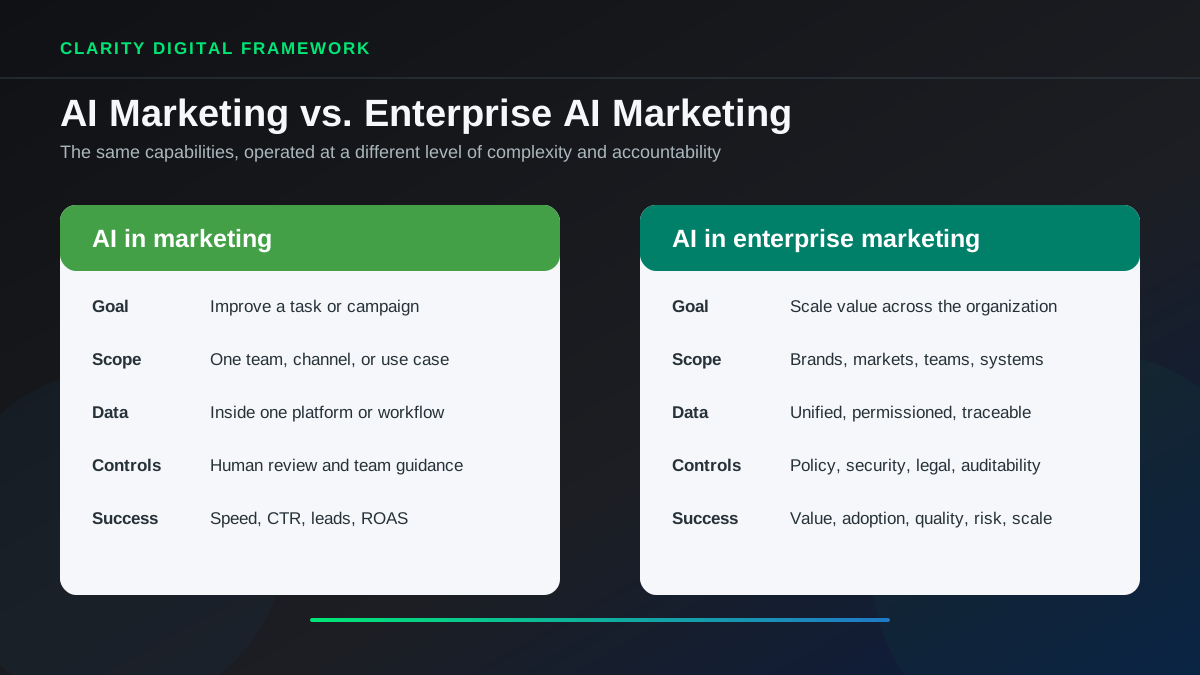
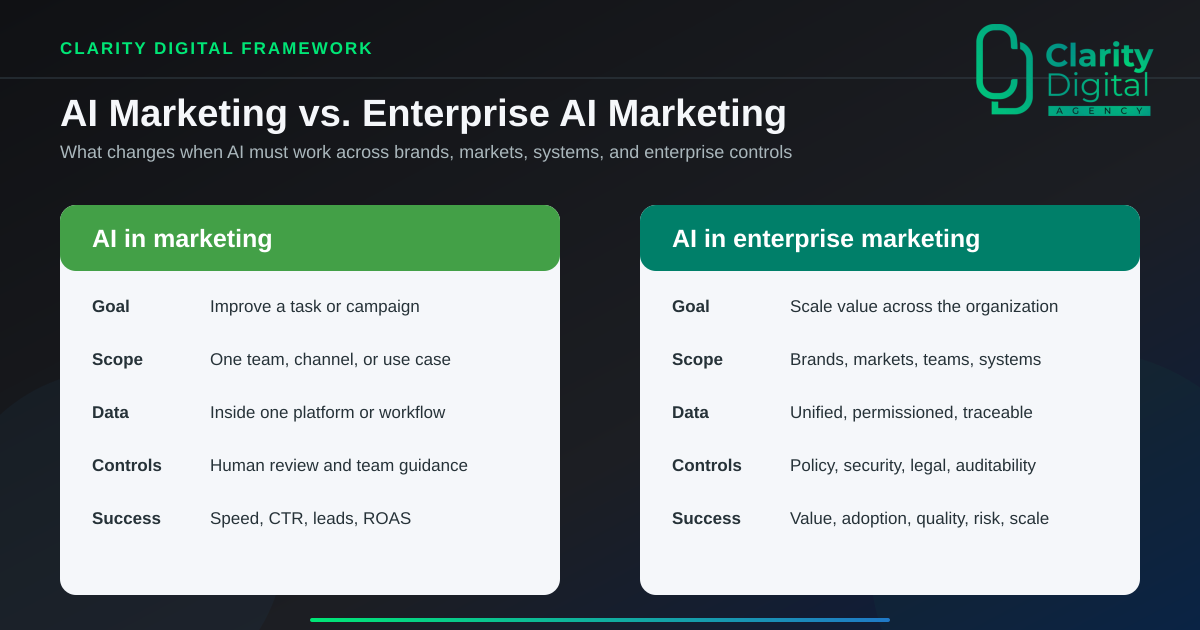
| Dimension | AI in marketing | AI in enterprise marketing |
|---|---|---|
| Primary goal | Make marketing more effective, efficient, personalized, or scalable | Create repeatable value across a complex organization while managing risk and standards |
| Scope | A marketer, team, campaign, or channel | Multiple brands, regions, business units, markets, channels, and shared services |
| Tools | AI assistants, ad automation, email AI, copy tools, analytics copilots | Governed AI platforms connected to CRM, CDP, DAM, CMS, PIM, analytics, identity, and workflows |
| Data | Campaign, web, CRM, and audience data used within one team or platform | Customer, product, sales, service, partner, consent, and operational data across systems |
| Governance | Team guidance and human review | Formal privacy, security, legal, accessibility, brand, vendor-risk, audit, and access standards |
| Content operations | Draft copy, images, posts, emails, and page variants | Generate localized, personalized, on-brand assets with approvals, rights, versions, and traceability |
| Measurement | Engagement, leads, CPA, ROAS, and conversion | Incremental revenue, pipeline quality, retention, margin, brand impact, adoption, risk, and scale |
| Operating model | Tool adoption and workflow improvement | Transformation across people, process, data, platforms, controls, and change management |
This is why enterprise adoption should begin with an AI marketing strategy, not a shopping list. The strategy defines where AI can create value, which decisions remain human, what data is required, and how proof will be measured.
AI in marketing: the five functional capabilities
IBM defines AI marketing as using capabilities such as data collection, data-driven analysis, natural language processing, and machine learning to deliver customer insights and automate critical marketing decisions. In practice, those capabilities appear in five functional forms.
1. Generative AI creates and transforms marketing assets
Generative AI produces copy, images, video concepts, emails, ad variants, social captions, SEO briefs, summaries, and translations. It can accelerate production, but enterprise value appears only when outputs stay grounded in approved facts, brand rules, rights, and review workflows.
2. Predictive AI estimates likely outcomes
Predictive systems score leads, forecast conversion, estimate churn, identify propensity to buy, and support budget allocation. Their usefulness depends on representative training data, stable definitions, and a clear process for monitoring drift.
3. Decisioning AI recommends or automates actions
Decisioning AI selects next-best actions, bid changes, personalization, send times, offers, and channel choices. The enterprise question is not merely whether the recommendation is accurate. It is whether the system has authority to act, within what limits, and with which exception path.
4. Conversational AI changes discovery and service
Conversational AI powers chatbots, internal search assistants, sales enablement, and customer-service interactions. Customer-facing systems need approved knowledge, disclosure where appropriate, escalation to a person, and monitoring for unsupported claims.
5. Orchestration AI connects work across systems
Orchestration AI coordinates data, tools, people, and channels. This is where enterprise AI becomes more than a collection of features. A useful workflow can retrieve approved product information, create a localized asset, route it through legal review, publish it through the CMS, and return performance data to the next decision cycle.
Free Visibility Audit
See how your site ranks across Google and AI search.
Technical SEO, AEO/GEO readiness, and competitive snapshot. No obligation.
What changes when marketing AI becomes enterprise AI?
Enterprise does not simply mean a larger budget or more users. It means the consequence of inconsistency is larger. A wrong claim can be copied across hundreds of pages. Uncontrolled customer data can move into a vendor model. A local market can publish an offer that conflicts with legal terms or inventory. Automation scales both good systems and bad ones.
The enterprise objective is therefore not another standalone AI application. It is a reliable operating workflow from insight to approved activation. That often requires thoughtful AI tools and integration work across the existing marketing technology stack rather than replacing every platform at once.
Data quality is especially important. Salesforce's 2026 State of Marketing findings identify siloed systems and poor data quality as leading barriers to AI-driven personalization. The lesson is direct: an enterprise cannot prompt its way around fragmented identity, inconsistent product data, missing consent, or unowned content.
The five layers of enterprise AI marketing
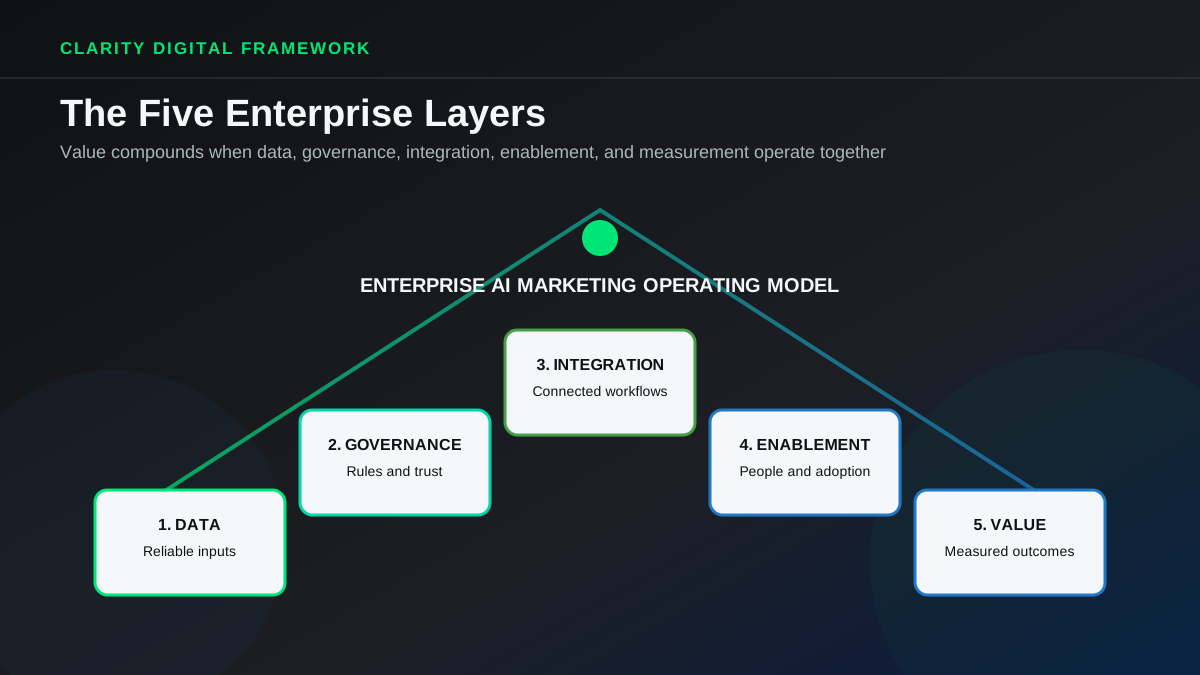
Layer 1: A reliable data foundation
AI depends on reliable inputs: customer profiles, product data, approved content, campaign history, consent status, sales outcomes, and service signals. Teams need named data owners, definitions, quality thresholds, and permission rules. If the inputs are inconsistent or siloed, AI scales inconsistency faster than it creates value.
Layer 2: Brand, risk, and content governance
Enterprise governance encodes approved messages, tone, claims, visual rules, accessibility, disclosures, and approval paths. IBM describes AI governance as the processes, standards, and guardrails that help ensure AI systems are safe and ethical. The NIST AI Risk Management Framework organizes this work around Govern, Map, Measure, and Manage.
A practical AI governance program for marketing turns those principles into approved-use policies, review tiers, vendor assessment, incident response, output logging, and decision rights. It should make responsible work easier, not create a legal bottleneck around every low-risk task.
Layer 3: Integration and workflow design
Enterprise AI must fit CRM, CDP, DAM, CMS, PIM, marketing automation, analytics, paid-media platforms, support systems, identity, and internal knowledge bases. The design question is where data enters, where the model acts, where a person approves, where the asset is stored, and how the outcome returns to measurement.
Layer 4: People, training, and change management
A governed platform without adoption is shelfware. Teams need role-specific instruction, examples from their own workflows, office hours, proficiency checks, and safe spaces to report failures. Effective AI readiness and training teaches judgment and decision rights, not only prompts.
Layer 5: Business value and continuous measurement
Time saved is useful, but it is not enough. Enterprise programs connect speed and quality to incremental revenue, pipeline, retention, margin, risk reduction, and adoption. They also monitor the model, vendor, data, and workflow because performance can change without a campaign manager changing a setting.
Practical example: healthcare or assisted-living marketing
At the team level, AI in marketing might mean using a language model to draft blog outlines, create Google Ads headlines, generate social captions, summarize call transcripts, and identify high-intent lead themes.
At the enterprise level, the organization may need a governed system that:
- Retrieves only approved clinical, service-line, location, availability, and pricing information.
- Produces localized ads, landing pages, email nurture streams, and call-center scripts for hundreds of communities or markets.
- Enforces rules around protected health information, substantiated claims, disclaimers, accessibility, and brand voice.
- Routes approved assets into the DAM, CMS, CRM, and marketing automation platform.
- Maintains source and approval trails from generation through publication.
- Measures impact from inquiry through tour, admission, retention, and lifetime value.
The first improves a marketer's output. The second redesigns a marketing operating system. When the organization needs a proprietary workflow, governed customer experience, or embedded AI capability that off-the-shelf tools cannot provide, AI product development can turn the operating model into a secure application rather than another manual chain of prompts.
From isolated pilots to an enterprise operating model
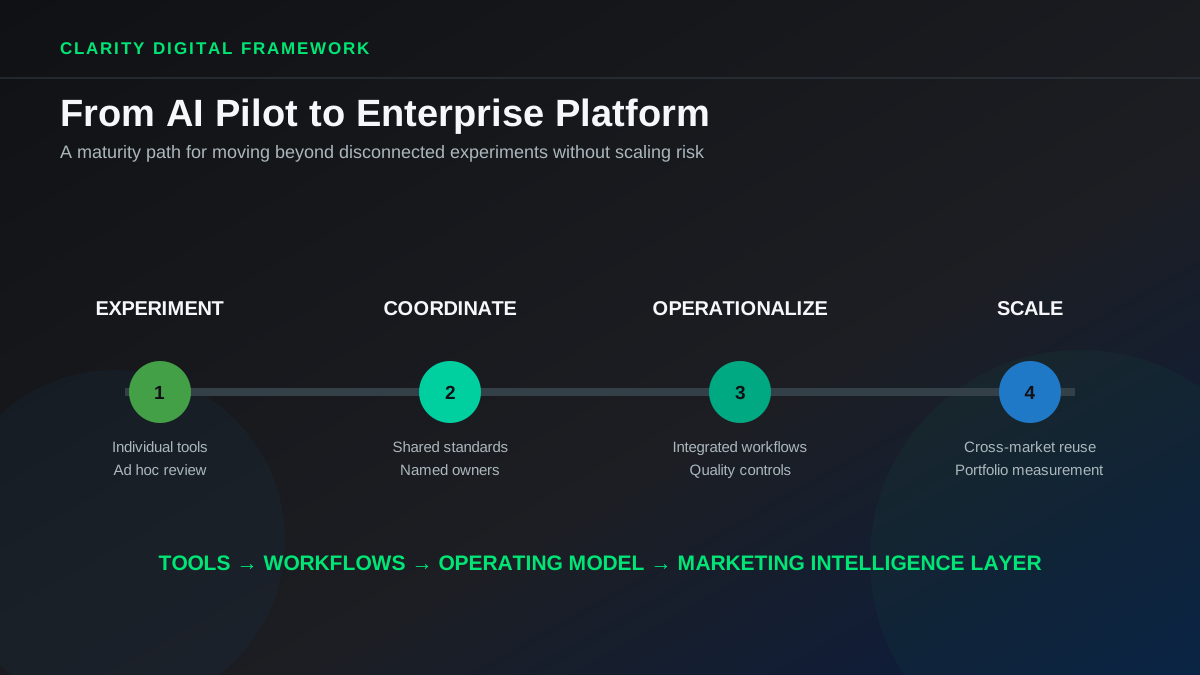
The common failure pattern is horizontal sprawl: many tools, many pilots, and no reusable system. The better path is vertical depth. Choose one workflow and build it end to end, including data access, prompt or model behavior, human decisions, output storage, approvals, activation, and measurement.
- Experiment: test the capability with non-sensitive data and a clear baseline.
- Coordinate: define owners, approved tools, review criteria, and shared patterns.
- Operationalize: integrate source systems, permissions, monitoring, and outcome measurement.
- Scale: reuse the governed pattern across brands, teams, markets, and adjacent workflows.
This sequence prevents the organization from scaling risk before it has proven value. It also makes tool selection easier because requirements come from the workflow rather than vendor demonstrations.
How should enterprise AI marketing be measured?
An enterprise scorecard should combine six categories. Reporting only speed encourages low-quality volume. Reporting only revenue can hide adoption and risk problems until they become expensive.
- Business value: incremental revenue, qualified pipeline, retention, margin, and cost per outcome.
- Quality: factual accuracy, brand compliance, approval pass rate, and rework.
- Velocity: cycle time, time to insight, localization time, and approved output per workflow.
- Adoption: active users, repeat use, workflow completion, and role-based proficiency.
- Risk: incidents, policy exceptions, unauthorized data use, and claim or rights violations.
- Scale: brands, markets, teams, channels, and workflows using the governed pattern.
The downloadable scorecard below provides a 25-point readiness assessment, integration checklist, KPI framework, and 90-day action plan that leadership can use to establish a baseline.
A practical 90-day enterprise AI marketing roadmap
Days 1 to 30: Map value, data, and risk
Inventory current AI use, including shadow tools. Choose two high-value, repeatable use cases. Name the owner, baseline, data sources, users, reviewers, prohibited inputs, and desired business outcome. Establish an initial governance forum and vendor review standard.
Days 31 to 60: Integrate and test one workflow
Connect approved sources, encode brand and compliance rules, establish role-based access, and run a controlled pilot. Compare quality, speed, and outcome against the baseline. Record where human judgment changed or rejected the output.
Days 61 to 90: Operationalize the strongest pattern
Train the relevant roles, document the workflow, publish decision rights, set monthly measurement, and scale only the strongest use case. Stop pilots that cannot prove value or cannot be governed. Use what the team learned to prioritize the next workflow.
The shift is strategic: from “Which AI tools should the team use?” to “Which marketing decisions, workflows, data assets, and customer experiences should AI improve, and what guardrails make that repeatable at enterprise scale?” Organizations ready to answer that question can contact Clarity Digital to assess the current state and build the roadmap.
Enterprise AI Marketing FAQ for Leaders Moving Beyond Pilots
When does AI marketing become enterprise AI marketing?
AI marketing becomes enterprise AI marketing when a use case must work across multiple teams, brands, markets, systems, data classes, or approval structures. The threshold is not company size or model size. It is the need for repeatable integration, formal governance, access control, traceability, adoption, and business-wide measurement.
What should an enterprise marketing team fix before buying more AI tools?
It should first define the workflow and outcome, identify approved data sources, assign owners, classify risk, establish human decision points, and set a baseline. Those requirements reveal whether an existing platform can do the job, an integration is needed, or a custom AI product is justified.
How does AI governance change enterprise content production?
Governance turns informal review into a consistent system. It defines which data can be used, which claims and sources are approved, what requires legal or subject-matter review, how rights and versions are tracked, who may publish, and how incidents are handled. The objective is faster compliant production with traceability, not blanket restriction.
How should enterprise AI connect to CRM, CDP, DAM, CMS, and marketing automation systems?
AI should retrieve the minimum approved data required, act within a documented workflow, route high-risk outputs through human approval, store final assets with source and version metadata, and return outcomes to analytics. Role-based access, logging, retention, and vendor offboarding should be designed before production access is granted.
Which marketing workflow is best for a first enterprise AI pilot?
The best first workflow is high-volume, repeatable, measurable, supported by reliable data, and moderate in risk. Examples include approved-content repurposing, localization with human review, campaign reporting narratives, internal knowledge search, or lead-summary assistance. Avoid starting with an autonomous customer-facing workflow that has unclear data or decision rights.
How can a CMO prove enterprise AI marketing ROI without relying on time-saved estimates?
Use a baseline or control and measure business value, quality, velocity, adoption, risk, and scale together. Depending on the workflow, proof may include incremental pipeline, conversion, retention, margin, approval pass rate, reduced rework, shorter cycle time, sustained active use, and fewer policy exceptions.
Should an enterprise build or buy its AI marketing capabilities?
Buy commodity capabilities when requirements are standard and vendor controls are adequate. Integrate when value depends on connecting approved internal data and existing systems. Build when the workflow, knowledge, customer experience, or competitive advantage is proprietary. Most enterprise programs use all three approaches within one governed architecture.
How long does it take to move from disconnected AI pilots to an enterprise marketing program?
A focused organization can establish the initial strategy, governance, inventory, and one controlled end-to-end workflow in 90 days. Scaling across brands or markets usually takes longer because data ownership, integrations, legal review, training, and change management must mature with the technology. The goal is not maximum speed. It is repeatable value without scaling avoidable risk.
Your Next Step
Two ways to turn this into results.
Pick the path that fits where you are right now. We will meet you there.
Free Executive Resource
Download the Enterprise AI Marketing Readiness Scorecard
Assess 25 readiness signals across strategy, data, integration, governance, content operations, adoption, and measurement. Includes an enterprise systems checklist and 90-day action plan.