
Your AI Marketing Strategy Isn’t Wrong. It’s Generic.
AI & MarketingThe short answer: AI-generated marketing strategies often fail because a general-purpose model can assemble familiar tactics without knowing which choices fit the company. An executable strategy needs proprietary data, commercial priorities, budget and staffing limits, channel evidence, explicit tradeoffs, accountable owners, and a measurement model. Without those inputs, AI produces a strategy-shaped document: polished, plausible, and potentially expensive to follow.
- ChatGPT is useful for research synthesis, ideation, scenarios, first drafts, and finding questions a team should investigate.
- A real strategy is a ranked set of choices, including what the company will not do.
- Published research found that ChatGPT-generated social strategies could be promising but also proposed unrealistic budgets and workloads.
- Better prompts help, but useful strategy requires first-party data, operating constraints, expert review, and decision ownership.
- Before acting, apply the five-question test: objective, evidence, tradeoff, owner, and 30, 60, or 90-day proof.
The convincing wrong answer
ChatGPT can create a marketing strategy in 30 seconds. That does not mean it has created a strategy the business should follow.
A marketing leader can enter, “Create a 12-month marketing plan for our company,” and receive a confident response covering SEO, paid media, social media, influencer partnerships, email nurture, thought leadership, webinars, video, personalization, account-based marketing, dashboards, and a detailed content calendar.
The plan sounds comprehensive. That is precisely the problem.
In our earlier look at why AI strategies often fail to create business value, the broader issue was shallow adoption. One of its most common expressions is more specific: companies mistake generic AI output for an executable strategy.
A strategy-shaped document is not a strategy
A real strategy is not a long list of good ideas. It is a set of choices about what the company will prioritize, what it will stop or defer, what it can afford, what its team can execute, and how it will know whether the bet is working.
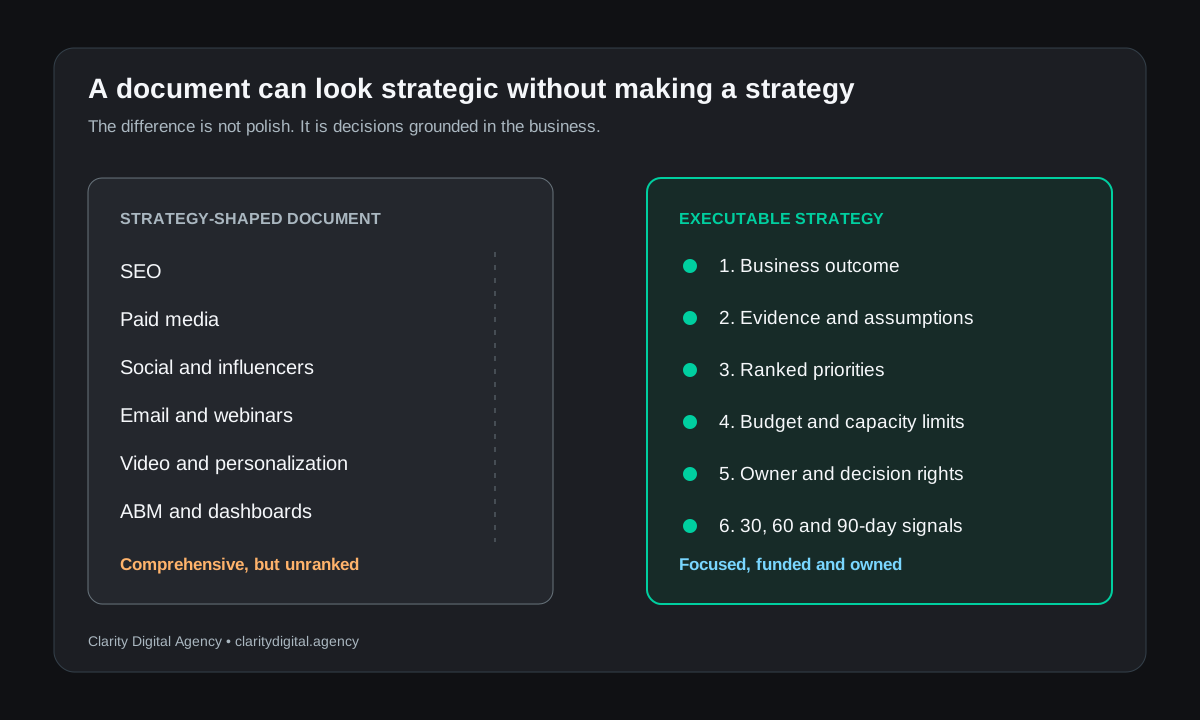
An executable plan needs a business objective, defined audience and buying committee, competitive position, budget, staffing and technology limits, existing performance data, ranked priorities, explicit tradeoffs, accountable ownership, and measurement tied to business outcomes.
AI is excellent at assembling familiar tactics. Strategy is deciding which tactics deserve scarce money, time, and organizational attention. That is why a practical AI marketing strategy engagement begins with the operating environment, not a prompt template.
Strategy Consultation
Want to apply this to your 2026 plan?
Book a 30-minute call with Al Sefati to pressure-test your SEO, AEO, and AI strategy.
What the research found: polished, expensive, impractical
This is not a theoretical concern. In the peer-reviewed 2025 study “Strategising with generative AI: Productivity gains in social media marketing”, Joel Gastmann and Marco Bastos interviewed social media professionals and evaluated ChatGPT-generated strategies for two real, anonymized organizations.
For a sustainable-fashion company, the generated six-month project cost reached approximately €101,460, including labor. The plan suggested up to four weekly posts per platform and work from Monday through Sunday, which the researchers found unrealistic for one social media manager. For a chemical corporation, the six-month budget ranged from €151,800 to €292,200, misaligned with the company’s relatively small marketing team and available budget.
The researchers did not conclude that AI was useless. They found value in idea generation and productivity. But they also found overly optimistic posting frequencies, unrealistic budget assumptions, and recommendations that were not always directly actionable.
A six-figure plan may be reasonable for some organizations. The issue is recommending it without understanding cash flow, market maturity, channel economics, team capacity, or performance benchmarks. The context matters even more when budgets are tight. Gartner reported that 2025 marketing budgets held at 7.7% of company revenue, unchanged from 2024.
Why generic AI strategy goes wrong
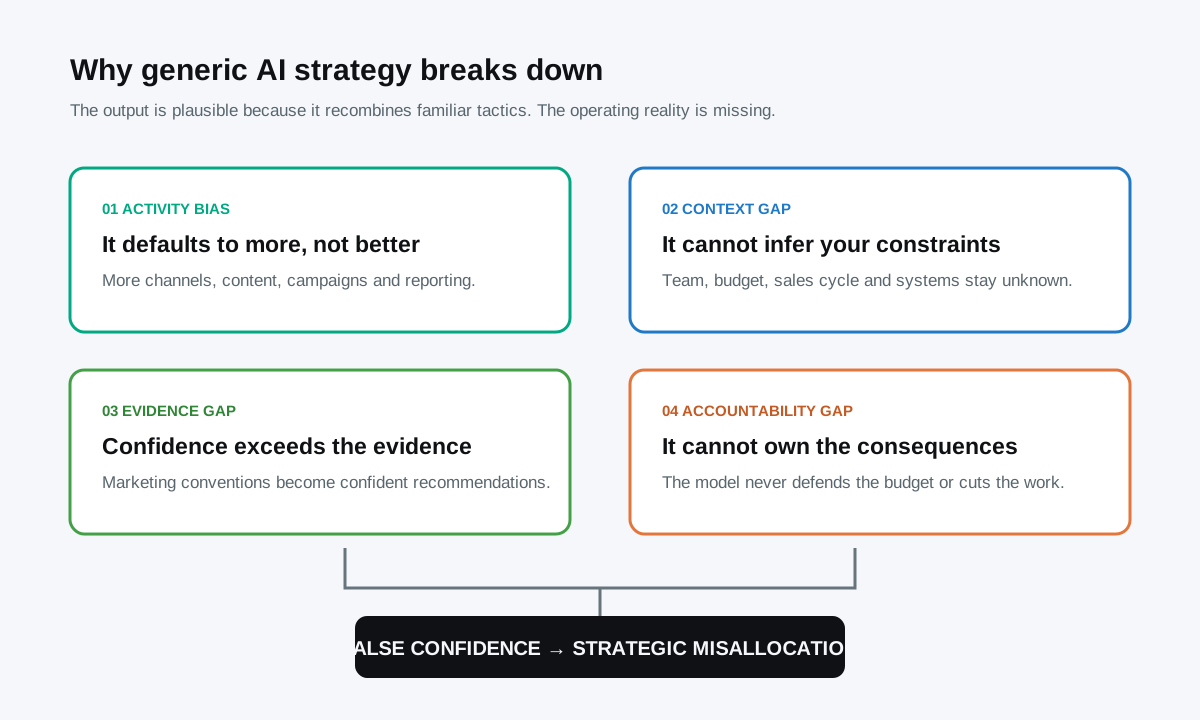
1. It defaults to more, not better
General-purpose models commonly recommend more content, more channels, more campaigns, and more reporting. They are not naturally accountable for prioritization or opportunity cost. A useful plan must rank initiatives and explain why one receives resources before another.
2. It has no native understanding of the company’s constraints
Unless the organization supplies real inputs, the model does not know whether there is one marketer or 20, a $10,000 test budget or a $1 million media budget, a six-week sales cycle or a 12-month enterprise buying process. It also cannot see the backlog, technical debt, approval delays, or team politics that shape execution.
3. It sounds more certain than its evidence warrants
An LLM can convert broad conventions into polished recommendations even when it lacks verified, current, company-specific evidence. That confidence should never substitute for customer research, channel performance, sales insights, competitive analysis, or validated demand.
4. It cannot own the consequences
The model does not attend the executive meeting, defend the budget, explain missed pipeline targets, or decide which initiative to kill when the team is over capacity. Those decisions need accountable leadership, whether from an internal CMO or an experienced Fractional CMO.
The hidden cost is false confidence
The danger is not merely generic copy. It is wasting a quarter on an initiative stack no one can execute.
- Hypothetical B2B example: a lean team launches LinkedIn thought leadership, paid search, SEO, webinars, nurture automation, video, and ABM at once, then discovers no one owns sales follow-up or attribution.
- Hypothetical local-business example: the company spreads effort across five social platforms while neglecting Google Business Profile, high-intent search ads, call tracking, and review generation.
- Hypothetical enterprise example: leaders invest in content volume when the actual constraint is weak positioning, disconnected CRM attribution, poor conversion paths, or slow sales follow-up.
These are examples, not client case studies. The pattern is familiar: activity rises, ownership blurs, and measurement arrives too late. Integrated marketing analytics and reporting can expose that problem, but reporting cannot rescue a strategy that never established priorities.
What AI should do instead
AI should operate as a high-leverage co-pilot under human strategic direction. It can compress the path from question to hypothesis. It should not replace evidence, prioritization, or executive judgment.
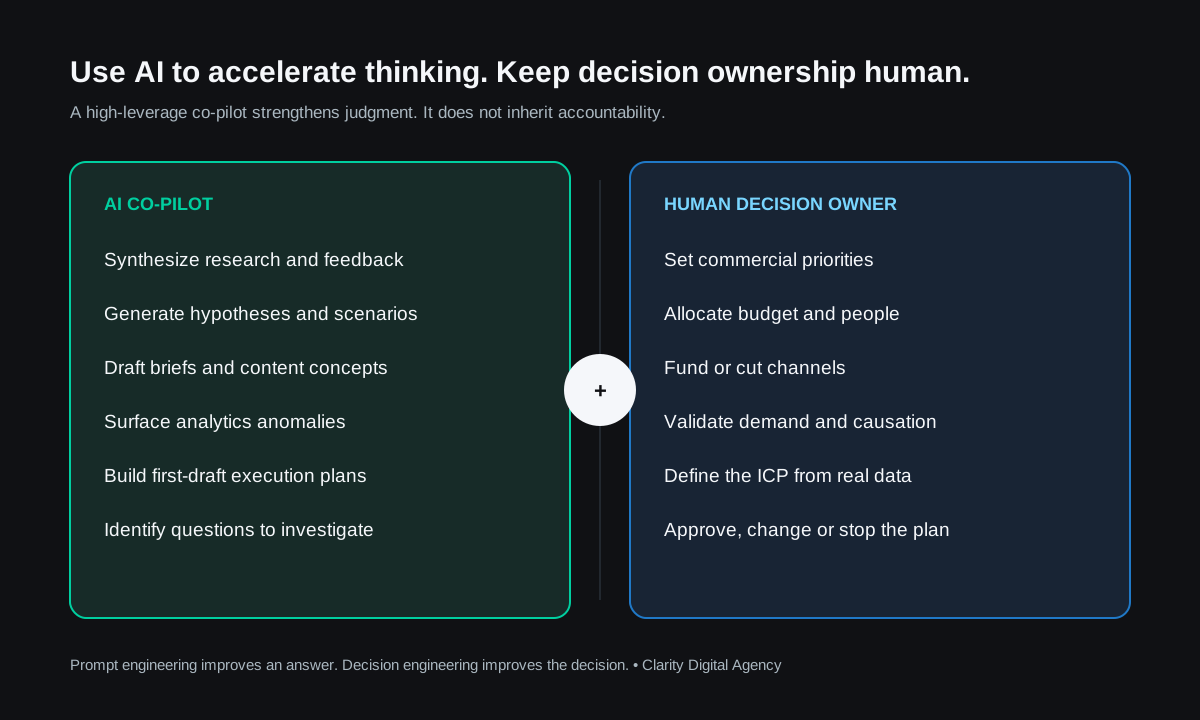
| Use AI for | Do not delegate to AI alone |
|---|---|
| Synthesizing research and customer feedback | Setting business priorities |
| Generating hypotheses and scenarios | Determining budget allocation |
| Drafting briefs and content concepts | Choosing which channels to fund or cut |
| Summarizing analytics and anomalies | Interpreting causation and commercial impact |
| Producing first-draft execution plans | Approving the plan without feasibility review |
This division also needs controls. A practical AI governance program defines approved tools and data, review tiers, disclosure, vendor risk, auditability, and who may approve or publish AI-influenced work.
A better prompt is not enough
Prompt engineering can improve an answer. Decision engineering improves the decision.
The real upgrade is a governed process that gives AI structured decision inputs: first-party performance data, CRM and pipeline outcomes, customer interviews, sales-call insights, competitive research, budget and capacity limits, approved positioning and claims, channel benchmarks, and a decision-maker who can say no.
That context may redirect the plan. A company asking for more content might actually need stronger SEO, AEO, and GEO foundations. A broad awareness plan might lose to a focused paid search program built around high-intent demand. The right strategy is not the one with the most tactics. It is the one that best matches the evidence and the constraint.
The five-question test for an AI marketing recommendation
Before the business acts on an AI-generated recommendation, ask:
- What specific business objective does this support?
- What evidence, internal data, or assumptions is it based on?
- What will the organization stop doing to fund and staff it?
- Who owns execution, and do they have the capacity?
- What would show within 30, 60, or 90 days that it is working or should change?
If AI cannot answer those questions using real information from the business, it has not produced a strategy. It has produced a plausible draft.
Questions marketing leaders ask about AI-generated strategy
Can ChatGPT create a marketing strategy?
ChatGPT can create a useful first draft, research synthesis, scenario, or tactical plan. It cannot independently validate company data, choose acceptable tradeoffs, confirm team capacity, or own the commercial result. Human leaders must ground and approve the strategy.
Why do AI-generated marketing plans feel generic?
They are usually generated from broad patterns rather than the company’s proprietary performance data, customer evidence, competitive position, budget, staffing, systems, sales cycle, and decision rights. The output reflects common tactics because the distinctive inputs are missing.
What information should a company give AI before asking for a marketing plan?
Provide the business objective, audience and buying process, first-party performance and pipeline data, budget, team capacity, technology constraints, approved positioning, competitive evidence, channel benchmarks, risk rules, and the decisions the model may recommend but not make.
Does AI governance make marketing strategy slower?
Well-designed governance should make responsible work faster. It predefines approved tools, data rules, review tiers, claims, disclosures, and decision rights so teams do not renegotiate risk for every task.
When should a Fractional CMO review an AI marketing strategy?
A Fractional CMO is valuable when the company lacks senior marketing leadership, has competing channel priorities, needs cross-functional budget decisions, or requires an accountable operator to convert recommendations into a plan the team can execute.
Build an AI-enabled plan the team can execute
If an AI roadmap is producing more activity than clarity, Clarity Digital can assess the strategy, data, workflow, governance, and measurement gaps before they become an expensive operating model. Explore AI Marketing Strategy, Fractional CMO leadership, or contact Clarity Digital to pressure-test the current plan.
Sources
- Gastmann, Joel and Marco Bastos. “Strategising with generative AI: Productivity gains in social media marketing.” Journal of Marketing Communications, 2025.
- Gartner. “Gartner 2025 CMO Spend Survey Reveals Marketing Budgets Have Flatlined at 7.7% of Overall Company Revenue.” May 12, 2025.
Your Next Step
Two ways to turn this into results.
Pick the path that fits where you are right now. We will meet you there.
Free Executive Worksheet
Download the Five-Question AI Marketing Strategy Test
Pressure-test any AI-generated recommendation for objective, evidence, tradeoffs, ownership, capacity, and measurable proof before approving it.