
AI Content Only Works When Strategy Leads
AI & MarketingThe short answer: AI content works best when strategy leads production. Marketing teams should give AI a defined audience, a business objective, and original evidence, then require human review before publication. SEO and answer engine optimization (AEO) depend on helpful, accurate, accessible content, not on how quickly a model can generate words.
TL;DR for marketing leaders
- Use first-party research and expert insight to give readers something competitors cannot reproduce with the same prompt.
- Keep an accountable human editor responsible for facts, brand voice, privacy, and approval.
- Answer a real user question before optimizing titles, headings, links, and structured data.
- Measure qualified engagement and business outcomes, not published word count.
What is a strategy-first AI content approach?
A strategy-first approach uses generative AI to support an editorial plan rather than decide the plan. Leaders establish who the content serves, which decision it helps readers make, what evidence supports it, and how success will be measured. AI can organize research, identify unanswered questions, and produce a first draft within those boundaries.
The debate about AI-generated content often becomes a false choice between banning the technology and publishing at unlimited scale. Neither is a strategy. The useful question is whether the finished page adds value that a generic model response does not. As explained in why generic AI marketing strategies fail, a polished output is not a substitute for business context and accountable judgment.

1. Ground AI content in original insights and proprietary data
Language models can summarize information that many competitors already have. Repeating that information does little to distinguish a brand. Original value can come from customer interviews, anonymized first-party analytics, documented experiments, expert explanations, and observations from actual implementation work.
The goal is not to claim that every sentence must be unprecedented. Established definitions can be useful. The goal is to add a perspective, example, or evidence base that helps a reader understand the subject better than another generic summary would.
Hypothetical example: a healthcare provider explaining outpatient scheduling could use approved staff interviews to describe common patient questions and how appointments are handled. AI may help organize the explanation, but it should not invent clinical claims, patient testimonials, or performance statistics. Sensitive information must stay out of unapproved tools.
A practical AI marketing strategy starts by identifying which company-owned insights can be used safely and which require additional research or permission.
Free Visibility Audit
See how your site ranks across Google and AI search.
Technical SEO, AEO/GEO readiness, and competitive snapshot. No obligation.
2. Make human-in-the-loop editing a publishing requirement
Human-in-the-loop editing means an accountable person reviews AI-assisted work before it reaches customers. That editor checks the claims against sources, corrects omissions, refines the voice, verifies links, and confirms that the content fulfills its purpose. A quick scan for grammatical errors is not enough.
- Facts: check names, dates, numbers, quotations, and citations against the original source.
- Experience: distinguish actual client work from hypothetical examples.
- Risk: review confidentiality, copyright, regulated claims, and brand safety.
- Ownership: record the reviewer and who approves publication.
These controls belong in an AI governance framework, with approved tools, escalation paths, and review intensity appropriate to the risk. AI can assist the checks, but it cannot replace the person responsible for the final decision.
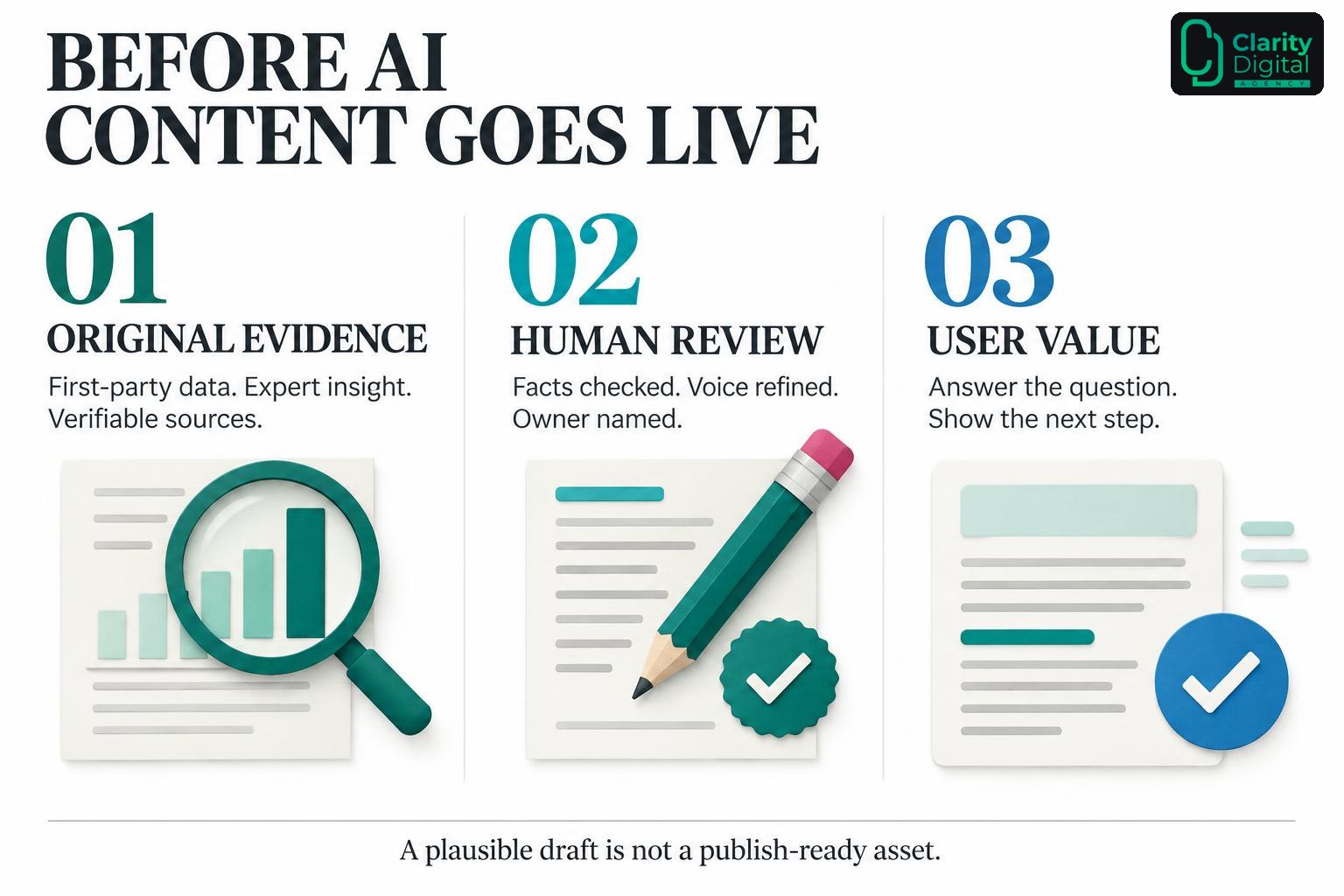
3. Optimize for user intent before SEO and AEO signals
Useful content answers the reader’s question directly, explains important qualifications, and provides a sensible next step. Search optimization makes that answer easier to find and understand. It does not rescue a page that has no meaningful substance.
Google’s guidance on generative AI content emphasizes accuracy, quality, and relevance. Its scaled content abuse policy addresses large amounts of low-value content created primarily to manipulate rankings, regardless of whether AI or humans produce it.
For SEO, AEO, and generative engine optimization (GEO), use descriptive headings, concise answer passages, transparent authorship, contextual internal links, and structured data that accurately matches the visible page. Keep important explanations accessible as text rather than hiding them only inside images or downloads.
Google’s AI features guidance says there is no special schema required for AI Overviews or AI Mode. Good content and valid markup do not guarantee a ranking, a ChatGPT recommendation, or an LLM citation.
A practical AI content publishing workflow
- Brief: define the audience question, business goal, intended next action, and editorial owner.
- Evidence: collect approved original insight and reliable sources before generating copy.
- Draft: ask AI to work within the brief and flag missing information rather than fabricate it.
- Review: verify facts, assess risk, and edit for clarity and brand voice.
- Publish: check the title, description, canonical URL, links, image descriptions, and relevant schema.
- Measure and refresh: track qualified visits, inquiries, conversions, and citation observations; revisit outdated claims.
Assign an owner to every stage. A Fractional CMO can align the workflow with commercial priorities, staffing, and budget rather than allowing a content calendar to become the strategy.
Playing devil’s advocate: does review erase AI’s efficiency?
The objection is reasonable: original research and serious editing cost time. If the only metric is the number of pages published, a governed workflow may look slower than mass generation. That comparison ignores rework, factual corrections, brand risk, and content that never helps a buyer.
AI can still reduce repetitive work through outline creation, transcript synthesis, content repurposing, and draft organization. The sensible test is whether the workflow saves effort while preserving quality. Start with a limited pilot, record drafting and editing time, and evaluate business results before scaling. No universal ROI improvement should be assumed.
How Clarity Digital helps marketing teams
Clarity Digital connects strategy, governance, and execution: AI marketing strategy defines the use cases and evidence; AI governance establishes guardrails and approval processes; and SEO, AEO, and GEO services improve content structure and search visibility. Fractional CMO leadership brings those decisions back to business priorities.
Talk with Clarity Digital about an AI content workflow that supports growth without trading credibility for volume.
Frequently asked questions about AI content strategy
Does Google penalize AI-generated content?
Google does not ban content simply because AI helped produce it. Its guidance focuses on useful, accurate, high-quality content. Generating many low-value pages primarily to manipulate rankings can violate its scaled content abuse policy, whether the pages are produced by AI or humans.
What makes AI content useful for SEO and AEO?
Useful AI-assisted content answers a specific audience question, adds original evidence or expert perspective, cites reliable sources, and passes human review. Clear headings, concise answers, accurate metadata, contextual internal links, and accessible text help search and answer systems understand the page.
What is human-in-the-loop editing for AI content?
Human-in-the-loop editing is a workflow in which a named editor verifies facts, reviews risks, refines the brand voice, and approves AI-assisted content before publication. It makes a person accountable for the final content rather than relying on the model’s confidence.
Can FAQ schema guarantee ChatGPT or AI Overview citations?
No. FAQ schema can describe questions and answers that are visible on a page, but it cannot guarantee rankings or AI citations. Google does not require special AI markup, and its FAQ rich results are generally limited to well-known authoritative government and health websites.
How should a marketing team measure AI content success?
Measure qualified organic traffic, meaningful engagement, inquiries, conversions, and the time required to produce and maintain approved content. Monitor AI citations where observable, but do not confuse content volume or isolated mentions with business impact.
Before the next AI draft goes live
Use a consistent publishing check rather than a subjective “looks good.” The downloadable checklist covers the strategy brief, original evidence, factual review, privacy and brand controls, SEO and AEO readiness, and final sign-off. Enter your details below to get the branded one-page PDF.
Your Next Step
Two ways to turn this into results.
Pick the path that fits where you are right now. We will meet you there.
Free one-page publishing checklist
Turn AI drafts into publish-ready content
A practical sign-off sheet for original evidence, human review, privacy, SEO and AEO readiness, and measurement. Enter your details to download the branded PDF.