
Google Merchant Center Product Feed SEO: How to Prepare for AI Shopping in 2026
EcommerceGoogle Merchant Center Product Feed SEO: How to Prepare for AI Shopping in 2026
The direct answer: Google Merchant Center product feeds should be managed as a core ecommerce SEO asset, not just an advertising upload. Accurate prices, availability, variant details, and product descriptions help Google understand what a retailer actually sells. The feed, the product detail page, and its structured data should describe the same offer without contradictory facts.
The opportunity is bigger than fixing a rejected Shopping ad. Google’s AI shopping experiences combine conversational discovery with structured product information. A retailer that invests in persuasive copy while leaving its underlying catalog inconsistent is solving only part of the discovery problem.
Why Google Merchant Center product feeds matter beyond Shopping ads in 2026
Merchant Center provides structured product information that can support both paid campaigns and unpaid product discovery. A feed is therefore part of the retailer’s search infrastructure. It should not sit in an isolated advertising workflow while the SEO team manages an unrelated version of the same catalog.
Google describes its AI shopping experience as powered by the Shopping Graph. In its overview of AI Mode shopping, Google explains how product information supports visual product discovery and buying decisions. Merchant Center is an important way for retailers to submit their catalog, but it is not the Shopping Graph’s only source of information.
Product feeds can support Shopping ads, retail Performance Max campaigns, and product-feed-enabled Demand Gen campaigns. Product information may also support eligible experiences across Search, Images, Lens, and AI shopping. Each surface has its own requirements. A submitted product does not automatically appear everywhere, and a feed does not replace a crawlable, useful website.
For ecommerce and retail marketing, the strategic change is straightforward: catalog quality belongs in the same conversation as technical SEO, merchandising, conversion rate optimization, and paid-media efficiency. The source data shapes what the platform can understand before a shopper ever clicks.
Free Visibility Audit
See how your site ranks across Google and AI search.
Technical SEO, AEO/GEO readiness, and competitive snapshot. No obligation.
How to audit Merchant Center feed and product-page consistency without missing variants
A useful audit compares the exact product and offer submitted to Google with the exact landing page a shopper receives. Checking the category page, the default parent product, or an administrator’s logged-in view is not enough. The relevant comparison is the selected variant, target market, currency, and price available to the shopper.
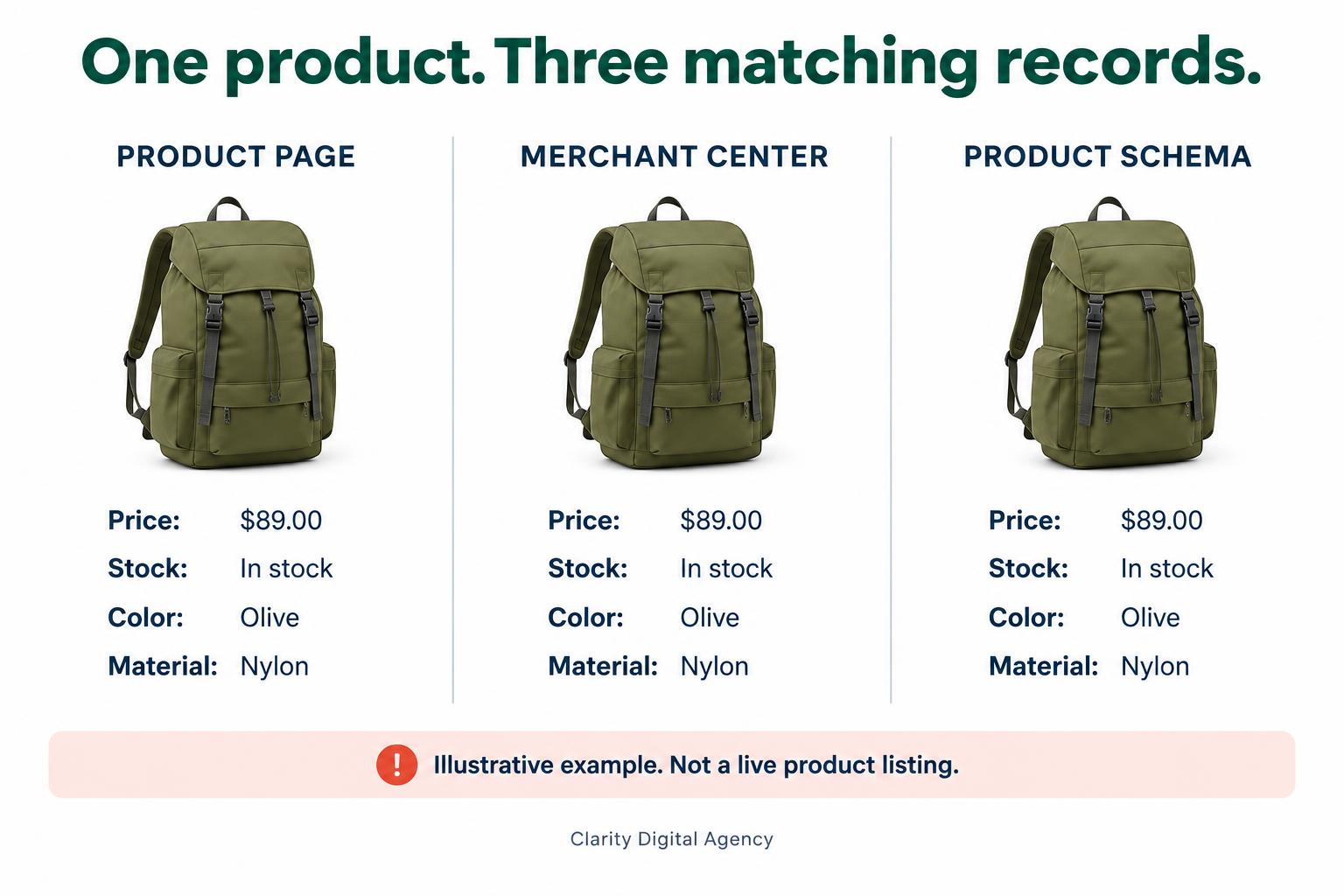
Which product facts should the feed consistency audit compare first?
Start with price, currency, availability, product identity, variant selection, and the landing URL. Then compare identifiers, titles, materials, dimensions, images, shipping, and return information where applicable. Titles do not need identical wording in every system, but they must accurately identify the same product without conflicting specifications or promotional claims.
- Price and sale timing: match the advertised offer, currency, and active promotion. Check scheduled sales, expired discounts, and stale cached prices.
- Availability: use the correct supported status for the selected offer. Distinguish in-stock, out-of-stock, preorder, and backorder conditions.
- Variant identity: confirm that the feed URL opens the intended color, size, quantity, or configuration rather than a different default.
- Product identifiers: use authentic brand, GTIN, and MPN information where applicable. Never invent identifiers to make a validation warning disappear.
- Market and fulfillment: check that currency, shipping coverage, costs, and return terms agree for the intended country.
- Page accessibility: verify that the landing page works for a signed-out shopper and is not dependent on a private session.
Google’s guidance on mismatched product prices documents the requirement to resolve discrepancies between submitted data and the website. Inconsistencies can trigger product issues and disapprovals. They are a compliance and customer-experience problem, not merely a missed keyword opportunity.
Two stronger claims should not be repeated as established fact: that a single mismatch makes an AI system stop trusting the entire product, or that Google is suspending stores more aggressively than last year. Those statements require evidence beyond vendor commentary. Correcting documented mismatches is worthwhile without inventing a hidden AI trust penalty or a year-over-year enforcement statistic.
Which Merchant Center product attributes support longer conversational shopping questions?
AI-assisted shoppers can ask for several constraints at once. A query might describe the intended activity, size, material, budget, delivery destination, and a compatibility requirement. A short title with a few generic keywords will not supply all the information needed to evaluate that request.
In its May 2026 analysis of AI Mode use in the United States, Google reported that the average AI Mode search was triple the length of a traditional Search query. That observation concerns search behavior. It does not establish that longer feed titles rank better or that every shopping query follows the same pattern.
The practical response is verified product detail, not keyword stuffing. A hypothetical backpack listing could explain capacity, dimensions, actual material, weight, compartment layout, intended use, and care instructions. If the manufacturer only claims water resistance, the feed and page should not upgrade that claim to waterproof.
How should ecommerce teams enrich product data without inventing new feed fields?
Use Google’s supported attributes and follow the rules for the product category and target country. Some details belong in the title or description, others in dedicated attributes, and some in product-detail fields or Merchant Center shipping and return settings. A field that is optional for one category can be required for another. Useful content still needs the correct data format.
- Titles: name the brand, product type, model, and distinguishing variant naturally, where relevant. Do not add unrelated claims or repetitive keywords.
- Descriptions: explain the actual product and its verified use cases. Avoid unsupported health, safety, sustainability, or performance claims.
- Specifications: provide applicable material, color, size, dimensions, compatibility, and other supported product details.
- Images: show the correct product and variant clearly. Additional views should help buyers inspect the item, not obscure it with promotional graphics.
- Policies: keep shipping and return information current and consistent across account settings and the website.
Google’s January announcement also described new Merchant Center attributes intended for conversational commerce. Teams should verify the current product data specification and account availability before implementing a field described by a feed vendor. An announcement, a beta feature, and a supported field in a specific account are not interchangeable.
How Product and Offer structured data should align with the Merchant Center feed
Product structured data gives search engines a machine-readable description of the product on a page. Offer data describes commercial terms such as price, currency, and availability. These records should reinforce the visible content rather than present a different offer to the crawler.
Google’s merchant listing structured-data documentation explains the supported properties and eligibility requirements. A reliable implementation uses the appropriate product identity, images, offer URL, currency, price, and availability, along with other applicable properties. Variant-heavy catalogs need special attention to the relationship between the selected offer and the markup.
What does matching Product schema mean for a retailer with changing inventory?
It means the markup describes the same current product and offer as the page and feed. If a sale ends or a variant sells out, all three should update from a coordinated source. Matching does not require every text field to be an identical string, but price, currency, availability, identifiers, and product characteristics must not contradict each other.
Passing a structured-data test confirms that the tested markup can be interpreted under that tool’s rules. It does not prove that every variant, country, or cached page is correct. Sample both the rendered page and submitted feed, validate relevant markup, and inspect real product issues in Merchant Center.
There is no special “AI shopping schema” that guarantees selection. Google’s guidance for AI Overviews and AI Mode states that existing SEO practices remain relevant and that no special schema or new AI text files are required. Accurate Product data supports the underlying product understanding; it does not buy a recommendation.
What Universal Commerce Protocol and Business Agent change for eligible retailers
On January 11, 2026, Google announced Universal Commerce Protocol and new agentic commerce tools. UCP is an open standard for interaction across the shopping journey, including discovery, buying, and post-purchase support. It is a commerce integration standard, not a replacement for a product feed or an SEO ranking factor.
The announcement said UCP would soon power checkout on eligible product listings in AI Mode and the Gemini app, initially involving eligible U.S. retailers. That is more precise than saying all AI agents have been able to check out from all Merchant Center stores since January. Access depends on the rollout, merchant eligibility, supported market, and integration.
Google also introduced Business Agent as a way for shoppers to chat with participating brands directly on Search. Its Business Agent documentation describes eligibility and setup. Submitting a feed alone does not automatically switch on a brand agent.
The strategic implication is operational. As discovery moves closer to a transaction, incomplete fulfillment terms and stale inventory become more consequential. Retailers should verify product truth, ownership, and commerce readiness before adding an agent experience that amplifies inconsistent information.
A practical workflow for improving product feed SEO before expanding AI shopping features
The following sequence is a recommended operating process, not a forecast of traffic or revenue. Start with high-value products and the patterns most likely to affect many offers, then expand coverage across the catalog.
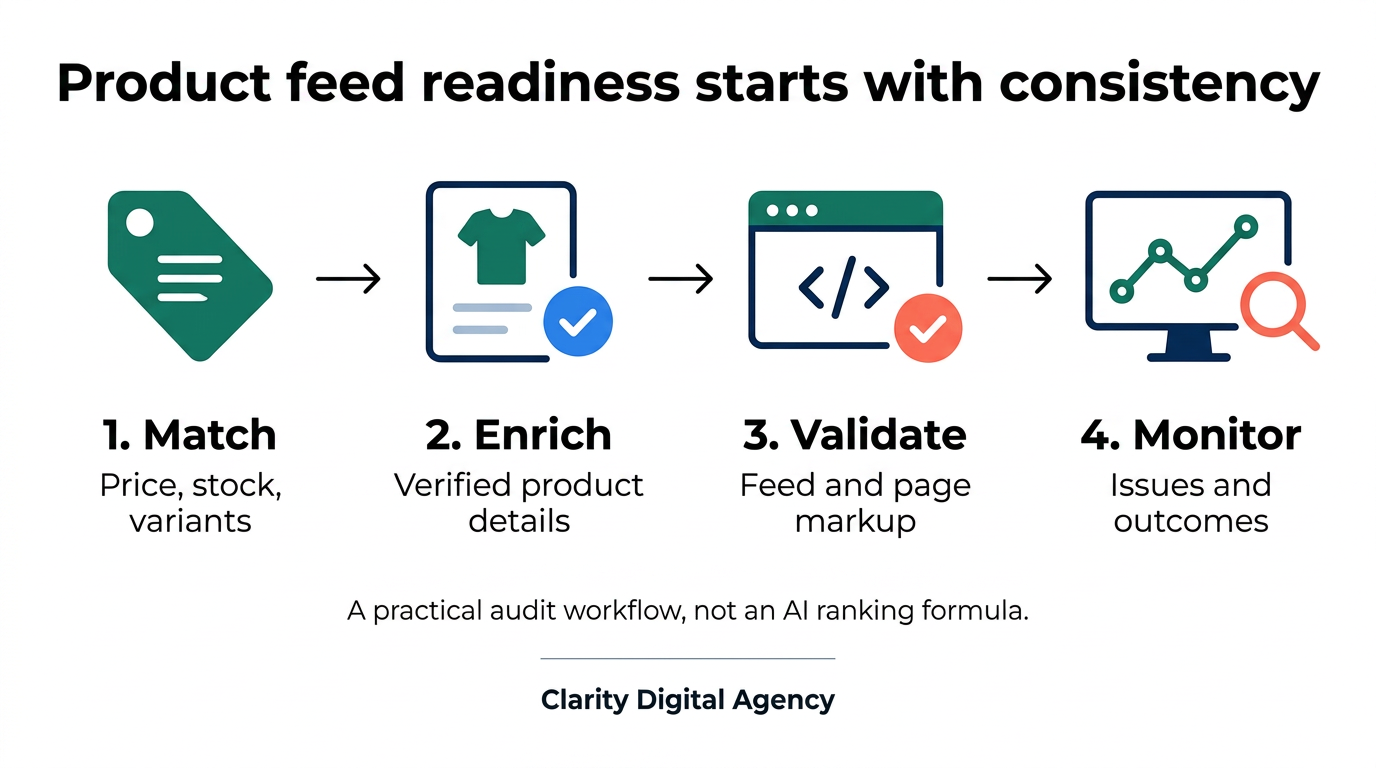
Step 1: establish the source of truth and record a dated baseline
Identify where product identity, pricing, inventory, and policy data originate. Record the feed export time, landing URL, selected variant, target country, and observed values. Include products with active promotions, frequent stock changes, and known Merchant Center issues.
Step 2: correct systemic mismatches before writing more product copy
Investigate synchronization delays, sale scheduling, caching, localization, and variant URL behavior. Fix the shared mechanism rather than correcting one item manually while hundreds of sibling products keep diverging. Assign an owner for each root cause and preserve evidence of the retest.
Step 3: enrich useful details and validate the product template
Improve verified descriptions and applicable attributes. Check Product and Offer markup across representative product types. Validate the feed rules, page rendering, and shopper experience together so an improvement in one system does not introduce a contradiction in another.
Step 4: monitor catalog health alongside qualified traffic and sales
Review recurring issues, update delays, eligible offers, free-listing performance, paid-campaign results, and landing-page conversion. Recheck after theme changes, new feed integrations, major promotions, and fulfillment-policy changes. The monitoring cadence should reflect how often the catalog changes.
How to measure Merchant Center SEO and AI shopping progress without false precision
Separate three questions: is the product data correct, is the offer eligible, and is the business seeing useful commercial outcomes? A feed can become healthier before traffic changes. A campaign can grow because of budget or bidding changes rather than because of richer descriptions.
- Catalog health: issue counts, affected offers, mismatch recurrence, and the time between a source update and its appearance in the feed and page.
- Discovery and engagement: available Merchant Center free-listing and ad reports, relevant Search Console data, and dated observations of selected shopping queries.
- Business value: qualified product visits, add-to-cart behavior, completed purchases, returns, and profitability where measurable.
AI query samples can help identify whether product facts are being represented accurately. They do not establish universal AI market share. Record the query, date, market, platform, and cited or displayed product, and avoid attributing every change to a feed edit.
The original newsletter correctly warned that much commentary comes from feed-tool vendors. Vendor experiments can be useful, but commercial interest, sample selection, and measurement limitations matter. Traffic claims and ranking promises should be evaluated separately from the documented need for accurate product data.
Questions ecommerce leaders ask about Merchant Center feeds, SEO, AEO, and GEO
Is Google Merchant Center only useful for paid Shopping campaigns?
No. Merchant Center can support unpaid product listings as well as eligible advertising campaigns and shopping experiences. Product data is therefore relevant to organic ecommerce discovery, not just media buying. Appearance on any particular surface still depends on that surface’s requirements and Google’s selection.
Does a Merchant Center feed replace ecommerce SEO?
No. A feed complements the website. Product pages still need to be accessible, useful, accurate, and supported by appropriate internal links and structured data. Merchant Center cannot compensate for a broken landing page, unclear product identity, or a poor buying experience.
Do product titles have to match the feed word for word?
Not necessarily. A feed title and visible page title can differ in wording while accurately describing the same product. They must not contradict the product type, model, size, color, or other material characteristics. Price and availability should accurately match the same current offer.
Can a price mismatch automatically remove a product from every AI answer?
That universal outcome is not established by Google’s documentation. Price mismatches are a documented product-data problem and can cause disapprovals. Correct them to protect eligibility and the customer experience, without claiming knowledge of an unpublished AI trust or exclusion algorithm.
Does adding Product schema guarantee visibility in Google AI Mode?
No. Accurate structured data can support Google’s understanding and eligibility for relevant product experiences, but it does not guarantee an AI recommendation. Google states that no special schema is required for AI Overviews or AI Mode. The markup must remain consistent with visible product information.
How do Merchant Center feeds relate to AEO and GEO?
AEO focuses on making information useful for direct answers, while GEO focuses on visibility in generated responses. Accurate product feeds support the product understanding behind Google shopping experiences. They are one part of a broader strategy, not a universal mechanism for ranking in ChatGPT, Perplexity, or every generative engine.
Does Universal Commerce Protocol work for every Merchant Center account?
No. UCP is a commerce standard, and Google’s checkout implementation depends on merchant eligibility, supported markets, rollout, and integration. Retailers should check the current requirements rather than assume that submitting an approved feed automatically enables AI Mode or Gemini checkout.
Official Google sources behind this product feed SEO guidance
- Google’s overview of AI Mode shopping and the Shopping Graph.
- Merchant Center Help: how to fix mismatched product prices.
- Merchant Center product data specification.
- Google Search Central: merchant listing structured data.
- Google Search Central: AI features and the website.
- Google’s May 19, 2026 analysis of AI Mode search behavior.
- Google’s January 11, 2026 UCP and agentic commerce announcement.
- Merchant Center Help: Business Agent requirements and setup.
The strongest AI shopping strategy starts with product information shoppers can trust
The central lesson is not that product feeds have replaced SEO. It is that SEO now needs to take product data seriously. The same business should not publish one price in Merchant Center, a different price on the product page, and outdated availability in its structured data.
Accurate catalog information creates a better foundation for paid campaigns, unpaid product discovery, and eligible AI shopping experiences. Richer verified detail helps describe which product meets a shopper’s needs. Coordinated updates protect the customer experience when pricing, inventory, or policies change.
Clarity Digital helps retailers connect ecommerce marketing, SEO, AEO, and GEO, and paid search around consistent product information and measurable business outcomes. Contact Clarity Digital to discuss a Merchant Center and product-page audit if the catalog, schema, and campaign systems are telling different stories.
Put the recommendations into practice: get the product feed consistency checklist below. The article is freely available; the worksheet download requires contact details and consent to receive occasional Clarity Digital marketing communications.
Your Next Step
Two ways to turn this into results.
Pick the path that fits where you are right now. We will meet you there.
Free product data audit worksheet
Download the Merchant Center feed and product-page consistency checklist
Compare prices, stock, variants, schema, and fulfillment terms. Record the evidence and assign each correction to an owner.