
The Real Reason Most Brands Are Invisible to AI
Digital PRThe short answer: A brand can have a technically sound website and still be absent from AI-generated recommendations. Crawlability makes content eligible to be discovered. It does not establish why a business deserves to be recommended. A stronger AI visibility strategy combines useful on-page answers with credible external coverage, a distinct and consistent identity, and a reputation supported by genuine customer experiences.
Why is a technically optimized brand still invisible to AI?
Technical optimization solves an access and interpretation problem. It helps crawlers reach pages, understand their structure, and associate information with the right subject. AI recommendations raise an additional question: what evidence supports choosing this particular business?
A service page may explain the offer perfectly while leaving important buying questions unanswered. Is the team experienced in the buyer’s industry? Do independent publications recognize that expertise? Are customers describing the experience positively? Are the company’s location, capabilities, and identity consistent across sources? Those questions cannot all be answered by adding another schema property.
Google’s official guidance for AI Overviews and AI Mode states that existing SEO best practices remain relevant. A supporting page must be indexed and eligible to appear in Search with a snippet. Google also says there are no special optimizations, AI text files, or special schema required for those features. Eligibility is not a promise that the page will be selected.
For ChatGPT search, OpenAI documents OAI-SearchBot separately from GPTBot. The former supports search discovery; the latter concerns potential use in model training. Allowing a search crawler is an access decision, not a shortcut to a recommendation.
That distinction matters. AI-assisted search may retrieve fresh information, combine multiple sources, or answer from information already available to the model. Not every response performs a live web search, and there is no single recommendation algorithm shared by ChatGPT, Perplexity, Gemini, and Google AI Overviews.
Free Visibility Audit
See how your site ranks across Google and AI search.
Technical SEO, AEO/GEO readiness, and competitive snapshot. No obligation.
A better framework: four connected workstreams, not a ranking pie
The newsletter’s four-piece pie is a useful planning metaphor: technical and on-page SEO, digital PR, branding, and reputation management. It encourages teams to stop treating the website as the entire visibility strategy.
It is not a measured 25% versus 75% ranking split. No official documentation establishes those weights across AI platforms. The relative importance of each workstream changes with the question, industry, geography, available sources, and system. A local provider and an enterprise software vendor may require very different evidence.
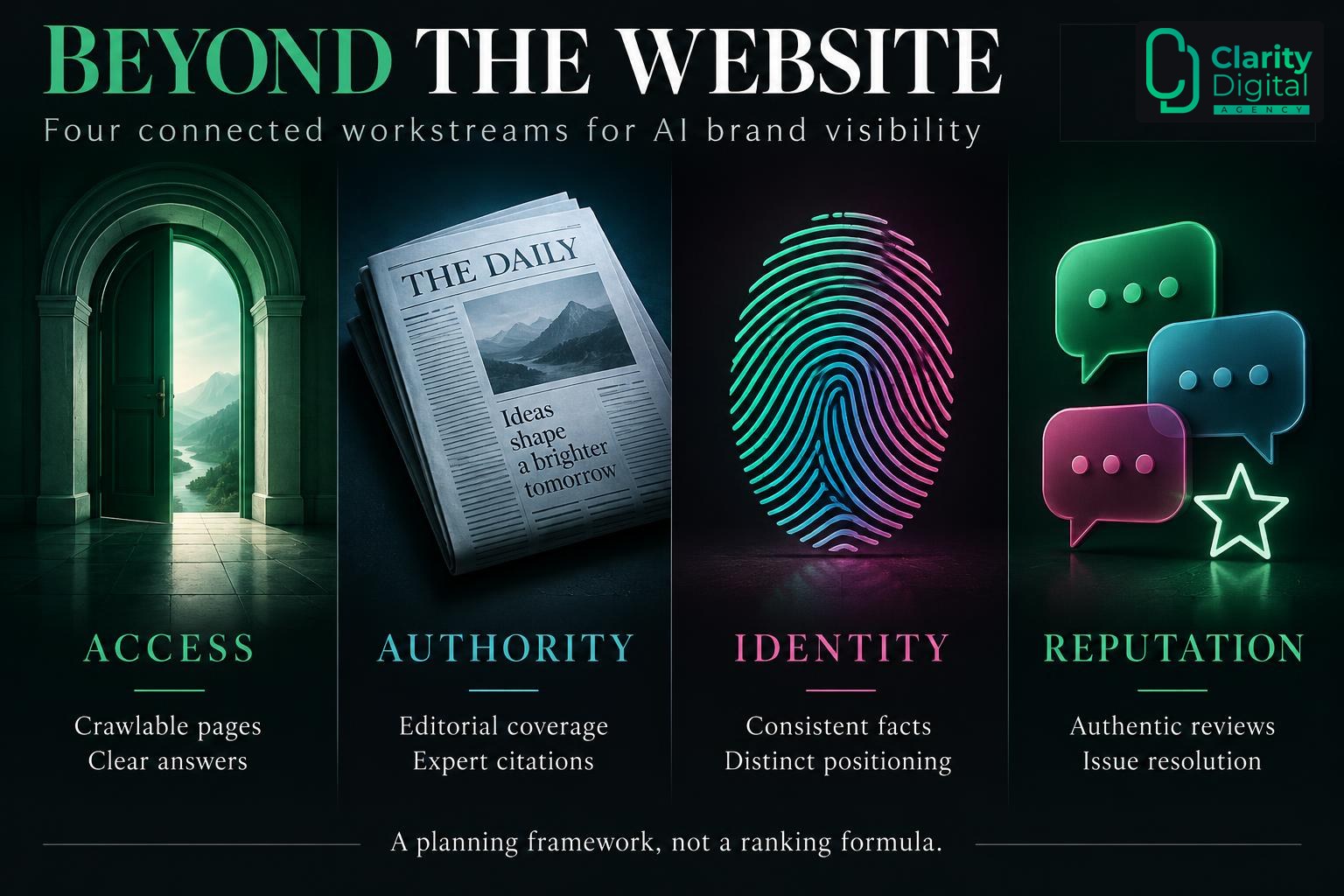
- Access: the business can be found and understood through accessible, useful content.
- Authority: relevant independent sources provide evidence of its expertise.
- Identity: a clear position and consistent facts distinguish the correct business.
- Reputation: genuine customer feedback and responsible issue resolution reinforce credibility.
A practical SEO, AEO, and GEO program coordinates all four. Answer engine optimization (AEO) makes information easier to use as a direct answer. Generative engine optimization (GEO) addresses visibility in generated responses. Neither should be reduced to FAQ production or a file in the website root.
1. How does digital PR build authority beyond the website?
Digital PR earns relevant third-party coverage through newsworthy research, expert commentary, useful resources, and relationships with journalists or industry publishers. It creates evidence outside the company’s own marketing pages. That evidence can help both buyers and search systems understand the business.
The strongest opportunity is not an indiscriminate list of publications. It is coverage in sources that matter to the intended audience. A trade publication explaining a genuine technical contribution may be more useful than a generic mention on a site unrelated to the buyer’s decision.
What makes a digital PR campaign useful for AI visibility?
A useful campaign gives independent sources a specific, verifiable reason to discuss the brand: original research, a documented result, a qualified expert explanation, or a genuinely useful resource. The coverage should connect the company to a relevant topic accurately. Whether an AI system cites it depends on the query and retrieval process.
For example, a hypothetical cybersecurity company could publish an anonymized analysis of common onboarding failures, explain the methodology, and offer an expert interview to a relevant industry publication. The resulting story gives readers something to evaluate. A press release announcing that the same company is “the leading solution” adds much less independently verifiable information.
Editorial backlinks can support traditional search discovery and authority. Unlinked mentions can also identify a brand within useful coverage. They should not be described as universally equivalent to links or as a guaranteed AI ranking signal. What matters operationally is whether the source is credible, the reference is accurate, and the audience is relevant.
Clarity Digital’s digital PR service connects editorial outreach with broader search visibility. Agencies seeking a partner can also explore digital PR support for agencies. The objective is defensible authority, not purchased consensus.
2. Why does distinctive branding matter in AI search?
Branding clarifies which business is being discussed, what it offers, and why it is different. When dozens of providers publish similar AI-generated descriptions, specific positioning becomes more useful than another generic claim about innovation, excellence, or customer focus.
Strong positioning describes an actual audience, problem, capability, and differentiator. A business serving regulated healthcare organizations should explain its relevant experience and safeguards rather than borrowing the same language as every generalist marketing agency. Claims should be supportable, not aspirational statements presented as facts.
How can a brand reduce confusion across AI and search sources?
Maintain consistent company names, website URLs, locations, service descriptions, leadership identities, and verified profile links. Explain any alternate trading name or former name clearly. Use accurate Organization and Person markup alongside visible information so the brand is identifiable without relying on schema alone.
Entity consistency is not the same as copying identical content everywhere. A company biography, a founder interview, and a directory listing can serve different purposes while agreeing on basic facts. The risk appears when one source describes a local agency, another presents a software company, and a third lists an outdated location with no explanation.
Branding also supports the human side of the purchase. A recognizable identity and a credible promise can reduce uncertainty and help explain value. Premium pricing, however, depends on delivered value, market conditions, and willingness to pay. A clearer logo or tagline alone does not establish pricing power.
A focused go-to-market strategy can align the audience, positioning, offer, and channel plan. Fractional CMO leadership helps ensure that PR, content, and reputation work tell the same business story.
3. How does reputation management support AI visibility?
Reputation management improves the evidence available about the customer experience. It combines monitoring, honest review collection, accurate business listings, response policies, and action on recurring complaints. The goal is not to manufacture positivity. It is to make the public record more accurate and the underlying experience better.
Reviews, forums, trade communities, and other discussions may appear in retrieved sources. If those sources repeatedly describe unresolved problems, a search-backed answer can reflect that context. But there is no published universal rule that a particular review score makes every LLM recommend or reject a business.
Can negative reviews prevent an AI recommendation?
Negative reviews can contribute unfavorable evidence when a system retrieves or uses those sources. Their impact depends on relevance, credibility, recency, context, and the platform. A single complaint does not establish a universal exclusion rule. The appropriate response is to investigate the issue, improve the experience, and communicate responsibly.
Modern reputation work begins with operations. If customers repeatedly report missed appointments or poor follow-up, the marketing team should not try to bury the pattern under promotional content. The business needs an owner for the problem, a corrective action, and a response that acknowledges the issue without exposing private information.
Review requests should invite genuine feedback without conditioning participation on a positive rating. Avoid fabricated reviews, undisclosed conflicts, purchased praise, and selective tactics that misrepresent the customer experience. Follow the review platform’s rules and any applicable legal requirements.
Online reputation management should therefore be connected to customer service and leadership, not isolated in a dashboard. In sensitive industries, escalation and privacy review are especially important. Marketing responses must never disclose a patient’s or customer’s confidential information to defend the brand.
What should an AI visibility strategy do in the first 90 days?
The following sequence is an illustrative operating plan, not a performance guarantee. Its purpose is to create a baseline, close obvious evidence gaps, and establish ownership before increasing activity.
Days 1 to 30: establish the baseline
- Choose buyer questions covering category discovery, comparisons, suitability, trust, and local availability where relevant.
- Record dated observations across selected AI platforms, including whether search was used, cited URLs, and the wording of any recommendation.
- Check crawl access, indexability, snippet eligibility, useful answer passages, and important internal links.
- Review company facts, biographies, directory listings, editorial coverage, and recurring customer feedback.
- Assign owners and prioritize gaps by buyer relevance, risk, and implementation effort.
Days 31 to 60: improve the evidence
- Strengthen the pages that answer high-intent buying questions with specific explanations and approved proof.
- Correct inconsistent company facts and outdated profile information.
- Develop one credible research or expert-commentary idea and pitch relevant publishers.
- Introduce a consistent, platform-compliant feedback request and complaint escalation process.
- Connect content, PR, customer service, and leadership through an agreed claims and approval policy.
Days 61 to 90: compare and refine
- Repeat the baseline questions and include a few semantically similar variants.
- Review new coverage, citation observations, inaccuracies, qualified visits, and lead quality.
- Identify which gaps remain unresolved rather than attributing every change to the latest campaign.
- Refresh outdated content, refine outreach, and address recurring operational issues.
- Choose the next quarter’s priorities using the evidence rather than a target for content volume.
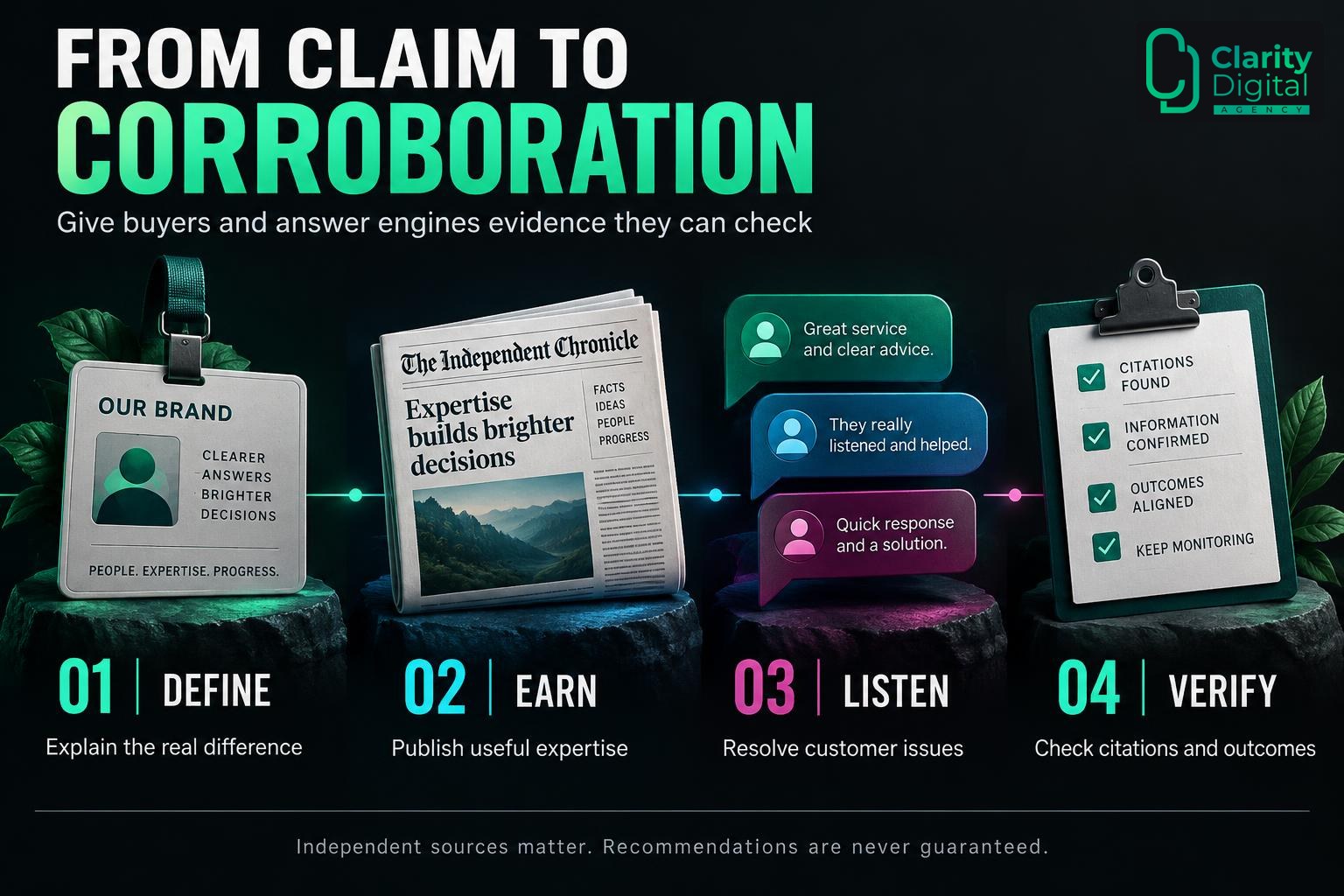
A governed AI marketing strategy sets priorities and measurement. AI governance adds the controls for approved claims, tools, privacy, and human review.
How should brands measure AI visibility without false certainty?
Measure three different outcomes: discovery, representation, and business value. A citation confirms that a source appeared in a sampled answer. It does not necessarily mean the business was recommended, preferred, or chosen by a buyer.
- Discovery: which questions produced a mention, which sources were cited, and whether the company’s own pages appeared.
- Representation: whether the name, capabilities, geography, and recommendation context were accurate.
- Business value: identifiable referral visits, qualified inquiries, conversion paths, and what prospects report about their discovery process.
Use the same documented prompt set for comparisons, but do not mistake a small sample for total market share. Record platform, date, location where relevant, search setting, and cited URLs. Answers can change because of query wording, retrieval, model updates, or other conditions unrelated to the campaign.
Google reports AI-feature traffic within overall Search Console web performance rather than providing a clean citation-level attribution report for every AI answer. Browser analytics can also miss discovery that later becomes direct traffic. Combine observed citations, web analytics, CRM data, and buyer feedback instead of claiming perfect attribution.
Custom marketing dashboards can organize those signals. The reporting should distinguish observed results from inference, avoid invented precision, and show what the team plans to investigate next.
Common mistakes that keep brands invisible
The most expensive mistake is optimizing what is easiest to change rather than what is missing. Adding markup is easier than producing useful research. Publishing another FAQ is easier than resolving a customer complaint. Buying placements is easier than earning a journalist’s interest. None of those shortcuts automatically supplies credible evidence.
Another mistake is treating AI search as a replacement for SEO. A technical failure can still prevent access. A vague service page can still leave the buyer uninformed. The stronger approach joins technical SEO and answer-focused content with relevant external validation.
Finally, avoid promises of guaranteed ChatGPT recommendations, universal sentiment weights, or fixed percentages for off-site signals. Honest strategy acknowledges uncertainty while improving the factors the business can control.
Frequently asked questions about AI brand visibility
What is AI brand visibility?
AI brand visibility is the presence and representation of a business in AI-generated answers, search summaries, and recommendations. It includes whether the brand is mentioned, whether sources are cited, and whether the description is accurate and relevant to a buyer’s question.
Is technical SEO enough to appear in ChatGPT or Google AI Overviews?
No. Technical SEO supports discovery and eligibility, but it does not guarantee selection or recommendation. Useful content, a clear identity, and credible evidence across relevant sources also matter. Google explicitly states that no special AI schema or AI text file is required for its AI search features.
Does an llms.txt file guarantee AI visibility?
No. An llms.txt file can provide a curated description of website resources, but it is not a universal requirement or recommendation guarantee. Google says its AI features do not require new AI text files. For ChatGPT search access, OpenAI documents the separate OAI-SearchBot crawler controls.
Are backlinks or brand mentions more important for GEO?
There is no universal published weighting that applies to every generative engine. Editorial backlinks support discovery and traditional SEO, while relevant mentions can contribute brand context within a source. Evaluate credibility, relevance, accuracy, and observed results instead of assuming one metric always dominates.
How long does it take to improve AI visibility?
There is no reliable universal timeline. Changes depend on the starting point, content and coverage quality, crawl and retrieval behavior, competition, and platform updates. A 90-day plan provides a useful review cycle, not a promise that a brand will be cited or recommended within that period.
Can digital PR guarantee AI recommendations?
No. Digital PR can earn independent coverage and strengthen the available evidence about a business. Editorial selection and AI recommendations remain outside the agency’s control. A credible engagement defines the process, measurement, and reporting without guaranteeing placement or generated answers.
Conclusion: a discoverable website needs a credible brand behind it
Technical SEO gets the information into a position where it can be found. Digital PR builds independent evidence. Branding clarifies why the business is different. Reputation management connects the public story to the customer experience.
The newsletter’s central lesson is not that technical work has lost value. It is that technical work cannot carry the entire burden of trust. A brand deserves a stronger strategy than endlessly adjusting its own pages while ignoring how the wider market describes it.
Clarity Digital connects SEO, AEO, and GEO with digital PR, reputation management, and strategic leadership. Discuss an AI visibility audit to identify the most important gaps in access, authority, identity, and reputation.
Next step: use the gated PDF below to document the current evidence, assign owners, and set the next review date. The article remains freely available; the downloadable worksheet requires contact details and marketing consent.
Your Next Step
Two ways to turn this into results.
Pick the path that fits where you are right now. We will meet you there.
Free PDF audit worksheet
AI Brand Visibility Audit Checklist
Assess access, authority, identity, and reputation. Record the evidence, assign an owner, and choose the next action.