The AI Marketing Strategy You Keep Putting Off: Why a Unified Roadmap Beats Scattered Tools
AI & MarketingThe AI Marketing Strategy You Keep Putting Off: Why a Unified Roadmap Beats Scattered Tools
The direct answer: A unified AI marketing strategy is a single, prioritized plan that defines where AI supports marketing goals, which workflows change, what data and tools are approved, who owns each decision, and how results are measured. Without it, AI adoption becomes a collection of disconnected tools that save a few hours but rarely change business outcomes.
Many marketing leaders know they need this plan and keep postponing it. The calendar is full, the tools keep changing, and individual team members are already experimenting. That delay has a cost. Every month without a shared strategy adds more unmanaged tools, inconsistent outputs, and pilots that cannot be compared or scaled.
Why do so many marketing teams put off building an AI marketing strategy?
The delay is rarely about skepticism. Most leaders postpone the strategy for practical reasons: the technology changes monthly, a formal plan feels like it will be outdated quickly, and quick wins from individual tools make a strategy seem optional. There is also a reasonable fear of committing budget to the wrong platform.
Meanwhile, AI use spreads anyway. McKinsey's State of AI research reported in 2025 that 78% of surveyed organizations use AI in at least one business function, with marketing and sales among the most common areas. The same research associates value capture with management practices such as workflow redesign and senior leadership oversight, not with tool access alone. In other words, waiting does not stop adoption. It only removes direction from it.
Strategy Consultation
Want to apply this to your 2026 plan?
Book a 30-minute call with Al Sefati to pressure-test your SEO, AEO, and AI strategy.
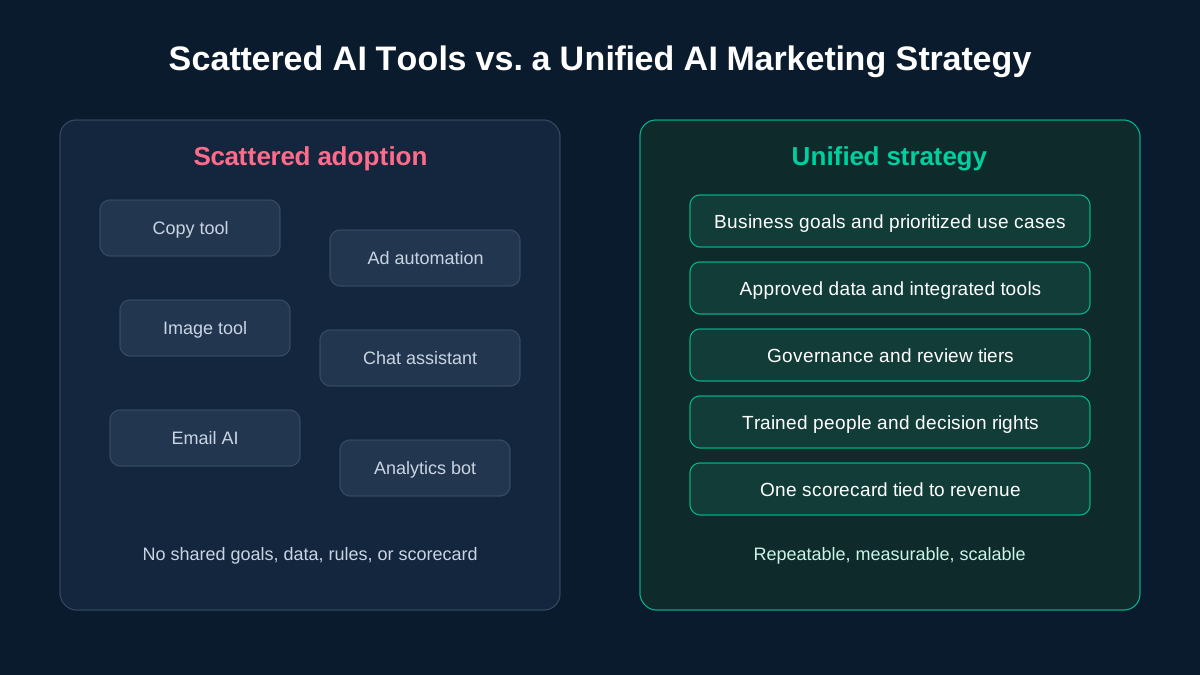
What does scattered AI adoption cost a marketing organization?
Scattered adoption looks productive from inside a single team. From the leadership level, it produces predictable problems:
- Duplicated spend: overlapping subscriptions with similar capabilities across teams.
- Inconsistent brand output: different prompts, rules, and quality standards for the same audience.
- Data and privacy exposure: customer or confidential information entered into unapproved tools.
- Unmeasurable results: pilots without baselines that cannot prove business value.
- Stalled scaling: successful experiments that never become repeatable workflows.
Data readiness compounds the problem. Salesforce's State of Marketing research identifies siloed systems and poor data quality as leading barriers to AI-driven personalization. A tool cannot compensate for data that no one owns.
What does a unified AI marketing strategy include?
A unified strategy is not a long document or a vendor shortlist. It answers six questions in one place:
- Goals: which business outcomes AI should improve, such as pipeline, retention, cost per acquisition, or speed to market.
- Use cases: a prioritized backlog scored by impact, effort, and risk.
- Data: the approved sources, owners, and permissions each use case requires.
- Tools and integration: which platforms are approved and how they connect to the existing stack.
- Governance: acceptable use, review tiers, disclosure, and incident handling.
- People and measurement: training, decision rights, baselines, and a shared scorecard.
Clarity Digital's AI marketing strategy engagements deliver these elements as a readiness assessment, a prioritized use case backlog, a 12-month roadmap, and an executive presentation. Governance is supported through a dedicated AI governance program, and adoption through AI readiness and training.
Where does AI fit into marketing strategy and operations?
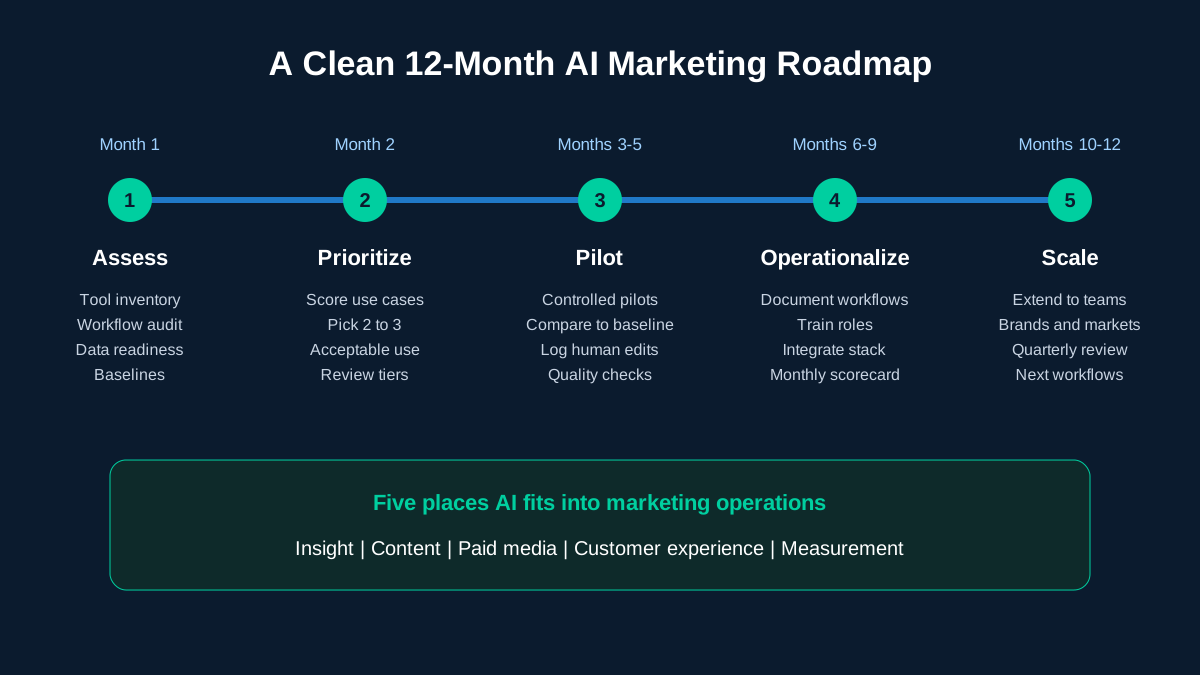
AI is most useful when it is mapped to the marketing operating model rather than bolted onto individual tasks. Five areas cover most of the opportunity:
1. Market and customer insight
Summarizing research, call transcripts, reviews, and search behavior to sharpen positioning and segmentation. Human judgment remains responsible for conclusions.
2. Content and creative production
Briefs, drafts, variants, localization, and repurposing grounded in approved facts and brand rules. This is where governance matters most, because errors scale with volume.
3. Paid media and channel optimization
Bidding, audience modeling, creative testing, and budget pacing. Platform automation works best when conversion data and goals are defined correctly.
4. Customer experience and personalization
Next-best actions, lifecycle email, on-site personalization, and conversational assistants that rely on approved knowledge and clear escalation to a person.
5. Measurement and reporting
Automated reporting narratives, anomaly detection, and attribution analysis that connect activity to revenue. Teams that need connected systems can explore AI tools and integration support.
A clean 12-month roadmap for AI in marketing
Month 1: Assess current AI use and readiness
Inventory every AI tool in use, including unofficial ones. Interview team leads, review workflows, and assess data quality, consent, and integration gaps. Record baselines for the metrics that matter.
Month 2: Prioritize use cases and set guardrails
Score candidate use cases by business impact, effort, and risk. Choose two or three. Publish an acceptable-use policy, approved tool list, and review tiers before pilots begin.
Months 3 to 5: Pilot with baselines
Run controlled pilots on the chosen workflows. Compare quality, speed, and business outcomes against the baseline. Document where human reviewers changed or rejected outputs.
Months 6 to 9: Operationalize what works
Turn successful pilots into documented workflows with owners, training, integration, and monthly measurement. Stop pilots that cannot prove value or cannot be governed.
Months 10 to 12: Scale and review
Extend proven patterns to adjacent teams, brands, or markets. Review the roadmap quarterly so the strategy evolves with the tools without losing its priorities.
Organizations operating at large scale face additional integration and governance requirements, covered in the guide to AI in marketing versus enterprise AI marketing. Teams that want to test an existing plan can also read why generic AI marketing strategies fail.
Does AI strategy stop at marketing? AI consulting for other departments
Marketing is often the first department to adopt AI, but the same questions about goals, data, governance, and measurement apply across the business. Sales, customer service, operations, finance, human resources, and product teams each have their own workflows where AI can create value or introduce risk.
Through its sister company, ClarityDigital.ai offers AI strategy consulting for departments beyond marketing and sales, including enterprise AI roadmaps, custom AI development, and broader AI transformation. This allows an organization to align marketing's AI roadmap with a company-wide plan rather than building each department's approach in isolation.
Questions leaders ask about a unified AI marketing strategy
What is a unified AI marketing strategy?
It is one prioritized plan that connects AI use to marketing goals, approved data and tools, governance, people, and measurement, so adoption is coordinated across teams instead of scattered.
Why is a unified AI strategy better than letting each team choose tools?
Independent tool choices create duplicated spend, inconsistent brand output, data exposure, and pilots that cannot be compared. A unified strategy makes successful workflows repeatable and measurable.
How long does it take to build an AI marketing strategy?
An initial assessment, prioritized backlog, and roadmap typically take several weeks. Execution follows a phased plan, commonly over 12 months, with quarterly reviews.
Do we need technical staff to adopt AI in marketing?
Not usually. Most marketing AI adoption depends on workflow design, tool selection, training, and governance. Technical support becomes important when integrations or custom AI products are required.
How should AI marketing success be measured?
Combine business outcomes such as pipeline, conversion, retention, and cost per outcome with quality, speed, adoption, and risk measures. Time saved alone is not enough.
Can AI strategy consulting cover departments other than marketing?
Yes. Clarity Digital focuses on marketing AI enablement, while its sister company ClarityDigital.ai provides AI strategy consulting for other departments and enterprise-wide AI programs.
Conclusion: the strategy you postpone is the one you need most
AI is already part of most marketing organizations. What separates teams that see measurable results from those that accumulate tools is a unified strategy: clear goals, prioritized use cases, approved data, governance, trained people, and a roadmap that moves from pilots to operations. Putting it off does not slow adoption. It only makes adoption harder to control.
Leaders ready to stop postponing can learn more about Clarity Digital's AI marketing strategy service or contact Clarity Digital to start with a readiness assessment.
Your Next Step
Two ways to turn this into results.
Pick the path that fits where you are right now. We will meet you there.
Free planning checklist
Download the Unified AI Marketing Strategy Roadmap Checklist
A month-by-month checklist to assess, prioritize, pilot, operationalize, and scale AI across marketing.