
AEO and GEO in 2027: The Next Search Revolution Is About Decisions, Not Rankings
AI & MarketingAEO and GEO in 2027: The Next Search Revolution Is About Decisions, Not Rankings
The direct answer: AEO and GEO strategy for 2027 should prepare brands to be understood, verified, and recommended by AI systems, while preserving the SEO foundations that make their information discoverable. The most consequential opportunities are agent-ready business facts, useful conversational answers, and measurement that connects AI discovery to qualified demand. These are strategic bets, not guarantees that AI will replace search or deliver a fixed conversion lift.
This expanded analysis develops the themes in Al Sefati's State of AEO and GEO: Strategic Predictions for 2027, prepared for Inc.com, with a closer look at the research and the decisions marketing leaders face.
Evidence cutoff: October 23, 2026. Published research is identified by its measurement period. Predictions are labeled separately. Industry terminology and product capabilities continue to evolve, so teams should revisit assumptions rather than turn a forecast into a permanent operating rule.
SEO, AEO, GEO, and AXO: what changes when an answer becomes a decision?
Search engine optimization (SEO) helps search engines discover, understand, and present useful website content. Answer engine optimization (AEO) is an industry term for making content useful in direct-answer experiences. Generative engine optimization (GEO) focuses on visibility and accurate representation in generated responses. These disciplines overlap rather than form independent systems with separate guaranteed ranking formulas.
Agent experience optimization (AXO) is an emerging label for making information and permitted actions usable by software agents. It is not a universally standardized ranking discipline. Its practical value is straightforward: an agent comparing providers needs facts it can interpret, and an agent taking action needs an interface that makes the permitted action unambiguous.
Google's guidance on AI features and websites says existing SEO best practices remain relevant and that no additional technical requirements or special optimizations are necessary for AI Overviews or AI Mode. Eligibility still does not guarantee inclusion. An integrated SEO, AEO, and GEO program should therefore build on accessible pages, useful content, accurate structured data, and credible evidence, not sell a secret replacement for SEO.
Free Visibility Audit
See how your site ranks across Google and AI search.
Technical SEO, AEO/GEO readiness, and competitive snapshot. No obligation.
What the AI search data shows, and what it does not prove
The strongest reason to update search strategy is observed behavior, not a prediction that Google disappears next year. Different studies illuminate different parts of the journey. They should not be combined into a single universal estimate of AI traffic or revenue.
AI summaries are associated with fewer outbound clicks
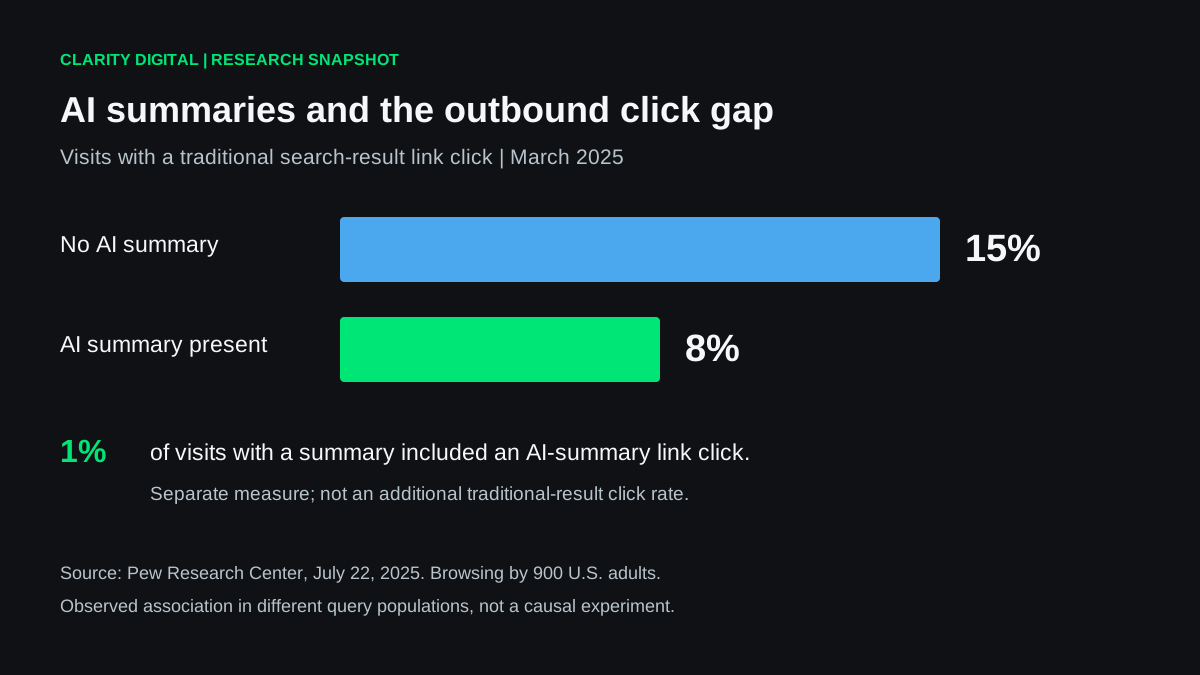
In a July 2025 Pew Research Center analysis, users clicked a traditional search-result link on 8% of visits with an AI summary, compared with 15% without one. Clicking a link within the AI summary occurred on 1% of visits with a summary. The study examined browsing from 900 U.S. adults during March 2025.
This is an observed association, not a randomized experiment proving summaries alone caused the difference. Query types and user intent may differ between the groups. The implication is narrower and more useful: a ranking report cannot describe the entire discovery experience when users receive answers before visiting a publisher.
AI referral growth does not establish a universal conversion multiplier
Adobe's January 2026 holiday analysis reported that generative-AI referral traffic to U.S. retail sites increased 693.4% year over year during the November-to-December 2025 holiday season. Adobe described its retail analysis as covering more than 1 trillion visits. The reported metric is traffic from clicked links, not all shopping conversations or all AI-influenced purchases.
A large percentage gain from a developing channel does not mean that channel dominates total traffic. Conversion quality also depends on the period, sector, and comparator. In Adobe's June 2025 report, AI-referred retail traffic converted 22% below non-AI traffic in May 2025, compared with a 91% gap in July 2024. These findings do not support a blanket claim that all AI visitors convert four to eight times better. Each business should measure its own qualified outcomes.
Agentic adoption forecasts should be read alongside execution risk
Gartner forecast in June 2025 that more than 40% of agentic AI projects would be canceled by the end of 2027, citing escalating costs, unclear business value, or inadequate risk controls. This is a forecast, not an observed cancellation rate. It supports a disciplined approach to agent pilots rather than an assumption that every website needs autonomous commerce immediately.
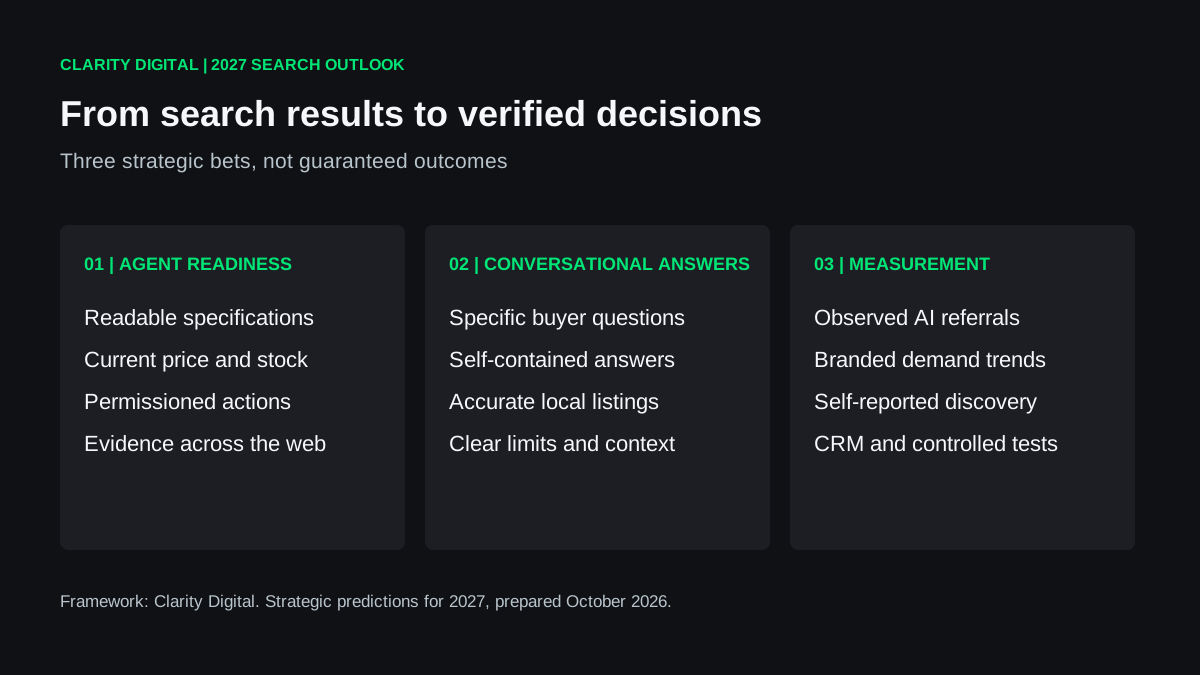
Prediction 1: the agentic web will reward verifiable business facts, not just persuasive copy
Strategic prediction: more discovery journeys will include software that compares options or completes bounded tasks for a person. A company should prepare for this possibility by improving information quality now, rather than assuming every AI search engine will become fully autonomous in 2027.
Consider an illustrative B2B request: “Find three providers that support these integrations, verify their pricing terms, and identify how to book a consultation.” The information needed is not another paragraph saying the company is innovative. It is a clear service definition, verified integration support, current commercial terms, and a reliable booking path.
Readable specifications are the first machine interface
Important facts should be available in rendered page content rather than depend entirely on an interaction, a hidden tab, or an image containing text. JavaScript is not inherently disqualifying, and crawler capabilities vary. The practical test is whether the relevant system can access and interpret the offer. Human accessibility and fast text rendering remain valuable at the same time.
Structured data should describe the visible page accurately. A price in markup that conflicts with the displayed price creates an information-quality problem, not an optimization advantage. Service boundaries, geographic availability, return terms, and eligibility criteria deserve the same attention as product specifications.
Feeds and permitted tools extend the source of truth
For retailers, the priority may be consistency between product pages and Merchant Center feeds. For service businesses, it may be a current catalog and a clear appointment workflow. The Merchant Center and AI shopping guide explains why price, stock, variants, and fulfillment terms should agree across these surfaces.
Emerging interfaces require careful status labeling. The WebMCP specification describes ways to expose web-application tools to agents, but its document is a Draft Community Group Report, not a completed W3C Standard. A pilot should evaluate actual platform support, permissions, and failure handling before a team depends on it commercially.
A public agent interface should never expose private customer records or unrestricted account actions. Booking, purchasing, and changing an account require appropriate authentication, limited permissions, confirmation, and a recovery path. Clarity Digital's AI governance work treats these as business controls, not optional technical refinements.
External evidence reduces ambiguity about the business
Consistent company names, locations, expertise, and offering descriptions help readers and systems identify the same entity. Independent coverage and genuine reviews provide additional evidence. There is no basis for promising that every agent performs the same cross-web consensus check. The defensible objective is to remove contradictions and make credible verification possible.
Prediction 2: conversational search will become more useful beyond the keyboard
Strategic prediction: better conversational interfaces will make spoken research and follow-up questions more useful in selected contexts. That does not establish voice as the primary search interface for every market in 2027. Device adoption, privacy, environment, and the complexity of the task all affect whether people speak or type.
An illustrative automotive question might ask for an SUV under a specified budget, with required seating, local availability, and a test drive this weekend. A credible answer needs current inventory and precise configuration details. The platform cannot safely infer seating capacity from “family-friendly” or treat an outdated advertised price as a verified quote.
Answer the whole question without imposing a magic word count
Self-contained passages make content easier for a reader to understand outside the surrounding page. A useful answer names the subject, gives the direct response, and states important qualifications. It should be as short as the question permits, but long enough to avoid misleading omissions. There is no established universal 30-to-50-word rule for voice selection.
For example, a provider answering whether a service is available locally should name the service area, explain relevant restrictions, and link to the current booking terms. A generic “yes, contact the team” answer is less helpful than a precise answer supported by current information. This also improves ordinary search and on-site comprehension.
Local accuracy matters more than speculative platform recipes
Keep business hours, addresses, service areas, and contact details consistent on the platforms relevant to the business. Google, Apple, and Bing do not necessarily consult the same sources for every voice interaction. Teams should not assume universal simultaneous API checks or guaranteed inclusion from listing alignment. Test the real questions customers ask and record the platform and location used.
Prediction 3: solving the AI attribution gap will become a budget advantage
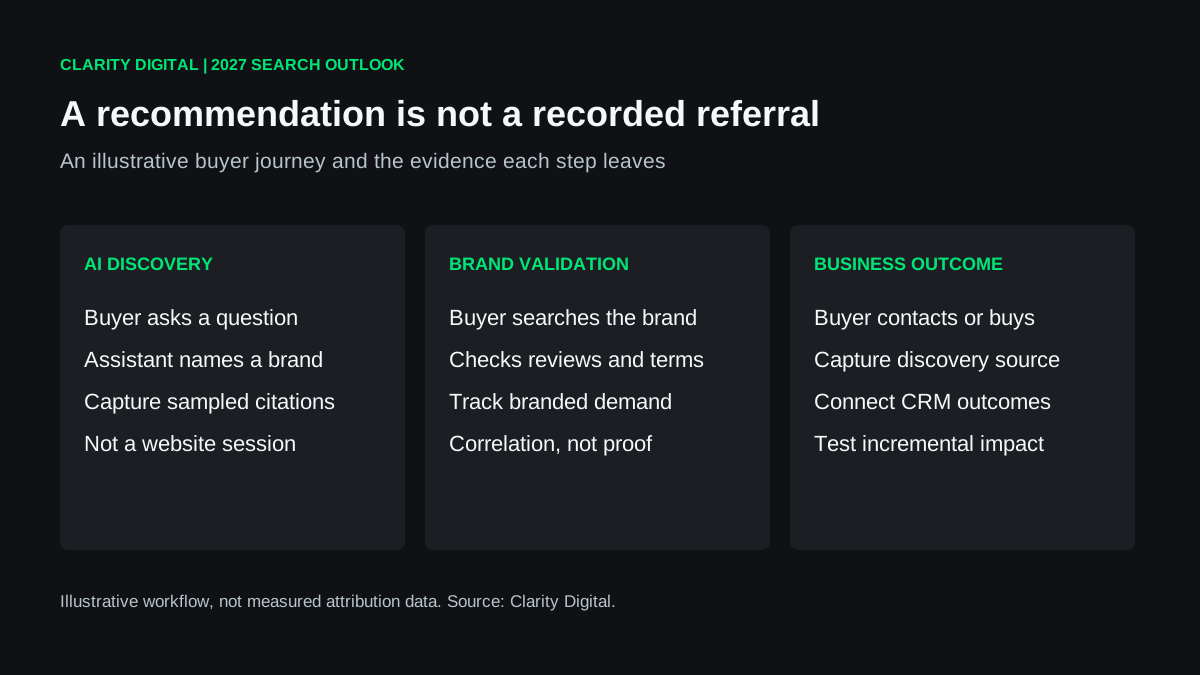
Strategic prediction: teams that connect visibility evidence to commercial outcomes will make better investment decisions than teams optimizing mention counts alone. The difficult journey is not always AI answer to website click. It can be AI recommendation, branded Google search, direct visit, and a later sales conversation.
Not every direct visit is AI-driven. Direct traffic can reflect bookmarks, messaging, missing campaign tags, privacy controls, and many other sources. A rise in branded search can also result from advertising, events, publicity, or seasonality. The task is to triangulate evidence, not relabel an entire channel as “dark AI.”
Separate platform citation reporting from conversion reporting
Bing announced AI Performance in public preview in February 2026, including citations, cited pages, and grounding queries across supported AI experiences. These metrics describe visibility, not website sessions or completed purchases. Platform coverage and definitions must accompany any executive report.
Google's AI-feature documentation places AI Overviews and AI Mode traffic within overall Search Console reporting. Teams should not claim that ordinary Search Console data supplies a complete, separately segmented generative-AI recommendation report.
Build a layered measurement model and disclose its limits
- Observed visibility: repeat a fixed set of buyer prompts and record mentions, citations, accuracy, platform, location, and date.
- Identifiable referrals: segment AI referral sessions and their qualified conversion outcomes where referrer data exists.
- Branded demand: trend branded impressions and clicks, annotated with campaigns and other influences.
- Self-reported discovery: ask buyers how they first heard about the company and retain the original response.
- Commercial outcomes: connect observations to CRM accounts, pipeline quality, and closed revenue.
- Incrementality: use a credible comparison or controlled test where practical.
A sampled mention rate can be useful if the prompt set and testing method stay consistent. Calling it “share of model voice” does not make it a census of all AI conversations. For deeper implementation guidance, see the AEO challenge nobody measures and custom reporting dashboards.
Prediction 4: first-party evidence will be a stronger differentiator than another generic answer
Strategic prediction: verifiable original material will become more commercially valuable as generic explanations become easier to produce. This is not a guarantee that platforms will prioritize every proprietary dataset. It is a reason to publish information that customers genuinely need and that an accountable expert can defend.
Examples include a documented benchmark with a stated sample, an expert comparison explaining tradeoffs, a current product compatibility matrix, or a case study with permission to publish the results. A dataset without methods or a case study with invented outcomes does not establish authority.
Publish the author, collection period, definitions, limitations, and update policy. Keep sensitive records private and use aggregated, approved findings where appropriate. Pair useful evidence with digital PR and online reputation management so a reader can verify the organization beyond its own website. Neither external coverage nor structured data guarantees AI recommendations.
Prediction 5: paid and organic AI visibility will require coordinated planning
Strategic prediction: as advertising evolves within AI-assisted discovery, teams will need to evaluate paid exposure alongside organic recommendations. Actual availability, eligibility, and measurement vary by platform. There is no defensible universal rule that organic authority becomes the quality score for a conversational advertising auction.
Google's Quality Score documentation identifies expected click-through rate, ad relevance, and landing-page experience. It also describes the score as a diagnostic, not an auction input. A useful landing page can support both paid and organic user experiences, but that does not prove a direct organic-ranking or GEO-authority bonus.
The sensible operating response is shared planning: accurate offers, approved claims, coherent landing pages, separate reporting for paid and organic exposure, and tests against qualified demand. Teams should avoid counting the same customer twice or treating a paid placement as evidence of an organic recommendation.
A 90-day plan to prepare for AEO and GEO without betting the budget on hype
Days 1 to 30: establish the commercial and measurement baseline
Choose the ten pages most important to revenue. Audit their rendered facts, indexing eligibility, structured data, feed consistency, and external identity. Select a repeatable set of buyer questions spanning discovery, comparison, and decision. Capture current AI referrals, branded demand, and qualified conversion outcomes, with clear definitions and an owner.
Days 31 to 60: improve answer quality and verifiable evidence
Fix contradictory pricing, service boundaries, inventory, or credentials first. Update priority answer pages with specific responses and named sources. Publish approved original evidence rather than increasing generic article volume. Test relevant spoken questions, and consider a bounded agent pilot only when a real customer task justifies it.
Days 61 to 90: repeat observations and decide what deserves scale
Repeat the prompt set, review citation accuracy, and compare commercial outcomes with the baseline. Account for seasonal effects, campaign changes, and tracking changes. A small cohort with a high conversion rate may still contain too few outcomes for a confident conclusion. Scale improvements that show useful evidence, and revise or stop experiments that do not.
The downloadable workbook provides an evidence checklist, prompt-observation log, measurement worksheet, and owner-based 90-day plan. It is a planning aid, not a validated readiness score or a forecast of revenue.
Questions marketing leaders ask about AEO and GEO strategy for 2027
What is the difference between AEO and GEO?
AEO is an industry term for making content useful in direct-answer experiences. GEO focuses on visibility and representation in generated responses. Their boundaries overlap, and both build on useful, accessible information. Neither term identifies a universal platform ranking formula or guarantees citations.
Will AEO and GEO replace SEO in 2027?
There is no sound basis for treating that as a certainty. Google says established SEO practices remain relevant to its AI features. A practical strategy retains crawlability, indexing, useful content, and accurate structured data while extending attention to generated answers, representation, and commercial measurement.
How should a business measure generative engine optimization success?
Use a consistent prompt sample to observe citations and accuracy, then combine identifiable referrals with branded demand, self-reported discovery, and CRM outcomes. State platform coverage and sampling limits. Citation growth is a visibility indicator; qualified pipeline and credible experiments provide stronger evidence for budget decisions.
Does AI referral traffic always convert better than organic search?
No. Conversion performance varies by industry, period, platform, and outcome definition. Adobe's May 2025 retail findings showed AI referrals converting below non-AI traffic. Published results from another cohort are not a promise for a particular business. Measure conversion quality and sample size locally.
Is WebMCP a required standard for AI search visibility?
No. Its specification is a Draft Community Group Report, not a completed W3C Standard or a general requirement for AI citations. It may be worth testing for a permitted web-application task, but useful pages, accurate facts, and safe workflows remain the more immediate priorities for many businesses.
How long should an answer be for voice search?
There is no established universal word-count requirement. An answer should address the question directly, identify the relevant entity and context, and include necessary qualifications. Concision helps comprehension, but removing price conditions, eligibility rules, or safety limits to meet an arbitrary length can make an answer misleading.
Can Google Search Console report every AI recommendation?
No. Google's documentation describes its AI-feature traffic within overall Search Console reporting. It is not a complete cross-platform recommendation log. Bing's AI Performance preview adds visibility information for supported experiences, but neither tool substitutes for broader observation and business-outcome measurement.
The strongest 2027 search strategy makes the business easier to verify and its results harder to misread
The next search revolution is about decisions, not only rankings. The actionable shift is to make the offer understandable, the evidence credible, and the permitted next step reliable for both people and software. Search traffic still matters, but it is no longer sufficient to describe every way a buyer discovers and evaluates a company.
Al Sefati's central prediction is an operating one: organizations that combine SEO foundations, clear answers, verifiable facts, and honest measurement will be better prepared for changing discovery interfaces. Teams do not need to believe every forecast to make those improvements worthwhile.
Clarity Digital helps organizations connect SEO, AEO, and GEO with authority, reporting, and responsible AI adoption. Contact Clarity Digital to discuss a readiness assessment grounded in the business, its customers, and its available evidence.
Sources and research limitations behind this 2027 outlook
- Pew Research Center, July 22, 2025: observed Google browsing by 900 U.S. adults in March 2025. Association, not a controlled causal estimate.
- Adobe Digital Insights, June 2025 and January 2026: U.S. retail referral findings from different periods. Percentage growth and conversion gaps should not be generalized to every sector.
- Gartner, June 25, 2025: agentic-project cancellation forecast through 2027. Not an observed outcome.
- Google Search Central: AI-feature eligibility and reporting guidance. Google Ads Help: documented Quality Score factors.
- Bing Webmaster Blog, February 10, 2026: AI Performance public preview and supported visibility metrics.
- WebMCP Draft Community Group Report: emerging interface specification, not a completed W3C Standard.
Each research claim links to its source in the relevant section. Framework diagrams are Clarity Digital illustrations, not external study results. No universal conversion multiplier, voice-adoption percentage, or guaranteed AI recommendation is assumed.
Your Next Step
Two ways to turn this into results.
Pick the path that fits where you are right now. We will meet you there.
Free executive planning workbook
Download the AEO and GEO 2027 Readiness Workbook
Three pages covering verifiable facts, prompt observations, commercial measurement, and a 90-day plan with owners and review dates.