
State of Enterprise SEO and Enterprise SEO Agencies and Consultants in 2027
SEO & AI SearchState of Enterprise SEO and Enterprise SEO Agencies and Consultants in 2027
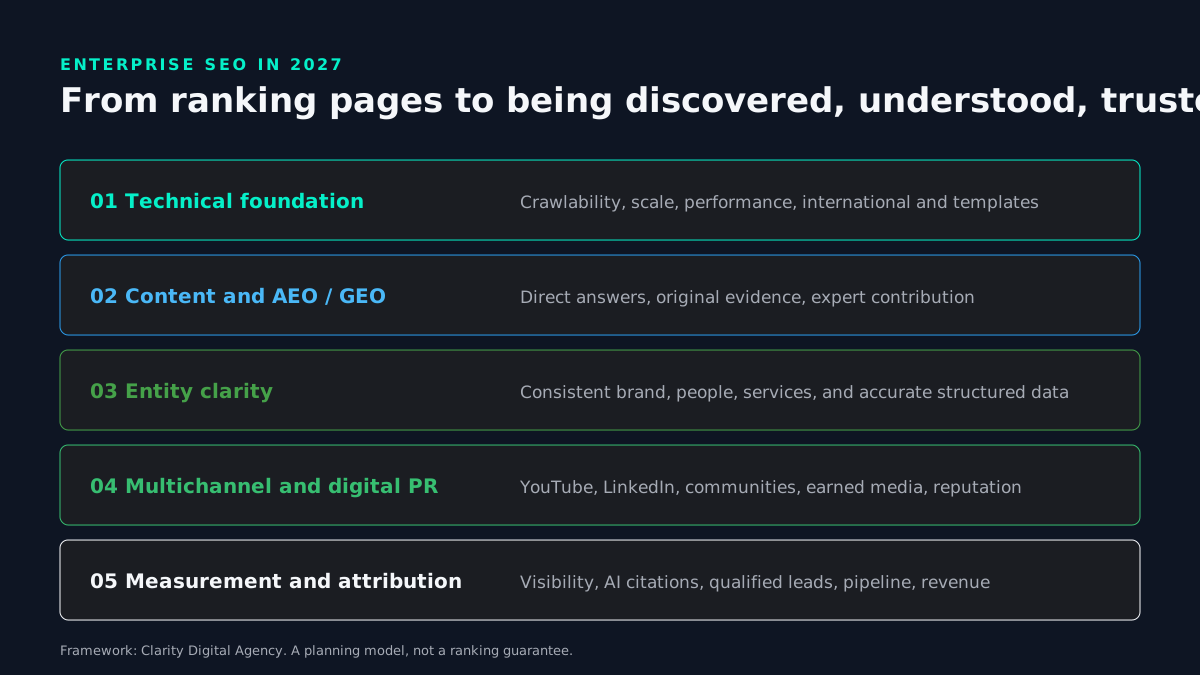
The direct answer: Enterprise SEO is the practice of improving how a large organization is discovered, understood, and chosen in search. It combines technical scalability, content quality, organizational coordination, and, increasingly, visibility across AI-generated answers and other discovery platforms. Answer Engine Optimization (AEO) and Generative Engine Optimization (GEO) extend that work. They do not replace it.
This article separates what is already observable as of October 30, 2026 from what Clarity Digital expects in 2027. Forecasts are labeled as forecasts. For leaders evaluating an enterprise SEO agency or enterprise SEO consultants, the goal is a clear view of the capabilities that matter and the questions worth asking.
Enterprise SEO in 2027: what is changing, and what still matters?
The surface of search is changing faster than its foundations. AI-generated summaries, conversational search modes, and assistants now sit between many customers and the websites they eventually visit. Yet the inputs those systems rely on are familiar: crawlable pages, clear content, credible sources, and accurate information.
Google's guidance on AI features and websites states that the same foundational SEO best practices apply to AI Overviews and AI Mode, and that no special schema or new machine-readable file is required to appear in them. That is an important correction to vendor claims that AI search demands an entirely new playbook.
The user behavior is shifting, though. A Pew Research Center analysis published in July 2025 found that users who saw an AI summary clicked a traditional result in about 8% of visits, compared with about 15% when no summary appeared. Fewer clicks raise the value of being represented accurately inside the answer itself.
What makes this an enterprise problem is scale and coordination. Large organizations operate thousands of templates, multiple markets and languages, complex technology stacks, and many stakeholders who can approve or block changes. An enterprise SEO strategy succeeds or fails on implementation governance as much as on insight.
Free Visibility Audit
See how your site ranks across Google and AI search.
Technical SEO, AEO/GEO readiness, and competitive snapshot. No obligation.
Why do AEO and GEO belong in an enterprise SEO strategy?
Two working definitions help keep the conversation precise:
- AEO (Answer Engine Optimization): improving the usefulness and accessibility of content for answer-oriented experiences such as featured answers, AI summaries, and voice assistants.
- GEO (Generative Engine Optimization): improving a brand's potential visibility and accurate representation in responses produced by generative AI systems.
These labels overlap with each other and with SEO. Neither is a universally standardized discipline, and no provider can guarantee that a page will be cited. What can be controlled is content quality and accessibility. Practical habits include:
- Opening key pages with a direct, accurate answer to the question the page targets.
- Using clear, descriptive headings that mirror how buyers phrase questions.
- Adding comparison tables where readers are choosing between options.
- Publishing original evidence: proprietary data, case results, and documented methods.
- Including named expert contributions with real experience behind them.
- Keeping content technically accessible, with structured data that matches what is visible on the page.
These practices are consistent with Google's emphasis on helpful, people-first content. Clarity Digital's AEO and GEO optimization service applies them to enterprise content libraries.
Entity optimization: how can enterprises make the brand and its expertise understandable?
An entity is a distinct, identifiable thing: a company, a product, a person, a place. Search engines and AI systems work better when the relationships between these entities are clear and consistent. For an enterprise, that means the organization, its brands, its leaders, its services, and its topics of expertise should be described the same way everywhere.
- Clear descriptions of the company, each service line, products, and subject-matter experts.
- Substantive author biographies with evidence of relevant experience, not one-line titles.
- Consistent relationships between brands, people, services, and topics across the website, profiles, and third-party coverage.
- Accurate structured data such as Organization, Person, and Service markup that reflects visible page content.
Structured data helps describe information. It does not guarantee rankings, knowledge panels, or AI recommendations. Its value comes from reducing ambiguity, which is especially useful for enterprises with similar product names, acquisitions, or regional brands.
What does multichannel SEO look like, including social media?
Multichannel SEO is an operating strategy rather than a ranking tactic. Customers research on YouTube, LinkedIn, industry communities, review platforms, and marketplaces before they ever reach a website. Enterprises that coordinate content across those places give buyers consistent evidence wherever they look.
In practice, one strong research asset can become a website guide, a YouTube explainer, a LinkedIn post from a named executive, and a contribution to a relevant community discussion. Each version should be native to its platform and consistent in its facts.
Two cautions apply. First, social discovery and referral traffic are real opportunities, but that is different from claiming social engagement directly improves Google rankings. Second, not every channel matters equally. A B2B manufacturer and a consumer retailer should not have the same channel mix. Prioritize the platforms where your customers actually research.
How do reputation management and digital PR support enterprise search?
Search visibility increasingly depends on what credible third parties say about a brand. Earned media, expert commentary, original research, customer feedback, and reputation monitoring belong inside the search program rather than in a separate silo.
Their strategic purpose is to build a trustworthy body of evidence around the brand and to help customers evaluate it wherever they encounter it. Clarity Digital integrates digital PR and online reputation management into enterprise SEO programs for that reason.
Legitimate digital PR is different from paid-link schemes or manufactured reviews, both of which carry policy and reputational risk. A media mention can strengthen credibility, but it does not automatically produce an AI citation or a ranking improvement.
What must enterprise SEO agencies and consultants deliver?
Enterprise buyers often choose between an enterprise SEO agency, an independent enterprise SEO consultant, or a combination. The roles overlap, but their strengths differ:
| Enterprise SEO agency | Enterprise SEO consultant |
|---|---|
| Cross-functional execution, production capacity, and ongoing operations | Senior strategy, diagnosis, governance, and specialized guidance |
| Coordination across technical SEO, content, analytics, and digital PR | Independent prioritization and leadership alignment |
| Scalable implementation support | Embedded or fractional expertise |
Whichever model fits, evaluate enterprise SEO consultants and agencies on five criteria:
- Implementation ability: can they get changes shipped inside your development and approval process?
- Enterprise experience: have they worked at your scale, with multiple markets and stakeholders?
- Transparent measurement: do they explain what their reports can and cannot prove?
- AI literacy: do they understand how AI answers are produced without overstating control?
- Business outcomes: do they connect work to leads, pipeline, and revenue?
Be cautious of proprietary "AI ranking" promises. No outside party controls how AI systems select sources.
Where could the enterprise SEO market go in 2027? Predictions, not established facts
The following are Clarity Digital forecasts based on current market signals. They are not established outcomes.
Prediction 1: SEO, AEO, and GEO will increasingly be purchased as integrated services
Basis: buyers already struggle to separate these disciplines, and the underlying work overlaps heavily. Clarity Digital expects more procurement teams to request a single, coordinated program rather than separate vendors.
Prediction 2: Agency differentiation will shift toward original expertise and trustworthy representation
Basis: as AI tools make generic content cheap, the scarce inputs become proprietary data, experienced practitioners, implementation capacity, and accurate brand representation across platforms.
Prediction 3: Measurement will expand beyond rankings and traffic
Basis: platforms have started reporting AI visibility directly. Bing Webmaster Tools has introduced AI performance reporting showing how often site content is cited in AI answers, and has announced additional intent, topic, and citation-share views. Features change, so verify current capabilities before relying on them. Citation counts are visibility indicators. They are not conversions or proof of revenue impact.
How should enterprises connect AI, attribution, and the customer journey?
A credible measurement framework links four stages rather than reporting each in isolation:
- Search visibility and AI citations: rankings, AI answer appearances, and citation share.
- Observable referral traffic and engaged visits: sessions from search and AI platforms that show meaningful engagement.
- Branded demand, qualified leads, and CRM opportunities: growth in branded search and leads that sales accepts.
- Assisted conversions, pipeline, and revenue: the outcomes executives fund.
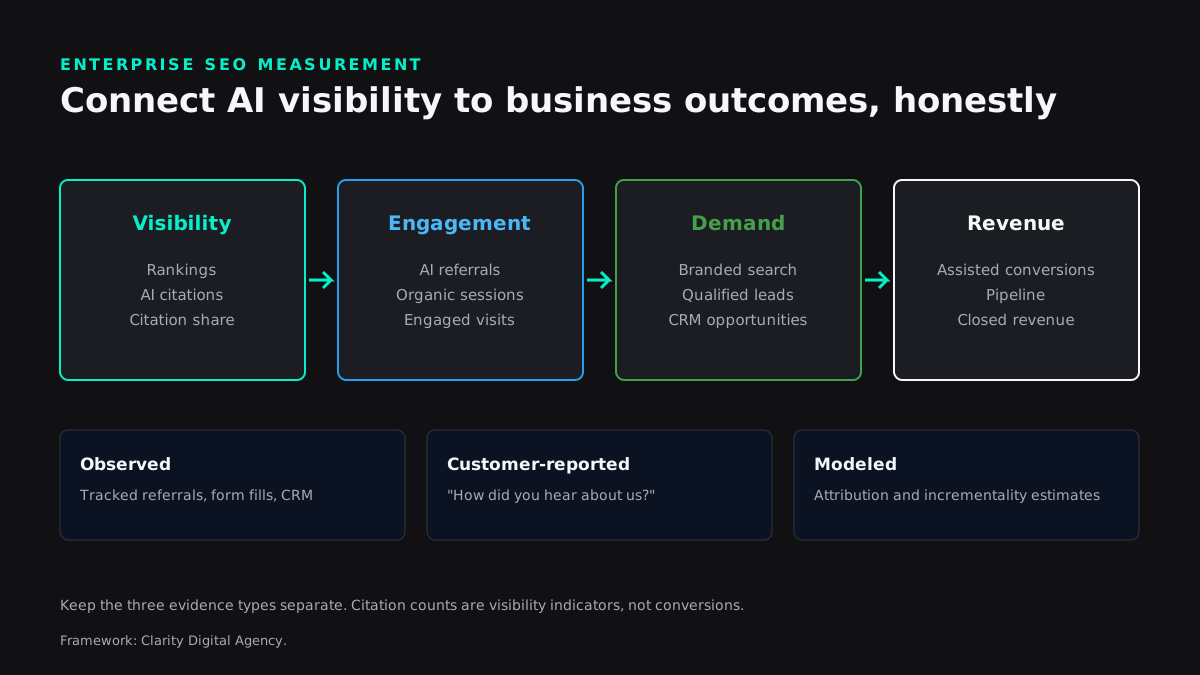
The limitation must be stated plainly: no dashboard can establish that every AI mention influenced a sale. Strong reporting separates three kinds of evidence. Observed results come from tracked referrals and CRM records. Customer-reported discovery comes from "how did you hear about us?" fields and sales conversations. Modeled attribution comes from statistical estimates. Mixing them hides uncertainty. Clarity Digital's article on measuring AI visibility as direct and branded traffic explores this in more depth.
Questions leaders ask about enterprise SEO in 2027
What is an enterprise SEO agency?
An enterprise SEO agency provides strategy and cross-functional execution for large organizations, covering technical SEO, content, analytics, digital PR, and increasingly AEO and GEO, across many pages, markets, and stakeholders.
Do enterprises need a separate AEO or GEO vendor?
Usually not. AEO and GEO overlap with SEO, and Google states that standard SEO practices apply to its AI features. Integrated programs avoid duplicated work and conflicting priorities.
Can an agency guarantee citations in ChatGPT or Google AI Overviews?
No. AI systems select sources independently. A partner can improve content quality, accessibility, and credibility, which may improve the likelihood of representation, but cannot guarantee it.
When should an enterprise hire an SEO consultant instead of an agency?
A consultant fits when internal teams can execute but need senior strategy, independent prioritization, or governance. An agency fits when execution capacity is the constraint. Many enterprises use both.
How should enterprise SEO success be measured in 2027?
Connect visibility and AI citations to engaged visits, branded demand, qualified leads, pipeline, and revenue, while reporting observed, customer-reported, and modeled results separately.
Conclusion: why consider Clarity Digital Agency for enterprise SEO in 2027?
Enterprise SEO in 2027 requires experienced leadership and a willingness to evolve. The foundations still hold, but discovery now spans AI answers, entity understanding, multiple platforms, and the reputation a brand earns from others. Measurement has to follow buyers through that whole journey without overstating what it can prove.
Clarity Digital Agency brings together enterprise SEO, AEO, GEO, multichannel strategy, digital PR, and measurement under the leadership of Al Sefati, a veteran enterprise SEO consultant with an AI-ready, forward-looking approach. For organizations evaluating an enterprise SEO agency, Clarity Digital offers a strategy centered on discoverability, credibility, and measurable business growth. Leaders can review the enterprise SEO service or contact Clarity Digital to discuss their program.
Your Next Step
Two ways to turn this into results.
Pick the path that fits where you are right now. We will meet you there.
Free one-page checklist
Download the Enterprise SEO 2027 Readiness and Partner Checklist
Twelve checks across foundation, entity clarity, multichannel, and measurement, plus questions for evaluating an agency or consultant.